Kirjahaku
Etsi kirjoja tekijän nimen, kirjan nimen tai ISBN:n perusteella.
1000 tulosta hakusanalla Jay W. Roberts
Risky Teaching examines the role of risk and uncertainty in teaching and learning in higher education. Discussing the current landscape of higher education and the challenges and opportunities we face, this book synthesizes a range of evidence-based and high-impact practices both in and out of the classroom, offering practical strategies and thought-provoking ideas on educational innovation for students and faculty.Covering topics such as taking risks inside the classroom, innovative teaching methods outside the classroom, rethinking assessment, and sustaining creativity as we grow in our careers, this practical resource is for faculty and instructors to work within and through uncertainty. The book also explores the inward challenges and opportunities associated with risky teaching and how institutional leaders can encourage productive risk-taking throughout the organization. This important text is for faculty and instructors in higher education who want to help their students thrive in a complex, unscripted, and disruptive world.
What is experiential education? What are its theoretical roots? Where does this approach come from? Offering a fresh and distinctive take, this book is about going beyond "learning by doing" through an exploration of its underlying theoretical currents. As an increasingly popular pedagogical approach, experiential education encompasses a variety of curriculum projects from outdoor and environmental education to service learning and place-based education. While each of these sub-fields has its own history and particular approach, they draw from the same progressive intellectual taproot. Each, in its own way, evokes the power of "learning by doing" and "direct experience" in the educational process. By unpacking the assumed homogeneity in these terms to reveal the underlying diversity of perspectives inherent in their usage, this book allows readers to see how the approaches connect to larger conversations and histories in education and social theory, placing experiential education in social and historical context.
Experiential Education in the College Context provides college and university faculty with pedagogical approaches that engage students and support high-impact learning. Organized around four essential categories—active learning, integrated learning, project-based learning, and community-based learning—this resource offers examples from across disciplines to illustrate principles and best practices for designing and implementing experiential curriculum in the college and university setting. Framed by theory, this book provides practical guidance on a range of experiential teaching and learning approaches, including internships, civic engagement, project-based research, service learning, game-based learning, and inquiry learning. At a time when rising tuition, consumer-driven models, and e-learning have challenged the idea of traditional liberal education, this book provides a compelling discussion of the purposes of higher education and the role experiential education plays in sustaining and broadening notions of democratic citizenship.
Special Report Of A Reconnoissance Of The Route For The Northern Pacific Railroad Between Lake Superior And Pubet Sound, Via The Columbia River, Made In 1869, By W.milnor Roberts, U.s. Civil Engineer, Under The Direction Of Messrs, Jay Cooke & Co.,
William Milnor Roberts
Hutson Street Press
2025
sidottu
Special Report Of A Reconnoissance Of The Route For The Northern Pacific Railroad Between Lake Superior And Pubet Sound, Via The Columbia River, Made In 1869, By W.milnor Roberts, U.s. Civil Engineer, Under The Direction Of Messrs, Jay Cooke & Co.,
William Milnor Roberts
Hutson Street Press
2025
pokkari
Out of the ferment of recent debates about the intellectual virtues, Roberts and Wood have developed an approach they call 'regulative epistemology'. This is partly a return to classical and medieval traditions, partly in the spirit of Locke's and Descartes's concern for intellectual formation, partly an exploration of connections between epistemology and ethics, and partly an approach that has never been tried before. Standing on the shoulders of recent epistemologists - including William Alston, Alvin Plantinga, Ernest Sosa, and Linda Zagzebski - Roberts and Wood pursue epistemological questions by looking closely and deeply at particular traits of intellectual character such as love of knowledge, intellectual autonomy, intellectual generosity, and intellectual humility. Central to their vision is an account of intellectual goods that includes not just knowledge as properly grounded belief, but understanding and personal acquaintance, acquired and shared through the many social practices of actual intellectual life. This approach to intellectual virtue infuses the discipline of epistemology with new life, and makes it interesting to people outside the circle of professional epistemologists. It is epistemology for the whole intellectual community, as Roberts and Wood carefully sketch the ways in which virtues that would have been categorized earlier as moral make for agents who can better acquire, refine, and communicate important kinds of knowledge.
This translation of this classic text contains a balance of cultural and biological considerations. While arguing for the strong influence of exposure and of formal training on the way that music is perceived, Frances draws on the literature concerning the amusias to illustrate his points about the types of cognitive abstraction that are performed by the listener.
Factors Affecting Physician Professional Satisfaction and Their Implications for Patient Care, Health Systems, and Health Policy
Mark W. Friedberg; Peggy G. Chen; Kristin R. Van Busum; Frances M. Aunon; Chau Pham; John P. Caloyeras; Soeren Mattke; Emma Pitchforth; Denise D Quigley; Robert H Brook; F. Jay Crossan; Michael Tutty
RAND
2013
pokkari
The American Medical Association asked RAND Health to characterize the factors that affect physician professional satisfaction. RAND researchers sought to identify high-priority determinants of professional satisfaction by gathering data from 30 physician practices in six states, using a combination of surveys and semistructured interviews. This report presents the results of the subsequent analysis.
The Gunny: A Tribute to the Life of MGySgt. Jay W. DeGraw, USMC
Tollie M. Degraw
Createspace Independent Publishing Platform
2015
nidottu
Amidst the rhythm of city life, Amaya's world is upended when she encounters Nid, the enigmatic driver from the latest mobile app-based, tech startup - The Chauffeur. Their connection is undeniable, but the shadow of Amaya's fianc , Craig, looms large, adding layers of complexity to her burgeoning feelings for Nid - a man whose past holds its own mysteries.Set against the backdrop of a bustling London, where every corner holds a memory and every moment is a crossroads, their tale is one of choices, chances, and the echoing consequences of the paths we choose. Dive into a narrative where every glance holds a promise, every touch echoes with longing, and every whispered secret could either bind them closer or tear them apart. Will love be their anchor, or will the weight of life's challenges pull them under?
Essential Oil Recipes for The Holidays is the ultimate recipe journal for the holiday season. This journal includes blank space for free thinking, notes on your favorite blends, and rating page guides to help you catalog the recipes that truly capture the essence of what the holidays mean to you Test your own blends to create everyday staples or new seasonal favorites. Great holiday gift idea.Conveniently sized at: 6"x 9"High-quality paper allows for perfect absorbency with pens, gel pens, or even markers.120 page- one full year.Matte cover finish.
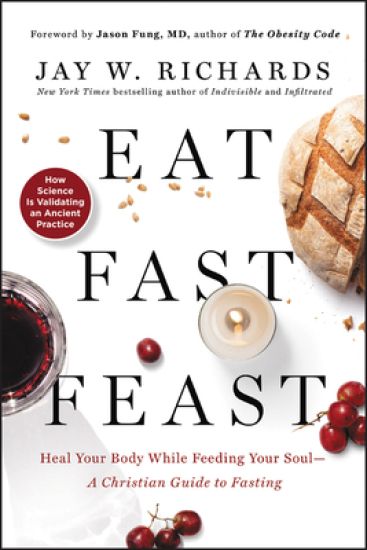
Eat, Fast, Feast: Heal Your Body While Feeding Your Soul—A Christian Guide to Fasting
Jay W. Richards
HarperCollins
2020
nidottu
The New York Times bestselling author and senior fellow at the Discovery Institute blends science and religion in this thoughtful guide that teaches modern believers how to use the leading wellness trend today--intermittent fasting--as a means of spiritual awakening, adopting the traditions our Christians ancestors practiced for centuries into daily life.Wellness minded people today are increasingly turning to intermittent fasting to bolster their health. But we aren't the first people to abstain from eating for a purpose. This routine was a common part of our spiritual ancestors' lives for 1,500 years. Jay Richards argues that Christians should recover the fasting lifestyle, not only to improve our bodies, but to bolster our spiritual health as well. In Eat, Fast, Feast, he combines forgotten spiritual wisdom on fasting and feasting with the burgeoning literature on ketogenic diets and fasting for improved physical and mental health. Based on his popular series "Fasting, Body and Soul" in The Stream, Eat, Fast, Feast explores what it means to substitute our hunger for God for our hunger for food, and what both modern science and the ancient monastics can teach us about this practice.Richards argues that our modern diet--heavy in sugar and refined carbohydrates--locks us into a metabolic trap that makes fasting unfruitful and our feasts devoid of meaning. The good news, he reveals, is that we are beginning to resist the tyranny of processed foods, with millions of people pursuing low carb, ketogenic, paleo, and primal diets. This growing body of experts argue that eating natural fat and fasting is not only safe, but far better than how we eat today. Richards provides a 40-day plan which combines a long-term "nutritional ketosis" with spiritual disciplines. The plan can be used any time of the year or be adapted to a penitential season on the Christian calendar, such as Advent or Lent. Synthesizing recent science with ancient wisdom, Eat, Fast, Feast brings together the physical, mental, and spiritual benefits of intermittent fasting to help Christians improve their lives and their health, and bring them closer to God.
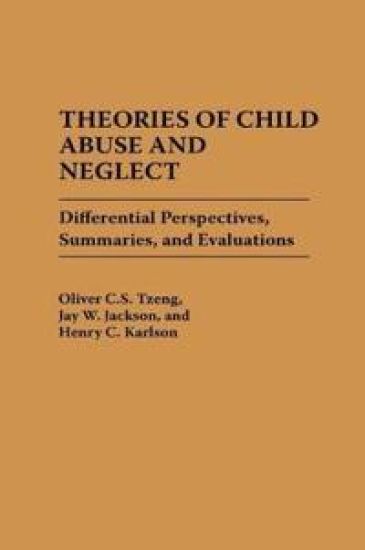
Theories of Child Abuse and Neglect
Jay W. Jackson; Henry Karlson; Oliver C. S. Tzeng
Praeger Publishers Inc
1991
sidottu
This volume was prepared under the impetus of desperate need in academic institutions and clinical and social services for a comprehensive introduction to the diverse theories about child abuse and neglect etiologies. Although history documents maltreatment of children since the beginning of human civilization, formal recognition of the problem has been relatively recent. During the past three decades, professionals in various fields, especially medicine, psychiatry, social work, law, sociology, and psychology, have been involved in the identification, treatment, and prevention of child victimization and its detrimental consequences. In studying the etiology of child maltreatment, many theoretical viewpoints have been proposed in the literature and used for clinical practice as well as academic research. The current work represents a comprehensive evaluation and integration of diverse theorizations concerning the abuse and neglect of children. The authors have compiled more than 40 theories, models, and perspectives from the literature. As the subtitle suggests, they describe individual theories, summarize across different theoretical views, and evaluate the current status of those theorizations. This volume is intended for three distinct audiences: practitioners, researchers, and the general public. Clinical practitioners will find it a source of strategies that can be applied in clinical settings. By documenting the absence of comprehensive, multidiscipinary-oriented theory development, it will encourage researchers toward refining existing theories through integration with other theoretical perspectives. For the general public, it provides insight into a troubling social problem.
As most managers know, you need a vision to motivate employees to achieve goals. But people, and companies, lose focus, and the future appears hazy. People say, We're getting stale, or, I just don't know where we're headed. Leaders know they need a vision to bring people together. And they know a good vision will renew enthusiasm and commitment. But waiting for inspiration rarely works—sometimes you need a vision now. But how? Recharge Your Team not only shows managers how to create an effective vision—it shows how to do it in as little as four hours, using a time-tested, proven approach.Traditionally, companies call in consultants to help create a vision. Experts can help—for $4,000 per day plus expenses. And then there's the time involved: Visioning efforts can take months. This book offers a less-expensive, faster method. Called Grounded Visioning, and based on a concept called appreciative inquiry, the process allows groups to come up with a revitalizing vision that everyone buys into in half a day or less. How? As this book shows, the key is to be sure everyone takes part, to base the vision on how the team acts when at its best, and to imagine a vision bold enough to inspire but practical enough to feel achievable. This book covers the six quick but essential steps that ensure such results—with small teams or large groups. And any manager, not just trainers or HR people, can lead a successful Grounded Visioning session. Grounded visioning is a breakthrough concept of breathtaking simplicity and power that any leader can put to use today. It works, because it frees employees to share their dreams, hopes, and aspirations. As they soar, a vision naturally arises that recharges the team.
Jay W. Baird comes to grips with a theme which has been generally avoided by over two generations of scholars and literary critics. He argues that German literature did not end with the advent of Hitler in 1933, only to be reborn after the fall of the Third Reich in 1945. Baird demonstrates how poets and writers responded enthusiastically to Hitler's summons to artists to create a cultural revolution commensurate with the political radicalism of the new state, thereby affirming the centrality of renewed German culture. Hitler's War Poets focuses on the lives and the works of six leading conservative, anti-communist yet revolutionary authors who articulated the dream of World War I veterans to form a socially just national community. Tradition was redrawn by Rudolf G. Binding, while Josef Magnus Wehner dramatized the link from Flanders fields and Verdun to the Third Reich. Hans Zöberlein exalted anti-Semitism, the Free Corps, and Nazi violence, providing the counterpoint to Edwin Erich Dwinger, who launched an unrelenting assault against 'Jewish-Bolshevism'. The torch was passed to Eberhard Wolfgang Möller, the leading bard of the revolutionary young generation. But it was Kurt Eggers, a tank commander in the 5th SS Panzer Division 'Viking', who delighted Hitler as he appeared as a prophet bearing the testament of Nietzsche's Zarathustra. Taken together, these authors offered the regime significant support. More importantly, their's was a tragic legacy because they provided aesthetic accompaniment to Nazi barbarism and ultimately to the Holocaust.