Kirjojen hintavertailu. Mukana 11 244 527 kirjaa ja 12 kauppaa.

Kirjahaku

Etsi kirjoja tekijän nimen, kirjan nimen tai ISBN:n perusteella.

1000 tulosta hakusanalla Jeff E. Frazier I.

Unclean: Expanded Edition

Unclean: Expanded Edition

Jeff E. Frazier I.

Createspace Independent Publishing Platform
2018
nidottu
Unclean is the journey of Jesus' life told through the eyes of his neighbors, friends, and fellow townspeople. Only days before Salem's birth, the wise men pass by Nazareth. Mashic, a friend of the family, learns the true reason why these kings from the east are in Israel. This revelation begins his life long journey in search of the Messiah. When Salem is an adult, he is stricken with leprosy and forced into exile. After Jesus healed Salem and nine other lepers, Salem is counted with the nine that did not thank Jesus for healing them. When he heard that one leper went to Jesus and thanked him, he realizes what he must do. Determined to find his healer, Salem learns that Jesus will be in Jerusalem for the Passover and sets out to give his thanks to Jesus. After arriving in Jerusalem, he learns that he might be too late.
Unclean: Return to Samaria

Unclean: Return to Samaria

Jeff E. Frazier

Createspace Independent Publishing Platform
2019
nidottu
UNCLEAN - RETURN TO SAMARIA is the continuing story of Salem, a former leper, through approximately the first fifteen years of the Book of Acts. He witnesses Pentecost, the miracles by the Apostles, and the stoning of Stephen. As the church grows, so does the anger toward those that follow Jesus Christ. Salem, like all the other believers, is being pursued and risks imprisonment, torture, and death. The man hunting Salem and his family is the cruelest man Salem knows, Jeru, his father. With all his options gone, Salem has no choice but to Return to Samaria, the place he lived in exile as a leper.
Applied Calculus

Applied Calculus

Deborah Hughes-Hallett; Patti Frazer Lock; Andrew M. Gleason; Daniel E. Flath; Sheldon P. Gordon; David O. Lomen; David Lovelock; William G. McCallum; Brad G. Osgood; Andrew Pasquale; Jeff Tecosky-Feldman; Joseph Thrash; Karen R. Rhea; Thomas W. Tucker

JOHN WILEY SONS INC
2022
nidottu
Calculus Single and Multivariable 6E Student Solutions Manual

Calculus Single and Multivariable 6E Student Solutions Manual

Hughes-Hallett Deborah; William G. McCallum; Gleason Andrew M.; Flath Daniel E.; Patti Frazer Lock; Gordon Sheldon P.; David O. Lomen; Lovelock David; Osgood Brad G.; Pasquale Andrew; Douglas Quinney; Tecosky-Feldman Jeff; Thrash Joseph; Karen R Rhea; Tucker Thomas W.

John Wiley Sons Inc
2013
nidottu
The Student Solutions Manual to CalculusCalculus teachers recognize this book as the leading resource among the reform projects that employ the rule of four and streamline the curriculum in order to deepen conceptual understanding. This edition uses all strands of the "Rule of Four" -- graphical, numeric, symbolic/algebraic, and verbal/applied presentations -- to make concepts easier to understand. The book focuses on exploring fundamental ideas rather than comprehensive coverage of multiple similar cases that are not fundamentally unique.
Calculus Single Variable 6E Student Solutions Manual

Calculus Single Variable 6E Student Solutions Manual

Hughes-Hallett Deborah; Gleason Andrew M.; William G. McCallum; Flath Daniel E.; Patti Frazer Lock; David O. Lomen; Lovelock David; Osgood Brad G.; Douglas Quinney; Karen R Rhea; Tecosky-Feldman Jeff; Tucker Thomas W.; Bretscher Otto K.; Gordon Sheldon P.; Pasquale Andrew; Thrash Joseph

John Wiley Sons Inc
2013
nidottu
Calculus teachers recognize Calculus as the leading resource among the "reform" projects that employ the rule of four and streamline the curriculum in order to deepen conceptual understanding. The Sixth Edition uses all strands of the 'Rule of Four' - graphical, numeric, symbolic/algebraic, and verbal/applied presentations - to make concepts easier to understand. The book focuses on exploring fundamental ideas rather than comprehensive coverage of multiple similar cases that are not fundamentally unique.
Calculus Multivariable 6E Student Solutions Manual

Calculus Multivariable 6E Student Solutions Manual

William G. McCallum; Hughes-Hallett Deborah; Gleason Andrew M.; David O. Lomen; Lovelock David; Tecosky-Feldman Jeff; Tucker Thomas W.; Flath Daniel E.; Thrash Joseph; Karen R Rhea; Pasquale Andrew; Gordon Sheldon P.; Douglas Quinney; Patti Frazer Lock

John Wiley Sons Inc
2013
nidottu
The Student Solutions Manual to CalculusCalculus teachers recognize this book as the leading resource among the reform projects that employ the rule of four and streamline the curriculum in order to deepen conceptual understanding. This edition uses all strands of the "Rule of Four" -- graphical, numeric, symbolic/algebraic, and verbal/applied presentations -- to make concepts easier to understand. The book focuses on exploring fundamental ideas rather than comprehensive coverage of multiple similar cases that are not fundamentally unique.
Workshops

Workshops

Jeff E. Brooks-Harris; Susan R. Stock

SAGE Publications Inc
1999
sidottu
This volume is designed to present a practical approach to designing and running workshops. It is meant to introduce novice facilitators as well as those with much experience to an integrated model of workshop design and development. Grounded in learning theory, this model is used to demonstrate how to design, facilitate, and direct workshops, as well as how to identify and improve existing skills. Practical, how-to sections assist readers in creating specific experiential activities designed to facilitate different types of learning. Readers also learn how to understand and attend to individual differences as well as to take all workshop participants through a universal cycle of learning. Workshops will be useful to anyone who facilitates workshops in higher education, adult education, business, health care, and other educational settings.
Workshops

Workshops

Jeff E. Brooks-Harris; Susan R. Stock

SAGE Publications Inc
1999
nidottu
This volume is designed to present a practical approach to designing and running workshops. It is meant to introduce novice facilitators as well as those with much experience to an integrated model of workshop design and development. Grounded in learning theory, this model is used to demonstrate how to design, facilitate, and direct workshops, as well as how to identify and improve existing skills. Practical, how-to sections assist readers in creating specific experiential activities designed to facilitate different types of learning. Readers also learn how to understand and attend to individual differences as well as to take all workshop participants through a universal cycle of learning. Workshops will be useful to anyone who facilitates workshops in higher education, adult education, business, health care, and other educational settings.
Documents on and from the History of Economic Thought
Contains two groups of archival materials. The first group includes Edwin Cannan's unsuccessful Cobden Essay; an early critique of economics by Eli Ginzberg; introductory notes on the study of the history of economic thought by Warren Samuels; and a memoir by Jacob Warshaw on Thorstein Veblen. The second group contains lecture notes taken by F. Taylor Ostrander in courses given by David Taggart Clark (Williams College), Redvers Opie (Oxford), and Frank H. Knight (Chicago) on the history of economics.
Progress through Regression

Progress through Regression

Jeff E. Biddle

Cambridge University Press
2025
pokkari
The Cobb-Douglas regression, a statistical technique developed to estimate what economists called a 'production function', was introduced in the late 1920s. For several years, only economist Paul Douglas and a few collaborators used the technique, while vigorously defending it against numerous critics. By the 1950s, however, several economists beyond Douglas's circle were using the technique, and by the 1970s, Douglas's regression, and more sophisticated procedures inspired by it, had become standard parts of the empirical economist's toolkit. This volume is the story of the Cobb-Douglas regression from its introduction to its acceptance as general-purpose research tool. The story intersects with the histories of several important empirical research programs in twentieth century economics, and vividly portrays the challenges of empirical economic research during that era. Fundamentally, this work represents a case study of how a controversial, innovative research tool comes to be widely accepted by a community of scholars.
Progress through Regression

Progress through Regression

Jeff E. Biddle

Cambridge University Press
2020
sidottu
The Cobb-Douglas regression, a statistical technique developed to estimate what economists called a 'production function', was introduced in the late 1920s. For several years, only economist Paul Douglas and a few collaborators used the technique, while vigorously defending it against numerous critics. By the 1950s, however, several economists beyond Douglas's circle were using the technique, and by the 1970s, Douglas's regression, and more sophisticated procedures inspired by it, had become standard parts of the empirical economist's toolkit. This volume is the story of the Cobb-Douglas regression from its introduction to its acceptance as general-purpose research tool. The story intersects with the histories of several important empirical research programs in twentieth century economics, and vividly portrays the challenges of empirical economic research during that era. Fundamentally, this work represents a case study of how a controversial, innovative research tool comes to be widely accepted by a community of scholars.

The Nephilim, a Giant Walk Through History

The Nephilim, a Giant Walk Through History

Jeff E Brannon

Createspace Independent Publishing Platform
2015
pokkari
Freshley Revised and updated with newly discovered names and events (11-25-21) A Biblically based, mostly historic, fictional story starting from the time of Jared (Noah's grandfather) through the present day. The word Nephilim is translated in Gen 6:1 as "giant", but means "from the fallen ones". They were the offspring of the Fallen Angels and the daughters of Adam. It is an exciting adventure filled with historical content designed to be a springboard for the reader to explore a side of history often not told. I believe one cannot fully comprehend the Old Testament without understanding the role the Nephilim played. This book helps answer questions like, "If God is a God of love, why did He allow genocide in the OT?" and "What did Jesus mean that the last days would be like the days of Noah?" The book pulls from Ancient Biblical text as well as scrolls found along with the Dead Sea Scrolls such as The Book of Giants. The synchronized, Biblically endorsed, extra-Biblical texts such as 1 Enoch, Jasher, and Jubilees also contribute to the historical accuracy of the narrative. Find out about the Vimana mentioned in over 1,000 texts in ancient writings and how they tie in with the Nephilim and Watcher-class angels. This book answers questions the modern church typically runs from in an exciting story-driven narrative that puts the reader right in the middle of the action. In this story, the author takes you on a journey from the dawn of time through the present day and even portrays a glimpse of what might happen in the very near future. Who were Nimrod and his wife? How do they tie into events both in the past and the future? Who are the Nephilim? Are they real? Do they live among us? Find out the answers to these and many more questions in this book today.
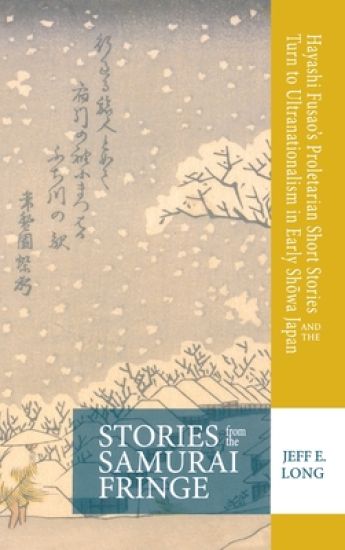
Stories from the Samurai Fringe

Stories from the Samurai Fringe

Jeff E. Long

Cornell University East Asia Program
2019
sidottu
A cultural history of writer and literary critic Hayashi Fusao's (1903–1975) tenko experience, Stories from the Samurai Fringe examines Hayashi's tenko (ideological conversion) through a close reading of his proletarian short stories. Tracing Hayashi's move from "romanticizing" to "defining" to "remembering" the proletarian literature movement and its participants in his proletarian fiction, this study argues for a far more personal and political rationale for Hayashi's subsequent turn to ultranationalism. Stories from the Samurai Fringe concludes with a consideration of Hayashi's tenko experience, first, within the historiographical context of the early Showa years (1926–1937), and then within the trans-war setting of Hayashi's reemergence as a proponent of wartime nationalism.
Stories from the Samurai Fringe

Stories from the Samurai Fringe

Jeff E. Long

Cornell University East Asia Program
2019
pokkari
A cultural history of writer and literary critic Hayashi Fusao's (1903–1975) tenko experience, Stories from the Samurai Fringe examines Hayashi's tenko (ideological conversion) through a close reading of his proletarian short stories. Tracing Hayashi's move from "romanticizing" to "defining" to "remembering" the proletarian literature movement and its participants in his proletarian fiction, this study argues for a far more personal and political rationale for Hayashi's subsequent turn to ultranationalism. Stories from the Samurai Fringe concludes with a consideration of Hayashi's tenko experience, first, within the historiographical context of the early Showa years (1926–1937), and then within the trans-war setting of Hayashi's reemergence as a proponent of wartime nationalism.