Composer's Note: This is a collection of original compositions for guitar that I composed over a time span of many years. The music embodies a wide variety of compositional styles - from romantic Spanish, to impressionistic, to Japanese traditional, as well as a group of atonal/12 tone works. A common element that they all share is an exploration of the virtually endless palette of color and timbre of the guitar.The pieces included in this collection are:1. Sakura, Introduction, Theme and Variations on the Japanese folk song. This is a virtuoso concert piece that weaves a dreamlike tapestry of eight variations and a coda, full of mystical evocations of spring, clouds, misty landscapes and serene meditative solitudes. Based on the Japanese folk tune "Sakura," it means "Blooming Cherry Blossoms." Originally composed in the Edo period, its lyrics are translated as: Cherry blossoms, cherry blossoms, Blanketing the countryside, As far as you can see.Is it a mist, or clouds?....Come now, comeLet's look, at last 2. Catalonian Reverie. This is a concert piece that is inspired by music of Spanish composers such as Albeniz, Granados, and De Falla, with a touch of flamenco as well.3. Romance. This short work, based on the iconic Romance D'Amour, has a middle section where the melody is heard in the bass. 4. Hands of My Angel for Solo Guitar. I originally composed this music as an homage to Eric Satie and his Gymnopedie # 1, originally for piano. The harmonic language is somewhat jazz oriented, along with an influence of Satie's friends Claude Debussy and Maurice Ravel.5. Hands of My Angel for Two Guitars. This is a two guitar version of the same melody that I composed for my "Hands of the Angels" CD. In the CD version the guitars are accompanied by pizzicato strings.6. Double of Sarabande from J. S. Bach's Cello Suite # 6. In old French the term 'double' meant melodic variation, where the harmonic design was kept unchanged. Bach composed many doubles, notably in his violin suite in B minor, where each dance is followed by a double. This work is an impressionistic variation on the Bach Sarabande from Cello Suite # 6, with episodic reminiscences of Villa Lobos, Debussy and Baden Powell.7. Ascent for Solo Guitar. Dedicated to my guitar mentor Theodore Norman, this work is inspired by the abstract paintings of Juan Miro, Wassily Kandinski and Paul Klee, as well as the 20th Century music of Anton Webern and Alban Berg. It is composed in a combination atonal/12-tone idiom and is a musical take on the inner experience of mountain climbing: dangling from ropes, suspended in space surrounded by primordial mountain peaks, amidst blue skies and fast-moving clouds.8-12. Children's Games: Five Pieces for Guitar. Composed in an atonal/12-tone idiom, this suite of miniatures explores in musical terms memories of a child-like inner world. Before the regimentation and constraints imposed by the world of adults, children, particularly in play, express a rich world of activity and emotions, often without fixed or rigid boundaries. There is a free alternation, often rapid and instantaneous, between states of joy, exuberance, and sometimes foreboding and anxiety. Los Angeles, July 2012
This is a transcription for three guitars of Georg Friedrich Handel's Water Music, Suite # 2 in D major, originally written for winds, horns and strings. The Water Music is one of Handel's most celebrated compositions. It premiered on July 17, 1717 and was composed at the request of King George I. The concert is said to have been performed by fifty musicians playing on a barge on the River Themes. The King and his party listened from the royal barge and the entire group traveled on the Themes from London to Chelsea or Lambeth. Some accounts record that the King so enjoyed the music he asked that the entire concert be repeated three times.This edition is designed for concert performance as well as for classroom instruction. The score is presented with amply notated guitar fingerings for each of the three parts. Also included are separate parts for each of the guitars.
Ernst Krenek was one of the greatest composers of the 20th Century. In 1980, after reviewing Jeffrey Goodman's transcription of his Suite for Flute and Piano (1956), he wrote, "I like your arrangement of my Flute Suite for two guitars very much. It is very carefully done and looks very practical and inviting...."This is the first publication of Jeffrey Goodman's arrangement for flute and two guitars of Ernst Krenek's Suite Opus 147. It has the unique quality of having received Ernst Krenek's careful review and unqualified endorsement for publication. The music itself is a masterpiece of miniature form, with a harmonic basis that reflects musical thought of wit, purity and unsurpassable originality.
This collection of authentic flamenco features music created and played by anonymous gypsies in Spain and dates back to the 1950s. The book is divided into two main sections, each with the same 15 pieces. The repertoire includes: Malague aSolearesJota TientosGypsy RumbaFlamenco RumbaFandangoZapateadoFaruccaGranadinasMedia GranadinasTangoSolearesTarantasAlbacinatasThe first section is entirely in music notation format and is fully notated as to fingering, strumming and special techniques. Section two is identical to section one, with each piece engraved using both tablature and music notation. The music ranges in technical level from beginning - for example Jota and Fandango, to intermediate pieces such as Farruca and Granadinas, to more advanced pieces such as Tango and Tarrantas.
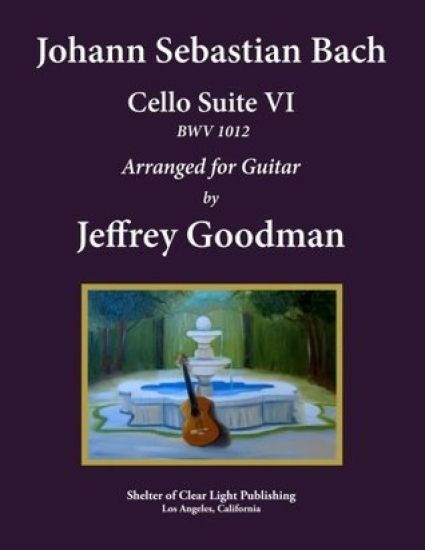
Bach's Suites Violoncello Solo senza Basso are thought to have been composed during 1717-1723, when Bach served as Kapellmeister in K then. Although no manuscript in Bach's own hand has survived, there is a manuscript in the hand of Bach's second wife Anna Magdalena Bach.This is the historical source from which this arrangement has been made. Bach's Cello Suite VI, BWV 1012, is in the key of D major, and this arrangement keeps the original key. A low D tuning of the 6th string is used throughout all the movements of the suite. This adds a rich sonority, and by extending the bass range, allows for a more authentic rendering of melodic lines, and also preserves much of the original voicing of chords.
Robert de Vis e (c.1655 - c.1732) was a French guitarist and composer who became a chamber musician to the court of Louis XIV. In 1709 he became a singer in the Royal Chapel, and in 1719 was appointed to the position of guitar teacher to Louis XIV. During his lifetime he published several books, including "Livre de Guitarre dedi au Roy," Paris, 1682, and "Livre de Pi ces pour Guitarre," Paris, 1686. The arrangements in this book are drawn mainly from those sources, as well as from manuscripts in the Bibliotheque nationale, Paris.All of the arrangements in this book are designed for performance, and have been made in the spirit of Baroque music practice.
At the age of thirty-seven, soon after Bach's wedding to Anna Magdalena on December 3, 1721, Bach presented her with a gift of his keyboard music. The Clavierb chlein of 1722 contained Bach's hand-copied manuscripts of the first five of the French Suites, as well as other of his keyboard compositions. Much of that original book has been lost, but the title page and several of the dance movements of French Suite III have survived. No other copies in Bach's hand exist today. Fortunately, a handful of manuscripts of the French Suites, often copied by Bach's pupils, have survived. Scholars of the renowned Bach-Gesellschaft created their definitive editions based on a study of all existing versions of Bach's works.This arrangement of Bach's French Suite III, BWV 814, is based on the Bach-Gesellschaft edition of his keyboard works. It contains both a fully notated score for two guitars, and individual guitar parts.
Johann Sebastian Bach's Suites Violoncello Solo senza Basso are thought to have been composed during 1717-1723, when Bach served as Kapellmeister in K then. The manuscript copy of Cello Suite III, BWV 1009 is the only surviving original. It is generally thought to be in the hand of Bach's second wife Anna Magdelena Bach. Some scholars now believe that the manuscript is indeed in the hand of Johann Sebastian Bach. It is housed in the Deutsche Staatsbibliothek in Berlin. This is the historical source, along with current scholarly editions of the Bach cello suites, from which this arrangement has been made. Cello Suite III, BWV 1009, is in the key of C major. This arrangement transposes the original key to A major.It is interesting to note that the great 20th century cello virtuoso Pablo Casals declined to edit his own edition of the cello suites. He said that was because his attitude to the music was founded on an unending search for musical and technical solutions, and thus was ever evolving and changing. He felt that any edition of his would therefore become out of date in a short time.For guitarists Casals's attitude of "unending search" is doubly applicable. This arrangement reflects my own current take on how Bach's Cello Suite III may be played on guitar. In order to offer guitarists a rich palette of resources with which to explore this music, this edition consists of three parts, each of which includes the complete suite: Part I - The fully realized guitar arrangement.Part II - The guitar arrangement in score with the unadorned cello part. This allows the player to always have at hand a definitive resource to see what the Bach original was.Part III - This is a reproduction of the original manuscript, which is essential for not only cellists, but for guitarists as well.
The South African Truth and Reconciliation Commission (TRC) is a modern social drama that enabled the nation's apartheid past to be constructed as a cultural trauma, and by doing so created a new collective narrative of diversity and inclusion. The TRC relied primarily on testimonies from victims and perpetrators of apartheid violence who came forward to tell their stories in a public forum. Rather than simply serving as data for setting the historical record straight, this book shows that it was not only the content of these testimonies but also how these stories were told and what values were attached to them that became significant. Goodman argues that the performative nature of the TRC process effectively designated the past as profane and simultaneously imagined a sacred future community based on democratic idealism and universal solidarity.