Kirjahaku
Etsi kirjoja tekijän nimen, kirjan nimen tai ISBN:n perusteella.
1000 tulosta hakusanalla Jennifer Barber
Winner of the Tenth Gate Prize. Says Daniel Tobin, "Barber's poems ask us 'to register each shifting of the air, ' and they do so with a contemplative brilliance rare in contemporary American poetry." Martha Collins adds, "Like masterful drawings, Jennifer Barber's Works on Paper calls our attention to every carefully executed line. Spare, suggestive, their images speak both for and beyond the fragility of existence. Barber offers us 'collisions of light and dark' that are 'impossible to divide.' The poet knows that 'Nothing will be saved'; but for us and for future readers, these beautiful poems will linger.
In her fourth collection, Jennifer Barber explores the facts and fascination of daily living as well as the greatest challenges of the spirit, and does so in a way that shows us the unbreakable connections between them. Says Afaa M. Weaver, "In The Sliding Boat Our Bodies Made, we see the ecology of compassion and hopefulness, a fragile latticework made of the concern for how all things might fall away in a world seeming to be too full of loss. With a meticulousness like the Zen of poets in ancient China, Barber takes us to a place where we can believe there will always be a chance to breathe, even as we feel the terror of life in the beauty of its most minute details. These are finely crafted poems with turns on the torso of history and the times in which we live as if those things are a single tree of life, and they are. Barber teaches us how to know subtlety, how it can bring a fullness to us, a light without limits."
Against a backdrop of xenophobic and ethnonationalist fantasies of linguistic purity, Poetry After Barbarism uncovers a stateless, polyglot poetry of resistance—the poetry of motherless tongues. Departing from the national and global paradigms that dominate literary history, Jennifer Scappettone traces the aesthetic and geopolitical resonance of “xenoglossic” poetics: poetry composed in the space of contestation between national languages, concretizing dreams of mending the ruptures traced to the story of Babel. As global migration, aerial bombardment, and the wireless telegraph shrank distances with brute force during the twentieth century, visions of transcultural communication emerged in the hopes of bridging linguistic difference. At the same time, evolving Fascist ideologies denied the reality of cultural admixture and the humanity of the stranger.Authors who write xenoglossic verse occupy languages without a perceived birthright or sanctioned education; they compose in ecstatic “orphan tongues” that rebuff nationalist ideologies, on the one hand, and globalization, on the other, uprooting notions of belonging ensconced in nativist metaphors of milk, blood, and soil while rendering the reactionary category of the barbarian obsolete. Raised within or in the wake of fascism, these poets practice strategic forms of literary and linguistic barbarism, proposing modes of collectivity that exceed geopolitical definitions. Studying experiments between languages by immigrant, refugee, and otherwise stateless authors—from Baroness Elsa von Freytag-Loringhoven to Emilio Villa, Amelia Rosselli, Etel Adnan, LaTasha N. Nevada Diggs, Chika Sagawa, and Sawako Nakayasu—this book explores how poetry can both represent and jumpstart metamorphosis of the shape and sound of citizenship, modeling paths toward alternative republics in which poetry might assume a central agency.

At some point, we will all lose someone so close to us that we think we will never be able to go on after they have passed. But what if they are not completely gone? What if they leave us signs and small miracles that they are still around and watching out over us? Would that knowledge help us to cope? Help us to be able to move forward in our daily life? That awareness is what has helped me to be able to go on and continue to live a life, without my daughter. I pray this story of mine and the signs I truly believe to be from her, can give you the hope and fortitude you need, to enable you to embrace every day that comes to pass after such a devastating loss.
"Wir sind keine Barbaren". Eine Tragikomödie im Stile Dürrenmatts?
Jennifer Braune
GRIN Verlag
2017
nidottu
Clear and Convincing Evidence: A Jennifer Roby Mystery
Barbara Townsend
Fine Nib Publishing
2016
nidottu
Carolyn Samuels is obsessed with the idea of being popular. She is convinced that the only thing keeping her from happiness is her too heavy for fashion body and not being a cheerleader. Hyperventilating when she gets nervous doesn't help. When she is paired for a math project with the girl who tormented her in middle school, Jennifer Taylor, she is sure it is going to be another year of pain. With Carolyn's crush on Jennifer's hunky junior quarterback, Brad, her freshman year in high school looks like a rerun of middle school. When Jennifer is the only student who knows why she fell in gym class, Carolyn is blackmailed into doing her math homework in return for Jennifer's silence. Jennifer takes on Carolyn as a pity project since she can't be seen with someone who dresses in jeans and sweatshirts. When Jennifer invites Carolyn to spend the night to make her over and teach her to tumble, Carolyn learns Jennifer's secretTeen Drama: and lies to her own friends to cover it up. Will Carolyn become a cheerleader and popular?
Best-selling author Barbara Kingsolver's life and works are explored in this comprehensive, unique reference guide. Ideal for book club members and essential for high school students, this valuable resource introduces the plot summaries as well as theme and character analysis for seven of Kingsolver's major works. Kingsolver's usual topics, primarily focusing on the working class, environmental issues, feminism, and Native American studies, are closely examined in relation to current events and contemporary popular culture. Also discussed are Kingsolver's presence on the Internet, as well as the media's reception of the author. Each chapter concludes with thought-provoking, analytical discussion questions, ideal for encouraging book club conversation as well as stimulating classroom discussion. The What Do I Read Next chapter will delight readers who enjoy Kingsolver's work. This guide is a must-have for public and high school library shelves! Best-selling author Barbara Kingsolver's life and works are explored in this comprehensive, unique reference guide. Ideal for book club members and essential for high school students, this valuable resource introduces the plot summaries as well as theme and character analysis for seven of Kingsolver's major works. Kingsolver's usual topics, primarily focusing on the working class, environmental issues, feminism, and Native American studies, are closely examined in relation to current events and contemporary popular culture. Also discussed are Kingsolver's presence on the Internet, as well as the media's reception of the author. Each chapter concludes with thought-provoking, analytical discussion questions, ideal for encouraging book club conversation as well as stimulating classroom discussion. The What Do I Read Next chapter will delight readers who enjoy Kingsolver's work. This guide is a must-have for public and high school library shelves!
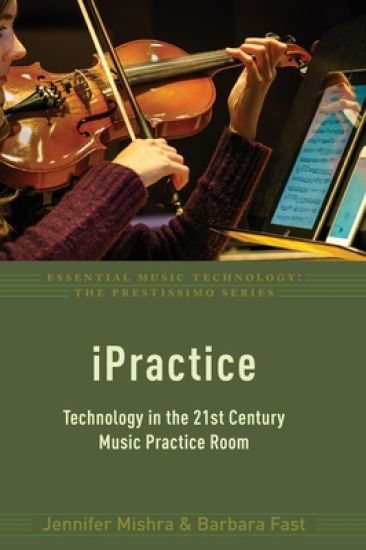
This book provides new practical tools that bridge the gap between familiar, easy-to-use technology and musical practice to enhance musicianship and motivate students. Authors Jennifer Mishra and Barbara Fast provide ideas for use with students of all levels, from beginners to musicians performing advanced repertoire. This book is written for teachers (both studio teachers and ensemble directors), but can be read by performers to help give new guidance to their own practice sessions. Some strategies in this book would not have been possible without advances in technology; others expand tried-and-true practice strategies with the use of technology. Most of the technologies discussed are free or inexpensive and don't require extensive specialist equipment or learning. Rather than replacing quality practice strategies, technology brings new tools to the practicing tool box. The strategies lay the foundation for how technology can be used in the practice room and are intended to spark creativity. The book encourages teachers and students to vary the integration of practice strategies with technology in personal ways to fit their own studios or practice routines. This book is all about exploring our musical practice through technology. The ideas in this book will invigorate your musical practice and lead to even more creativity between you and your students
Creating Book Clubs in the English Language Classroom
Barbara Vaille; Jennifer QuinnWilliams
The University of Michigan Press
2005
nidottu
Although it is a natural way for students to improve their language skills, a classroom book club can also be challenging for teachers to facilitate. Creating Book Clubs lays out a successful three-part model in which students read, discuss, and make Book Log entries that the authors developed in their own multilevel adult ESL classroom. The book explains how book clubs support students' need for extensive reading and high-interest reading. Chapters show how discussion and analysis are sparked by making personal connections, cultural connections, and media connections to book club texts, and by asking questions, making predictions, and drawing inferences.Although Creating Book Clubs in the English Language Classroom was written with adult ELL learners in mind, it can be adapted easily to Adult Basic Education (ABE). A list of books and texts that can be used successfully in student book clubs is included in the appendix.
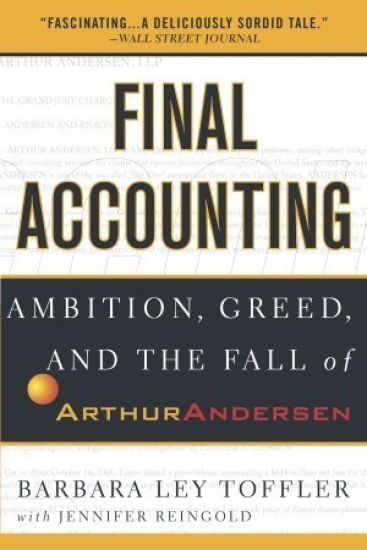
Final Accounting: Ambition, Greed and the Fall of Arthur Andersen
Barbara Ley Toffler; Jennifer Reingold
Crown Currency
2004
nidottu
A withering expos of the unethical practices that triggered the indictment and collapse of the legendary accounting firm. Arthur Andersen's conviction on obstruction of justice charges related to the Enron debacle spelled the abrupt end of the 88-year-old accounting firm. Until recently, the venerable firm had been regarded as the accounting profession's conscience. In Final Accounting, Barbara Ley Toffler, former Andersen partner-in-charge of Andersen's Ethics & Responsible Business Practices consulting services, reveals that the symptoms of Andersen's fatal disease were evident long before Enron. Drawing on her expertise as a social scientist and her experience as an Andersen insider, Toffler chronicles how a culture of arrogance and greed infected her company and led to enormous lapses in judgment among her peers. Final Accounting exposes the slow deterioration of values that led not only to Enron but also to the earlier financial scandals of other Andersen clients, including Sunbeam and Waste Management, and illustrates the practices that paved the way for the accounting fiascos at WorldCom and other major companies. Chronicling the inner workings of Andersen at the height of its success, Toffler reveals "the making of an Android," the peculiar process of employee indoctrination into the Andersen culture; how Androids--both accountants and consultants--lived the mantra "keep the client happy"; and how internal infighting and "billing your brains out" rather than quality work became the all-important goals. Toffler was in a position to know when something was wrong. In her earlier role as ethics consultant, she worked with over 60 major companies and was an internationally renowned expert at spotting and correcting ethical lapses. Toffler traces the roots of Andersen's ethical missteps, and shows the gradual decay of a once-proud culture. Uniquely qualified to discuss the personalities and principles behind one of the greatest shake-ups in United States history, Toffler delivers a chilling report with important ramifications for CEOs and individual investors alike.
Dragonfly Effect Workbook: The Power of Stories
Barbara McCarthy; Jennifer Aaker; Andrew Smith
Createspace Independent Publishing Platform
2013
nidottu
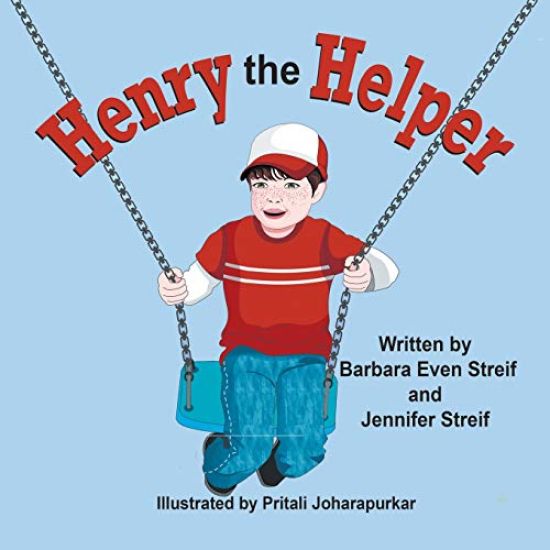
Meet Henry, a loveable young boy who likes to help other people.One day something happens to prevent him from doing what he loves to do.See how Henry learns the value of accepting help from others.
Sexual Assault and the Justice Gap: A Question of Attitude
Barbara Krahé; Jennifer Temkin
Hart Publishing
2008
nidottu
This book is set against the background of the 'justice gap' in sexual assault cases - the dramatic gap between the number of offences recorded by the police and the number of convictions. It seeks to examine the attitudinal problems which bedevil this area of law and possible strategies for addressing them. Written by a professor of law and a professor of psychology, it reviews evidence from socio-legal and social cognition research and presents new data drawn both from interviews with judges and barristers and from studies with prospective lawyers and members of the public. In the final part, it considers different ways in which rape trials could be improved and suggests steps that could be taken to change public attitudes about sexual assault.
Technology for Success
Jennifer Campbell; Mark Ciampa; Barbara Clemens; Steven Freund; Mark Frydenberg; Ralph Hooper; Lisa Ruffolo; Jill West
Course Technology Inc
2020
nidottu
Gain a thorough understanding of today's sometimes daunting, ever-changing world of technology as you learn how to apply the latest technology to your academic, professional and personal life with TECHNOLOGY FOR SUCCESS: COMPUTER CONCEPTS. Written by a team of best-selling technology authors and based on extensive research and feedback from students like you, this edition breaks each topic into brief, inviting lessons that address the “what, why and how” behind digital advancements to ensure deep understanding and application to today's real world. Optional online MindTap and SAM (Skills Assessment Manager) learning tools offer hands-on and step-by-step training, videos that cover the more difficult concepts and simulations that challenge you to solve problems in the actual world. You leave this course able to read the latest technology news and understand its impact on your daily life, the economy and society.
Technology for Success
Jennifer Campbell; Mark Ciampa; Barbara Clemens; Steven Freund; Lisa Ruffolo; Jill West
CENGAGE LEARNING, INC
2024
nidottu
Campbell/Ciampa/Clemens/Freund/Frydenberg/Hooper/Ruffolo/West's TECHNOLOGY FOR SUCCESS: COMPUTER CONCEPTS, 2nd Edition, teaches you to be a digital citizen by engaging you in the history, use and concepts of technology. Each module begins with a scenario that introduces how one person may use the concepts covered in the module. The modules’ content are mapped to high-level learning objectives such as databases, networking, hardware, software, the web and digital communication. Each objective is further broken into digestible tasks and topics focused on how you will interact or utilize the technology. Topics covered that go beyond the nuts and bolts of technology include the digital divide, how technology is used in the professional world, applying information literacy skills to web searches, computer safety and health and the legal and ethical responsibilities of being a digital citizen.