Kirjojen hintavertailu. Mukana 11 244 527 kirjaa ja 12 kauppaa.

Kirjahaku

Etsi kirjoja tekijän nimen, kirjan nimen tai ISBN:n perusteella.

1000 tulosta hakusanalla Jennifer Fleeger

Sounding American

Sounding American

Jennifer Fleeger

Oxford University Press Inc
2014
sidottu
Sounding American: Hollywood, Opera, and Jazz tells the story of the interaction between musical form, film technology, and ideas about race, ethnicity, and the nation during the American cinema's conversion to sound. Contrary to most accepted narratives about the conversion, which tend to explain the competition between the Hollywood studios' film sound technologies in qualitative and economic terms, this book argues that the battle between disc and film sound was waged primarily in an aesthetic realm. Opera and jazz in particular, though long neglected in studies of the film score, were extremely important in defining the scope of the American soundtrack, not only during the conversion, but also once sound had been standardized. Examining studio advertisements, screenplays, scores, and the films themselves, the book concentrates on the interactions between musical form and film technology, arguing that each of the major studios appropriated opera and jazz in a unique way in order to construct its own version of an ideal American voice. The book's central question asks what the synthesis of opera and jazz during the conversion reveals about the stylistic and ideological norms of classical Hollywood cinema and the racial, ethnic, gendered, and socially stratified spaces of American musical production. Unlike much of the scholarship on film music, which gravitates toward feature film scores, Sounding American concentrates on the musical shorts of the late 1920s, showing how their representations of the stage, conservatory, ballroom, and nightclub reflected what opera and jazz meant for particular groups of Americans and demonstrating how the cinema helped to shape the racial, ethnic, and national identities attached to this music. Traditional histories of Hollywood film music have tended to concentrate on the unity of the score, a model that assumes a passive spectator. Sounding American claims that the classical Hollywood film is essentially an illustrated jazz-opera with a musical structure that encourages an active form of listening and viewing in order to make sense of what is ultimately a fragmentary text.
Sounding American

Sounding American

Fleeger Jennifer

Oxford University Press Inc
2014
nidottu
Sounding American: Hollywood, Opera, and Jazz tells the story of the interaction between musical form, film technology, and ideas about race, ethnicity, and the nation during the American cinema's conversion to sound. Contrary to most accepted narratives about the conversion, which tend to explain the competition between the Hollywood studios' film sound technologies in qualitative and economic terms, this book argues that the battle between disc and film sound was waged primarily in an aesthetic realm. Opera and jazz in particular, though long neglected in studies of the film score, were extremely important in defining the scope of the American soundtrack, not only during the conversion, but also once sound had been standardized. Examining studio advertisements, screenplays, scores, and the films themselves, the book concentrates on the interactions between musical form and film technology, arguing that each of the major studios appropriated opera and jazz in a unique way in order to construct its own version of an ideal American voice. The book's central question asks what the synthesis of opera and jazz during the conversion reveals about the stylistic and ideological norms of classical Hollywood cinema and the racial, ethnic, gendered, and socially stratified spaces of American musical production. Unlike much of the scholarship on film music, which gravitates toward feature film scores, Sounding American concentrates on the musical shorts of the late 1920s, showing how their representations of the stage, conservatory, ballroom, and nightclub reflected what opera and jazz meant for particular groups of Americans and demonstrating how the cinema helped to shape the racial, ethnic, and national identities attached to this music. Traditional histories of Hollywood film music have tended to concentrate on the unity of the score, a model that assumes a passive spectator. Sounding American claims that the classical Hollywood film is essentially an illustrated jazz-opera with a musical structure that encourages an active form of listening and viewing in order to make sense of what is ultimately a fragmentary text.
Mismatched Women

Mismatched Women

Fleeger Jennifer

Oxford University Press Inc
2014
sidottu
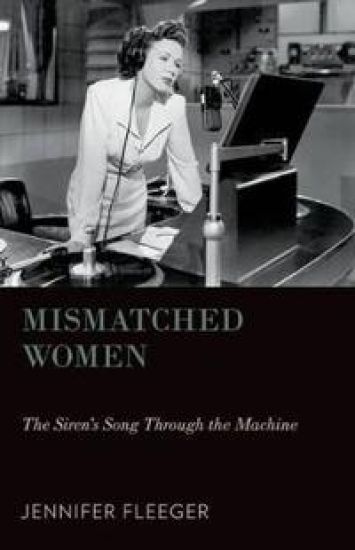
In 2009, Susan Boyle's debut roused Simon Cowell from his grumbling slumber on the television show "Britain's Got Talent" and viewers across the world rallied to the side of the unemployed, older woman with the voice of a trained Broadway star. In Mismatched Women, author Jennifer Fleeger argues that the shock produced when Boyle began to sing belies cultural assumptions about how particular female bodies are supposed to sound. Boyle is not an anomaly, but instead belongs to a lineage of women whose voices do not "match" their bodies by conventional expectations, from George Du Maurier's literary Trilby to Metropolitan Opera singer Marion Talley, from Snow White and Sleeping Beauty to Kate Smith and Deanna Durbin. Mismatched Women tells a new story about female representation in film by theorizing a figure regularly dismissed as an aberration. The mismatched woman is a stumbling block for both sound and feminist theory, argues Fleeger, because she has been synchronized yet seems to have been put together incorrectly, as if her body could not possibly house the voice that the camera insists belongs to her. Fleeger broadens the traditionally cinematic context of feminist psychoanalytic film theory to account for literary, animated, televisual, and virtual influences. This approach bridges gaps between disciplinary frameworks, showing that studies of literature, film, media, opera, and popular music pose common questions about authenticity, vocal and visual realism, circulation, and reproduction. The book analyzes the importance of the mismatched female voice in historical debates over the emergence of new media and unravels the complexity of female representation in moments of technological change.
Mismatched Women

Mismatched Women

Fleeger Jennifer

Oxford University Press Inc
2014
nidottu
In 2009, Susan Boyle's debut roused Simon Cowell from his grumbling slumber on the television show "Britain's Got Talent" and viewers across the world rallied to the side of the unemployed, older woman with the voice of a trained Broadway star. In Mismatched Women, author Jennifer Fleeger argues that the shock produced when Boyle began to sing belies cultural assumptions about how particular female bodies are supposed to sound. Boyle is not an anomaly, but instead belongs to a lineage of women whose voices do not "match" their bodies by conventional expectations, from George Du Maurier's literary Trilby to Metropolitan Opera singer Marion Talley, from Snow White and Sleeping Beauty to Kate Smith and Deanna Durbin. Mismatched Women tells a new story about female representation in film by theorizing a figure regularly dismissed as an aberration. The mismatched woman is a stumbling block for both sound and feminist theory, argues Fleeger, because she has been synchronized yet seems to have been put together incorrectly, as if her body could not possibly house the voice that the camera insists belongs to her. Fleeger broadens the traditionally cinematic context of feminist psychoanalytic film theory to account for literary, animated, televisual, and virtual influences. This approach bridges gaps between disciplinary frameworks, showing that studies of literature, film, media, opera, and popular music pose common questions about authenticity, vocal and visual realism, circulation, and reproduction. The book analyzes the importance of the mismatched female voice in historical debates over the emergence of new media and unravels the complexity of female representation in moments of technological change.
Jennifer

Jennifer

Elizabeth Moreton

Createspace Independent Publishing Platform
2018
nidottu
Jennifer Ryder had been engaged to James Cotts and they had been very happy.James had been an officer in the police force and the Special Forces unit and as far as Jennifer knew he had been well liked and respected.Things had been going well until James was asked to go to work in America. It seemed to Jennifer to be a hasty decision. He started his tour of duty in America and their relationship deteriorated. It was only because of Jennifer's persistence in trying to keep the relationship alive that eventually, all was made clear.The months that followed were hazardous, not just for James but for all his colleagues and friends too. They were all in terrible danger until after a great deal of hard work and sheer determination, James and his team brought the culprits to justice. However, success came at a price.
Jennifer Johnson Is Sick of Being Single

Jennifer Johnson Is Sick of Being Single

Heather McElhatton

William Morrow Paperbacks
2009
nidottu
Body conscious, cubicle-working, and love lorn in the Minneapolis suburbs, Jennifer Johnson is your average American woman. So it's totally understandable when she freaks out after learning her ex-boyfriend is getting married, as is her younger sister, Hailey. To add insult to injury, this means she'll have to wear an Asian-inspried kimono bridesmaid dress, which shows every curve and dimple plus more. Approaching thirty, single, and still unsatisfied with her career as a copywriter for the family-owned Keller's department store, like any woman would, Jen begins to obsess about finding a boyfriend, losing weight, and perhaps chasing her dream job. When Brad Keller, heir to the Keller's business, comes into the picture, it looks like Jen's luck just might be changing. But, as often is the case, in reality, things are never quite as glossy beneath the surface and life's decisions aren't always about following your dream. We're with Jen every step of the way from her daily struggle to eat or not eat a Cinnabon to her decision to ruin the kimono with Drano, and finally, to her chance to define her 'happiness'.
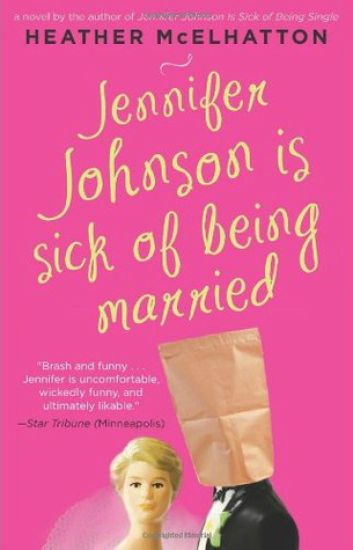
Jennifer Johnson Is Sick of Being Married

Jennifer Johnson Is Sick of Being Married

Heather McElhatton

William Morrow Paperbacks
2012
nidottu
Jennifer Johnson is your average American woman who just so happened to marry the handsome wealthy son of a Midwest department store magnate. Not too long ago she was stuck in a cubicle, love-lorn and addicted to Cinnabon frosting, now she has her Prince Charming and all she could have dreamed of. But as the wedding bells fade, Jennifer quickly learns that the grass on this too-manicured other side is not as green as she thought. After a honeymoon from hell at a gated Christian Resort in the Virgin Islands - bought and paid for by the in-laws and complete with alcohol-free drinks, curfews and joy-ga (satan-free yoga) - Jennifer finds herself in all too bizarre new life. Soon she's organizing Valentine's Day Abstinence dances with her mother-in-law's church committee, sewing size 4 tags into all of her clothing because she can't possibly reveal the truth to her husband, and dining with a Trophy Wives club with their own theories about how to hold on the their men. There must be more to life than this? "Jennifer Johnson is Sick of Being Married" is a laugh-out-loud, no-holds barred lesson about the "good life" and how getting what you want most might just be the worst thing for you.
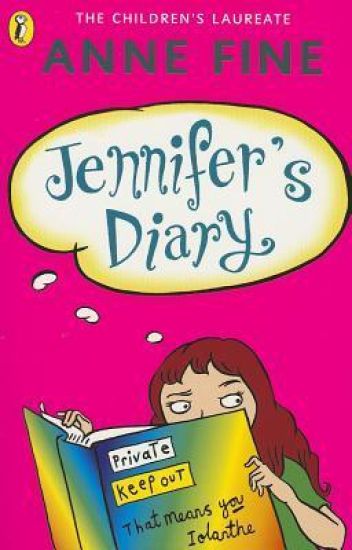
Jennifer's Diary

Jennifer's Diary

Anne Fine

Puffin
1997
pokkari
Jennifer has a diary and Iolanthe doesn't. But Iolanthe does have a vivid imagination and a gift for writing stories. When she sees empty pages in Jennifer's diary, she can't help herself - they're clearly waiting for tales much more exciting than her friend's records of shop visits and weather. Iolanthe is so taken with the diary that soon sharing it is not enough and, eventually, she finds something to swop with Jennifer for it - extra stories to be available to order whenever Jennifer needs them.