Kirjojen hintavertailu. Mukana 11 234 096 kirjaa ja 12 kauppaa.

Kirjahaku

Etsi kirjoja tekijän nimen, kirjan nimen tai ISBN:n perusteella.

1000 tulosta hakusanalla Jennifer Lackey

Criminal Testimonial Injustice

Criminal Testimonial Injustice

Jennifer Lackey

Oxford University Press
2023
sidottu
Through a detailed analysis that draws on work across philosophy, the law, and social psychology, Criminal Testimonial Injustice shows that, from the very beginning of the American criminal legal process in interrogation rooms to its final stages in front of parole boards, testimony is extracted from individuals through processes that are coercive, manipulative, or deceptive. This testimony is then unreasonably regarded as representing the testifiers' truest or most reliable selves. With chapters ranging from false confessions and eyewitness misidentifications to recantations from victims of sexual violence and expressions of remorse from innocent defendants at sentencing hearings, it is argued that there is a distinctive epistemic wrong being perpetrated against suspects, defendants, witnesses, and victims. This wrong involves brute State power targeting the epistemic agency of its citizens, extracting false testimony that is often life-shattering, and rendering the victims in question complicit in their own undoing. It is concluded that it is only through understanding what it means to respect the epistemic agency of each participant in the criminal legal system that we can truly grasp what justice demands and, in so doing, to reimagine what is possible.
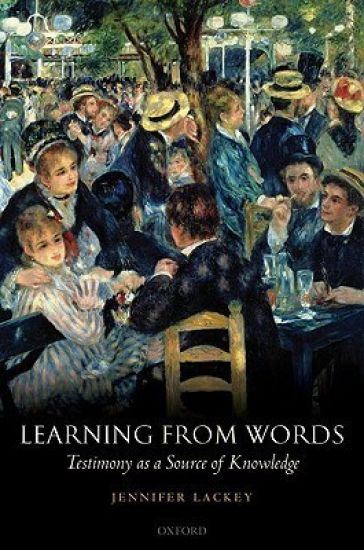
Learning from Words

Learning from Words

Jennifer Lackey

Oxford University Press
2008
sidottu
Testimony is an invaluable source of knowledge. We rely on the reports of those around us for everything from the ingredients in our food and medicine to the identity of our family members. Recent years have seen an explosion of interest in the epistemology of testimony. Despite the multitude of views offered, a single thesis is nearly universally accepted: testimonial knowledge is acquired through the process of transmission from speaker to hearer. In this book, Jennifer Lackey shows that this thesis is false and, hence, that the literature on testimony has been shaped at its core by a view that is fundamentally misguided. She then defends a detailed alternative to this conception of testimony: whereas the views currently dominant focus on the epistemic status of what speakers believe, Lackey advances a theory that instead centers on what speakers say. The upshot is that, strictly speaking, we do not learn from one another's beliefs - we learn from one another's words. Once this shift in focus is in place, Lackey goes on to argue that, though positive reasons are necessary for testimonial knowledge, testimony itself is an irreducible epistemic source. This leads to the development of a theory that gives proper credence to testimony's epistemologically dual nature: both the speaker and the hearer must make a positive epistemic contribution to testimonial knowledge. The resulting view not only reveals that testimony has the capacity to generate knowledge, but it also gives appropriate weight to our nature as both socially indebted and individually rational creatures. The approach found in this book will, then, represent a radical departure from the views currently dominating the epistemology of testimony, and thus is intended to reshape our understanding of the deep and ubiquitous reliance we have on the testimony of those around us.
Learning from Words

Learning from Words

Jennifer Lackey

Oxford University Press
2010
nidottu
Testimony is an invaluable source of knowledge. We rely on the reports of those around us for everything from the ingredients in our food and medicine to the identity of our family members. Recent years have seen an explosion of interest in the epistemology of testimony. Despite the multitude of views offered, a single thesis is nearly universally accepted: testimonial knowledge is acquired through the process of transmission from speaker to hearer. In this book, Jennifer Lackey shows that this thesis is false and, hence, that the literature on testimony has been shaped at its core by a view that is fundamentally misguided. She then defends a detailed alternative to this conception of testimony: whereas the views currently dominant focus on the epistemic status of what speakers believe, Lackey advances a theory that instead centers on what speakers say. The upshot is that, strictly speaking, we do not learn from one another's beliefs - we learn from one another's words. Once this shift in focus is in place, Lackey goes on to argue that, though positive reasons are necessary for testimonial knowledge, testimony itself is an irreducible epistemic source. This leads to the development of a theory that gives proper credence to testimony's epistemologically dual nature: both the speaker and the hearer must make a positive epistemic contribution to testimonial knowledge. The resulting view not only reveals that testimony has the capacity to generate knowledge, but it also gives appropriate weight to our nature as both socially indebted and individually rational creatures. The approach found in this book will, then, represent a radical departure from the views currently dominating the epistemology of testimony, and thus is intended to reshape our understanding of the deep and ubiquitous reliance we have on the testimony of those around us.
The Epistemology of Groups

The Epistemology of Groups

Jennifer Lackey

Oxford University Press
2020
sidottu
Groups are often said to bear responsibility for their actions, many of which have enormous moral, legal, and social significance. When children were separated from their parents or guardians at the U.S.-Mexico border as part of America's immigration policy, for example, the Trump Administration was said to be responsible for the harms these families suffered as a result. But are groups subject to normative assessment simply in virtue of their individual members being so, or are they somehow agents in their own right? Answering this question depends on understanding key concepts in the epistemology of groups, as we cannot hold the Trump Administration responsible without first determining what it believed, knew, and said. Deflationary theorists hold that group phenomena can be understood entirely in terms of individual members and their states. Inflationary theorists maintain that group phenomena are importantly over and above, or otherwise distinct from, individual members and their states. In The Epistemology of Groups Jennifer Lackey argues that neither approach is satisfactory. Groups are more than their members, but not because they have 'minds of their own,' as the inflationists hold. Instead, she shows how group phenomena--like belief, justification, and knowledge--depend on what the individual group members do or are capable of doing while being subject to group-level normative requirements. This framework allows for the correct distribution of responsibility across groups and their individual members.
Jacques Cartier

Jacques Cartier

Jennifer Lackey

Crabtree Publishing Co,Canada
2006
nidottu
In 1534, Jacques Cartier departed from St. Malo, France, on a mission to discover the Northwest Passage. While he did not find this elusive sea route, Cartier’s expeditions set up a new era for French colonization in the New World, particularly in the region along the St. Lawrence River. This exciting new book covers Cartier’s three voyages, including his attempts to build colonies, and his interactions with the Native peoples who lived in the regions he explored.
Jennifer

Jennifer

Elizabeth Moreton

Createspace Independent Publishing Platform
2018
nidottu
Jennifer Ryder had been engaged to James Cotts and they had been very happy.James had been an officer in the police force and the Special Forces unit and as far as Jennifer knew he had been well liked and respected.Things had been going well until James was asked to go to work in America. It seemed to Jennifer to be a hasty decision. He started his tour of duty in America and their relationship deteriorated. It was only because of Jennifer's persistence in trying to keep the relationship alive that eventually, all was made clear.The months that followed were hazardous, not just for James but for all his colleagues and friends too. They were all in terrible danger until after a great deal of hard work and sheer determination, James and his team brought the culprits to justice. However, success came at a price.
Jennifer Johnson Is Sick of Being Single

Jennifer Johnson Is Sick of Being Single

Heather McElhatton

William Morrow Paperbacks
2009
nidottu
Body conscious, cubicle-working, and love lorn in the Minneapolis suburbs, Jennifer Johnson is your average American woman. So it's totally understandable when she freaks out after learning her ex-boyfriend is getting married, as is her younger sister, Hailey. To add insult to injury, this means she'll have to wear an Asian-inspried kimono bridesmaid dress, which shows every curve and dimple plus more. Approaching thirty, single, and still unsatisfied with her career as a copywriter for the family-owned Keller's department store, like any woman would, Jen begins to obsess about finding a boyfriend, losing weight, and perhaps chasing her dream job. When Brad Keller, heir to the Keller's business, comes into the picture, it looks like Jen's luck just might be changing. But, as often is the case, in reality, things are never quite as glossy beneath the surface and life's decisions aren't always about following your dream. We're with Jen every step of the way from her daily struggle to eat or not eat a Cinnabon to her decision to ruin the kimono with Drano, and finally, to her chance to define her 'happiness'.
Jennifer Johnson Is Sick of Being Married

Jennifer Johnson Is Sick of Being Married

Heather McElhatton

William Morrow Paperbacks
2012
nidottu
Jennifer Johnson is your average American woman who just so happened to marry the handsome wealthy son of a Midwest department store magnate. Not too long ago she was stuck in a cubicle, love-lorn and addicted to Cinnabon frosting, now she has her Prince Charming and all she could have dreamed of. But as the wedding bells fade, Jennifer quickly learns that the grass on this too-manicured other side is not as green as she thought. After a honeymoon from hell at a gated Christian Resort in the Virgin Islands - bought and paid for by the in-laws and complete with alcohol-free drinks, curfews and joy-ga (satan-free yoga) - Jennifer finds herself in all too bizarre new life. Soon she's organizing Valentine's Day Abstinence dances with her mother-in-law's church committee, sewing size 4 tags into all of her clothing because she can't possibly reveal the truth to her husband, and dining with a Trophy Wives club with their own theories about how to hold on the their men. There must be more to life than this? "Jennifer Johnson is Sick of Being Married" is a laugh-out-loud, no-holds barred lesson about the "good life" and how getting what you want most might just be the worst thing for you.
Jennifer's Diary

Jennifer's Diary

Anne Fine

Puffin
1997
pokkari
Jennifer has a diary and Iolanthe doesn't. But Iolanthe does have a vivid imagination and a gift for writing stories. When she sees empty pages in Jennifer's diary, she can't help herself - they're clearly waiting for tales much more exciting than her friend's records of shop visits and weather. Iolanthe is so taken with the diary that soon sharing it is not enough and, eventually, she finds something to swop with Jennifer for it - extra stories to be available to order whenever Jennifer needs them.