

Kirjahaku
Etsi kirjoja tekijän nimen, kirjan nimen tai ISBN:n perusteella.
496 tulosta hakusanalla Jerald G Graeme
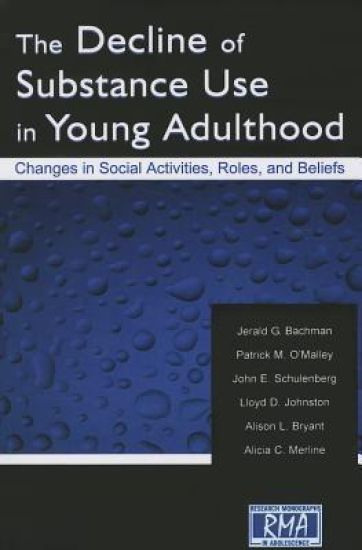
The Decline of Substance Use in Young Adulthood
Jerald G. Bachman; Patrick M. O'Malley; John E. Schulenberg; Lloyd D. Johnston; Alison L. Bryant; Alicia C. Merline
Psychology Press Ltd
2013
nidottu
This book is intended as a thoughtful extension to Bachman et al.'s well-received monograph Smoking, Drinking, and Drug Use in Young Adulthood. That volume showed that the new freedoms of young adulthood lead to increases in substance use, while the responsibilities of adulthood--marriage, pregnancy, parenthood--contribute to declines in substance use. The Decline of Substance Use in Young Adulthood examines how the changes in social and religious experiences and in attitudes toward substance use observed among young adults are related to changes in substance use, family transitions, living arrangements, college experience, and employment. The research uses a variety of analysis techniques and is based on the nationwide Monitoring the Future surveys of more than 38,000 young people followed from high school into adulthood. The research covers the last quarter of the 20th century, a period when drug use and views about drugs underwent many important changes. In spite of these shifts, the overall patterns of relationships reported in this book are impressive in their consistency across time and in their general similarity for men and women.Specific questions addressed include the following: *As young adults experience new freedoms and responsibilities, do their attitudes about drugs change? *Do their religious views and behaviors shift? *Do their new freedoms and responsibilities affect the amount of time they spend in social activities, including going to parties and bars? *And how are any of these changes linked to changes in cigarette use, alcohol use, marijuana use, and cocaine use?
Smoking, Drinking, and Drug Use in Young Adulthood
Jerald G. Bachman; Katherine N. Wadsworth; Patrick M. O'Malley; Lloyd D. Johnston; John E. Schulenberg
Psychology Press
1997
sidottu
Why do some young adults substantially change their patterns of smoking, drinking, or illicit drug use after graduating from high school? In this book, the authors show that leaving high school and leaving home create new freedoms that are linked to increases in the use of cigarettes, alcohol, marijuana, and cocaine. They also show that marriage, pregnancy, and parenthood create new responsibilities that are linked to decreases in drug use. The research is based on more than 33,000 young people followed from high school through young adulthood by the nationwide Monitoring the Future project. Every two years, participants reported on their drug use, as well as their schooling, employment, military service, living arrangements, marriages, pregnancies, parenthood, and even their divorces. The unique qualities of this research--large nationally representative samples, follow-ups extending up to 14 years beyond high school, and multiple approaches to analysis and data presentation--allowed the examination of several important influences simultaneously, while retaining much of the rich detail encountered in the real world. On the whole, the results are encouraging, suggesting that the potentials for change and improvement during the transition to adulthood are as important as the detrimental effects of problem behavior in adolescence. This research is a "must" read for anyone concerned with how new freedoms and responsibilities impact adolescents, young adults, and the use of licit and illicit drugs.
Smoking, Drinking, and Drug Use in Young Adulthood
Jerald G. Bachman; Katherine N. Wadsworth; Patrick M. O'Malley; Lloyd D. Johnston; John E. Schulenberg
Psychology Press
1997
nidottu
Why do some young adults substantially change their patterns of smoking, drinking, or illicit drug use after graduating from high school? In this book, the authors show that leaving high school and leaving home create new freedoms that are linked to increases in the use of cigarettes, alcohol, marijuana, and cocaine. They also show that marriage, pregnancy, and parenthood create new responsibilities that are linked to decreases in drug use. The research is based on more than 33,000 young people followed from high school through young adulthood by the nationwide Monitoring the Future project. Every two years, participants reported on their drug use, as well as their schooling, employment, military service, living arrangements, marriages, pregnancies, parenthood, and even their divorces. The unique qualities of this research--large nationally representative samples, follow-ups extending up to 14 years beyond high school, and multiple approaches to analysis and data presentation--allowed the examination of several important influences simultaneously, while retaining much of the rich detail encountered in the real world. On the whole, the results are encouraging, suggesting that the potentials for change and improvement during the transition to adulthood are as important as the detrimental effects of problem behavior in adolescence. This research is a "must" read for anyone concerned with how new freedoms and responsibilities impact adolescents, young adults, and the use of licit and illicit drugs.
The Decline of Substance Use in Young Adulthood
Jerald G. Bachman; Patrick M. O'Malley; John E. Schulenberg; Lloyd D. Johnston; Alison L. Bryant; Alicia C. Merline
Psychology Press
2001
sidottu
This book is intended as a thoughtful extension to Bachman et al.'s well-received monograph Smoking, Drinking, and Drug Use in Young Adulthood. That volume showed that the new freedoms of young adulthood lead to increases in substance use, while the responsibilities of adulthood--marriage, pregnancy, parenthood--contribute to declines in substance use. The Decline of Substance Use in Young Adulthood examines how the changes in social and religious experiences and in attitudes toward substance use observed among young adults are related to changes in substance use, family transitions, living arrangements, college experience, and employment. The research uses a variety of analysis techniques and is based on the nationwide Monitoring the Future surveys of more than 38,000 young people followed from high school into adulthood. The research covers the last quarter of the 20th century, a period when drug use and views about drugs underwent many important changes. In spite of these shifts, the overall patterns of relationships reported in this book are impressive in their consistency across time and in their general similarity for men and women.Specific questions addressed include the following: *As young adults experience new freedoms and responsibilities, do their attitudes about drugs change? *Do their religious views and behaviors shift? *Do their new freedoms and responsibilities affect the amount of time they spend in social activities, including going to parties and bars? *And how are any of these changes linked to changes in cigarette use, alcohol use, marijuana use, and cocaine use?
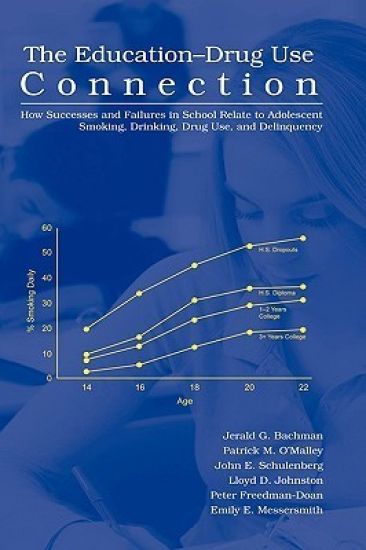
The Education-Drug Use Connection
Jerald G. Bachman; Patrick M. O'Malley; John E. Schulenberg; Lloyd D. Johnston; Peter Freedman-Doan; Emily E. Messersmith
Psychology Press
2007
sidottu
Does success in school protect teenagers from drug use? Does drug use impair scholastic success? This book tackles a key issue in adolescent development and health - the education-drug use connection. The authors examine the links and likely causal connections between educational experiences, delinquent behavior, and adolescent use of tobacco, alcohol, marijuana, and cocaine.The book uses data from the University of Michigan's Monitoring the Future project. It focuses on a large and nationally representative sample of 8th grade students in the United States who were initially surveyed in 1991-1993 and then followed over the vitally important developmental period between ages 14 and 22. The volume uses a variety of statistical analysis techniques, and the findings can be understood by individuals with limited, as well as with extensive, backgrounds in research design. The findings convincingly demonstrate that if young people can be successful in school, it can improve a broad range of outcomes in their lives, not the least of which is their ability to resist pressures to use drugs. The book provides: a summary of the findings and conclusions; a review of relevant literature; a detailed discussion of the survey and analysis methods; the academic attainment of those in the longitudinal panel; the delinquent behaviors of panel members as they relate to measures of educational success; and the patterns of initiation, continuation, and cessation for each substance: cigarettes, marijuana, cocaine, and alcohol.This book is intended for anyone who deals with education and/or substance use, including educational, developmental, and social psychologists; sociologists; epidemiologists; educators; and policy makers. The analysis of panel survey data, using a variety of techniques, will also appeal to survey methodologists and students.
The Education-Drug Use Connection
Jerald G. Bachman; Patrick M. O'Malley; John E. Schulenberg; Lloyd D. Johnston; Peter Freedman-Doan; Emily E. Messersmith
Psychology Press
2007
nidottu
Does success in school protect teenagers from drug use? Does drug use impair scholastic success? This book tackles a key issue in adolescent development and health - the education-drug use connection. The authors examine the links and likely causal connections between educational experiences, delinquent behavior, and adolescent use of tobacco, alcohol, marijuana, and cocaine.The book uses data from the University of Michigan's Monitoring the Future project. It focuses on a large and nationally representative sample of 8th grade students in the United States who were initially surveyed in 1991-1993 and then followed over the vitally important developmental period between ages 14 and 22. The volume uses a variety of statistical analysis techniques, and the findings can be understood by individuals with limited, as well as with extensive, backgrounds in research design. The findings convincingly demonstrate that if young people can be successful in school, it can improve a broad range of outcomes in their lives, not the least of which is their ability to resist pressures to use drugs. The book provides: a summary of the findings and conclusions; a review of relevant literature; a detailed discussion of the survey and analysis methods; the academic attainment of those in the longitudinal panel; the delinquent behaviors of panel members as they relate to measures of educational success; and the patterns of initiation, continuation, and cessation for each substance: cigarettes, marijuana, cocaine, and alcohol.This book is intended for anyone who deals with education and/or substance use, including educational, developmental, and social psychologists; sociologists; epidemiologists; educators; and policy makers. The analysis of panel survey data, using a variety of techniques, will also appeal to survey methodologists and students.
The American Southeast at the End of the Ice Age
David G. Anderson; Derek T. Anderson; Katherine McMillan Barry; Kara Bridgman Sweeney; Samuel O. Brookes; Adam M. Burke; Stephen B. Carmody; Philip J. Carr; William A. Childress; I. Randolph Daniel; Ryan Duggins; Grayal E. Farr; Michael K. Faught; Brendan Fenerty; Jay D. Franklin; Lauren M. Franklin; J. Christopher Gillam; Joseph A. M. Gingerich; Jessi J. Halligan; Kandace D. Hollenbach; Vance T. Holliday; Thomas A. Jennings; K. C. Jones; Shawn A. Joy; Jerald Ledbetter; Greg J. Maggard; Steven M. Meredith; D. Shane Miller
THE UNIVERSITY OF ALABAMA PRESS
2022
sidottu
The definitive book on what is known about the Late Pleistocene and Early Holocene archaeological record in the Southeast The 1996 benchmark volume The Paleoindian and Early Archaic Southeast, edited by David G. Anderson and Kenneth E. Sassaman, was the first study to summarize what was known of the peoples who lived in the Southeast when ice sheets covered the northern part of the continent and mammals such as mammoths, saber-toothed cats, and ground sloths roamed the landscape.The American Southeast at the End of the Ice Age provides an updated, definitive synthesis of current archaeological research gleaned from an array of experts in the region. It is organized in three parts: state records, the regional perspective, and reflections and future directions. Chapters survey a diversity of topics including the distribution of the earliest archaeological sites in the region, chipped-stone tool technology, the expanding role of submerged archaeology, hunter-gatherer lifeways, past climate changes and the extinction of megafauna on the transitional landscape, and evidence of demographic changes at the end of the Ice Age. Discussion of the ethical responsibilities regarding the use of private collections and the relationship of archaeologists and the avocational community, insight from outside the Southeast, and considerations for future research round out the volume.
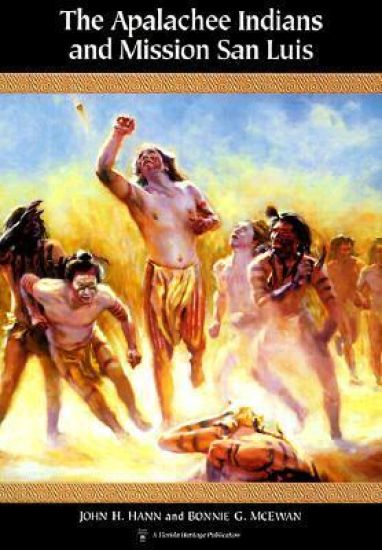
The Apalachee Indians and Mission San Luis
John H. Hann; Bonnie G. McEwan; Jerald T. Milanich
University Press of Florida
1998
nidottu
This text offers a combination of archaeology and history to tell the story of the Apalachee Indians of northwest Florida and their Spanish conquerors. The book portrays the dwellings, daily life, religious practices, social structures and recreation activities of the mission.
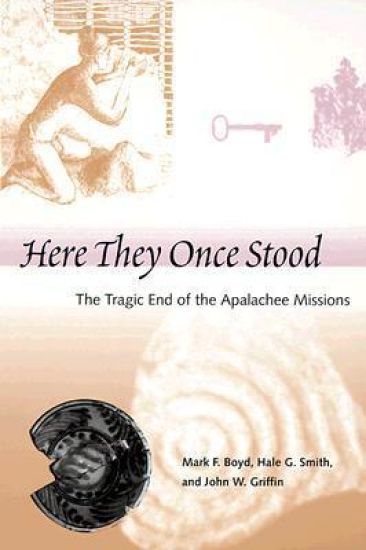
Here They Once Stood
Mark F. Boyd; Hale G. Smith; John W. Griffin; Jerald T. Milanich
University Press of Florida
1999
nidottu
A presentation of first-hand accounts describing the horrific fate of the Apalachee missions in 17th-century Florida. It also offers archaeological reports documenting the missions and the lives of the native peoples who lived and died as Christians under Spanish rule.
Archaeology of the Mid-Holocene Southeast
Kenneth E. Sassaman; Jerald T. Milanich; David G Anderson
University Press of Florida
1996
nidottu
From the foreword: "With this important volume, the editors serve notice that old characterizations of the cultures of the Archaic period have been buried under the back dirt of new excavations and new interpretations. . . . It places the Archaic cultures squarely at the forefront of archaeological theory."This volume summarizes our archaeological knowledge of natives who inhabited the American Southeast from 8,000 to 3,000 years ago and examines evidence of many of the native cultural expressions observed by early European explorers, including long-distance exchange, plant domestication, mound building, social ranking, and warfare. ContentsSection I. Mid-Holocene Environments1. Geoarchaeology and the Mid-Holocene Landscape History of the Greater Southeast, by Joseph Schuldenrein2. Mid-Holocene Forest History of Florida and the Coastal Plain of Georgia and South Carolina, by William A. Watts, Eric C. Grimm, and T. C. HusseySection II. Technology3. Changing Strategies of Lithic Technological Organization, by Daniel S. Amick and Philip J. Carr4. Technological Innovations in Economic and Social Contexts, by Kenneth E. Sassaman5. Middle and Late Archaic Architecture, by Kenneth E. Sassaman and R. Jerald LedbetterSection III. Subsistence and Health6. The Paleoethnobotanical Record for the Mid-Holocene Southeast, by Kristen J. Gremillion7. Mid-Holocene Faunal Exploitation in the Southeastern United States, by Bonnie W. Styles and Walter E. Klippel8. Biocultural Inquiry into Archaic Period Populations of the Southeast: Trauma and Occupational Stress, by Maria O. SmithSection IV. Regional Settlement Variation9. Approaches to Modeling Regional Settlement in the Archaic Period Southeast, by David G. Anderson10. Southeastern Mid-Holocene Coastal Settlements, by Michael Russo11. Accounting for Submerged Mid-Holocene Archaeological Sites in the Southeast: A Case Study from the Chesapeake Bay Estuary, Virginia, by Dennis B. BlantonSection V. Regional Integration and Organization12. The Emergence of Long-Distance Exchange Networks in the Southeastern United States, by Richard W. Jefferies13. A Consideration of the Social Organization of the Shell Mound Archaic, by Cheryl P. Claassen14. Southeastern Archaic Mounds, by Michael Russo15. Poverty Point and Greater Southeastern Prehistory: The Culture That Did Not Fit, by Jon L. GibsonKenneth E. Sassaman is archaeologist with the Savannah River Archaeological Research Program, South Carolina Institute of Archaeology and Anthropology, and instructor in the Department of History and Anthropology at Augusta College, Augusta, Georgia. He is the author of Early Pottery in the Southeast: Tradition and Innovation in Cooking Technology. David G. Anderson is archaeologist with the Southeast Archaeological Center, National Park Service, Tallahassee, Florida. He is the author of The Savannah River Chiefdoms: Political Change in the Late Prehistoric Southeast. They are coeditors of The Paleoindian and Early Archaic Southeast.
Reducing Attrition in Selected Air Force Training Pipelines
Thomas Manacapilli; Carl F. Matthies; Louis W. Miller; Paul Howe; P.J. Perez; Chaitra M. Hardison; Hugh G. Massey; Jerald Greenberg; Christopher Beighley; Carra S. Sims
RAND
2012
pokkari

Jerald's Little Black Book: The Perfect Dating Companion for a Handsome Man Named Jerald. A secret place for names, phone numbers, and addresses.
Wingman Publishing
Independently Published
2019
nidottu
Keep a record of all the girls that catch your eye

The Untold Love: Jerald Brooks
Jerald R. Brooks
Createspace Independent Publishing Platform
2011
nidottu

"Jerard the Chair" is a series about two funny characters Jerald and Jeff, who like to mess around and enjoy their life. Jerard is very low in IQ, as per his character he does lot of funny actions to make world laugh on him. Jeff buys all his actions and try to resolve mess created by his dude Jerard. All n all Jeff is indirect guardian of Jerald and protect him at every possible time. Both together never miss to enjoy each funny moment created by them. They are building up with their daily embarrassing moments without any regret. This book is a comedy with multiple hidden good messages. This book refresh the mind of readers to move on their next action with full energy.

Hurricane Jerald: A Story of Forgiveness, Healing, and Breaking Free "I spent years trapped in a storm I couldn't escape. But I found a way out-through forgiveness." Sterling's childhood was one marked by the unseen scars of abuse-a reality so ingrained that he didn't even recognize it as different from what others experienced. For years, pain was his constant companion, and his suffering seemed as normal as breathing. But at the age of 12, something changed. For the first time, Sterling realized that the world wasn't supposed to feel this way. His life wasn't meant to be a cycle of fear and turmoil. Hurricane Jerald is the gripping and raw autobiography of a man who survived unimaginable hardship and emerged with a message of hope. This is the true story of one boy's struggle to understand his worth, his fight to reclaim his identity, and his powerful journey toward letting go of the past. At its core, this book is about transformation. It's about the choice to stop being defined by pain and start living for the future. Sterling's journey is a testament to the strength of the human spirit, and how it's possible to find peace, not by forgetting the past, but by forgiving it. In Hurricane Jerald, Sterling opens his heart and his history, offering readers an intimate look at the emotional toll of abuse-and the incredible resilience it takes to heal. Through heart-wrenching honesty, he reveals the depths of his anger, the struggles with his own identity, and the long road toward forgiving those who wronged him. But this book is not just about the past. It's about what happens when you decide to break free from it. If you've ever felt trapped in your own pain, if you've ever wondered how to forgive those who hurt you, or if you simply need a reminder that healing is possible-Hurricane Jerald will inspire you to find the courage to let go. Sterling's story is a beacon for anyone who has ever thought, "Can I truly heal? Can I really forgive?" Sterling's courage to share his painful story shows that healing isn't just a dream-it's a choice. And once that choice is made, freedom can follow. The power of forgiveness lies not in excusing the past, but in reclaiming your own future. Sterling's life proves that no matter how broken you feel, healing is possible. Through his story, you'll discover that when you choose to forgive-when you finally let go of the weight that holds you down-you can find peace, joy, and a new beginning.

*** Finalist for the PEN/Diamonstein-Spielvogel Award for the Art of the Essay****In this engaging follow up to How to Make a Slave and Other Essays, the recipient of PEN New England Award for nonfiction and finalist for the National Book Award sharply examines and explains Black life and culture with equal parts candor and humor.In Magically Black and Other Essays Jerald Walker elegantly blends personal revelation and cultural critique to create a bracing and often humorous examination of Black American life. He thoughtfully addresses the inherent complexities of topics as eclectic as incarceration, home renovations, gentrification, the crip walk, pimping, and the rise of the MAGA movement, approaching them through various Black perspectives, including husband, father, teacher, and writer. The collection’s overarching theme is captured in the titular essay, which examines the culture of heroic action African Americans created in response to their enslavement and oppression, giving proof to Albert Murray’s observation that the “fire in the forging process . . . for all its violence, does not destroy the metal that becomes the sword.”

*** Finalist for the PEN/Diamonstein-Spielvogel Award for the Art of the Essay****In this engaging follow up to How to Make a Slave and Other Essays, the recipient of PEN New England Award for nonfiction and finalist for the National Book Award sharply examines and explains Black life and culture with equal parts candor and humor.In Magically Black and Other Essays Jerald Walker elegantly blends personal revelation and cultural critique to create a bracing and often humorous examination of Black American life. He thoughtfully addresses the inherent complexities of topics as eclectic as incarceration, home renovations, gentrification, the crip walk, pimping, and the rise of the MAGA movement, approaching them through various Black perspectives, including husband, father, teacher, and writer. The collection’s overarching theme is captured in the titular essay, which examines the culture of heroic action African Americans created in response to their enslavement and oppression, giving proof to Albert Murray’s observation that the “fire in the forging process . . . for all its violence, does not destroy the metal that becomes the sword.”

Publisher's Note: Products purchased from Third Party sellers are not guaranteed by the publisher for quality, authenticity, or access to any online entitlements included with the product.

A broad, all-encompassing look at the chef as a manager, examining the roles of leadership, management, training, and supervision. The World of Culinary Management: Leadership and Development of Human Resources, 6/e, one of the only texts designed for human resource management from a culinary perspective, gives aspiring chefs the foundational knowledge and skills required to lead, supervise, and manage food service workers. It outlines in clear terms those elements crucial to success in today's quality-driven foodservice industry, with in-depth exploration of the roles and responsibilities of a successful food service manager. The text examines all aspects of training, providing practical discussions on essential management skills and functions. The new edition incorporates new time-sensitive information about issues such as the Affordable Care Act issues of diversity, and addresses women culinary industry leaders.