Kirjojen hintavertailu. Mukana 12 390 323 kirjaa ja 12 kauppaa.

Kirjahaku

Etsi kirjoja tekijän nimen, kirjan nimen tai ISBN:n perusteella.

1000 tulosta hakusanalla Jeremy Carpendale; Charlie Lewis

What Makes Us Human: How Minds Develop through Social Interactions
"How do you go from a bunch of cells to something that can think?" This question, asked by the 9-year-old son of one of the authors, speaks to a puzzle that lies at the heart of this book. How are we as humans able to explore such questions about our own origins, the workings of our mind, and more? In this fascinating volume, developmental psychologists Jeremy Carpendale and Charlie Lewis delve into how such human capacities for reflection and self-awareness pinpoint a crucial facet of human intelligence that sets us apart from closely related species and artificial intelligence.Richly illustrated with examples, including questions and anecdotes from their own children, they bring theories and research on children’s development alive. The accessible prose shepherds readers through scientific and philosophical debates, translating complex theories and concepts for psychologists and non-psychologists alike. What Makes Us Human is a compelling introduction to current debates about the processes through which minds are constructed within relationships. Challenging claims that aspects of thinking are inborn, Jeremy Carpendale and Charlie Lewis provide a relationally grounded way of understanding human development by showing how the uniquely human capacities of language, thinking, and morality develop in children through social processes. They explain the emergence of communication within the rich network of relationships in which babies develop. Language is an extension of this earlier communication, gradually also becoming a tool for thinking that can be applied to understanding others and morality. Learning more about the development of what is right in front of us, such as babies’ actions developing into communicative gestures, leads to both greater appreciation of the children in our lives and a grasp of what makes us human.This book will be of interest to anyone curious about the nature of language, thinking, and morality, including students, parents, teachers, and professionals working with children.
What Makes Us Human: How Minds Develop through Social Interactions
"How do you go from a bunch of cells to something that can think?" This question, asked by the 9-year-old son of one of the authors, speaks to a puzzle that lies at the heart of this book. How are we as humans able to explore such questions about our own origins, the workings of our mind, and more? In this fascinating volume, developmental psychologists Jeremy Carpendale and Charlie Lewis delve into how such human capacities for reflection and self-awareness pinpoint a crucial facet of human intelligence that sets us apart from closely related species and artificial intelligence.Richly illustrated with examples, including questions and anecdotes from their own children, they bring theories and research on children’s development alive. The accessible prose shepherds readers through scientific and philosophical debates, translating complex theories and concepts for psychologists and non-psychologists alike. What Makes Us Human is a compelling introduction to current debates about the processes through which minds are constructed within relationships. Challenging claims that aspects of thinking are inborn, Jeremy Carpendale and Charlie Lewis provide a relationally grounded way of understanding human development by showing how the uniquely human capacities of language, thinking, and morality develop in children through social processes. They explain the emergence of communication within the rich network of relationships in which babies develop. Language is an extension of this earlier communication, gradually also becoming a tool for thinking that can be applied to understanding others and morality. Learning more about the development of what is right in front of us, such as babies’ actions developing into communicative gestures, leads to both greater appreciation of the children in our lives and a grasp of what makes us human.This book will be of interest to anyone curious about the nature of language, thinking, and morality, including students, parents, teachers, and professionals working with children.
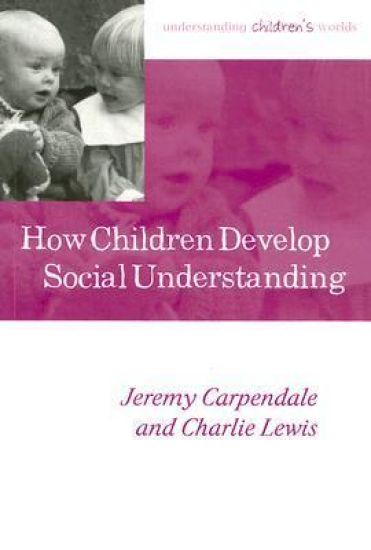
How Children Develop Social Understanding

How Children Develop Social Understanding

Jeremy Carpendale; Charlie Lewis

Wiley-Blackwell (an imprint of John Wiley Sons Ltd)
2006
sidottu
This book provides a critical review of research into how children come to understand the social world, an area often known as children's "theories of mind". Takes an integrated approach to the development of children's social understandingBrings out the connections between mental state understanding and children's understanding of language, social skills, morality and emotions. Sets research within a historical and theoretical contextContributes unique insights and perspectives, particularly in its discussions of Piaget and Vygotsky, and in its Wittgensteinian focus on the role of language.
How Children Develop Social Understanding

How Children Develop Social Understanding

Jeremy Carpendale; Charlie Lewis

Wiley-Blackwell (an imprint of John Wiley Sons Ltd)
2006
nidottu
This book provides a critical review of research into how children come to understand the social world, an area often known as children's "theories of mind". Takes an integrated approach to the development of children's social understandingBrings out the connections between mental state understanding and children's understanding of language, social skills, morality and emotions. Sets research within a historical and theoretical contextContributes unique insights and perspectives, particularly in its discussions of Piaget and Vygotsky, and in its Wittgensteinian focus on the role of language.
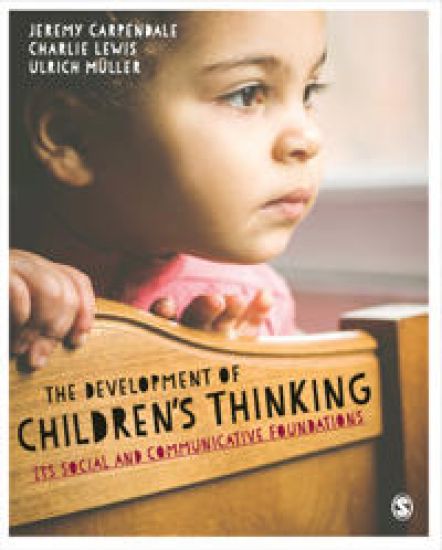
The Development of Children’s Thinking

The Development of Children’s Thinking

Jeremy Carpendale; Ulrich Muller; Charlie Lewis

SAGE Publications Ltd
2017
sidottu
The Development of Children’s Thinking offers undergraduate and graduate students in psychology and other disciplines an introduction to several core areas of developmental psychology. It examines recent empirical research within the context of longstanding theoretical debates. In particular, it shows how a grasp of classic theories within developmental psychology is vital for a grasp of new areas of research such as cognitive neuroscience that have impacted on our understanding of how children develop. The focus of this book will be on infancy and childhood, and it looks at: Theories and context of development How developmental psychology attempts to reconcile influences of nature and nurture Communication in infancy as a precursor to later thinking Language development in primates and young children Cognitive and social development, including the child’s understanding of the mind How studies of moral reasoning reflect upon our understanding of development
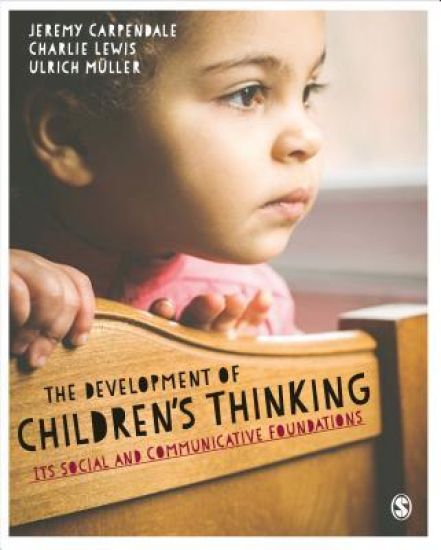
The Development of Children’s Thinking

The Development of Children’s Thinking

Jeremy Carpendale; Ulrich Muller; Charlie Lewis

SAGE Publications Ltd
2017
nidottu
The Development of Children’s Thinking offers undergraduate and graduate students in psychology and other disciplines an introduction to several core areas of developmental psychology. It examines recent empirical research within the context of longstanding theoretical debates. In particular, it shows how a grasp of classic theories within developmental psychology is vital for a grasp of new areas of research such as cognitive neuroscience that have impacted on our understanding of how children develop. The focus of this book will be on infancy and childhood, and it looks at: Theories and context of development How developmental psychology attempts to reconcile influences of nature and nurture Communication in infancy as a precursor to later thinking Language development in primates and young children Cognitive and social development, including the child’s understanding of the mind How studies of moral reasoning reflect upon our understanding of development
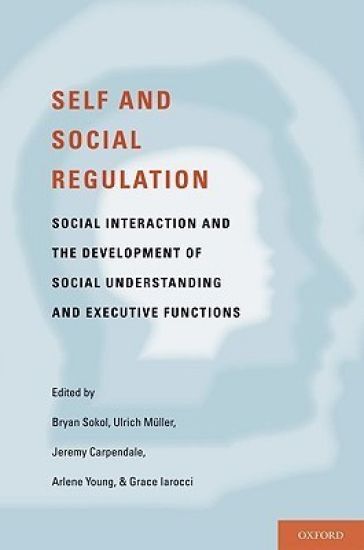
Self- and Social-Regulation

Self- and Social-Regulation

Bryan Sokol; Ulrich Muller; Jeremy Carpendale; Arlene Young; Grace Iarocci

Oxford University Press Inc
2010
sidottu
New research on children's executive functioning and self-regulation has begun to reveal important connections to their developing social understanding (or "theories of mind") and emotional competence. The exact nature of the relations between these aspects of children's social and emotional development is, however, far from being fully understood. Considerable disagreement has emerged, for instance, over the question of whether executive functioning facilitates social-emotional understanding, or vice versa. Recent studies linking the development of children's social understanding with aspects of their interpersonal relationships also raise concerns about the particular role that social interaction plays in the development of executive function. Three key questions currently drive this debate: Does social interaction play a role in the development of executive function or, more generally, self-regulation? If it does play a role, what forms of social interaction facilitate the development of executive function? Do different patterns of interpersonal experience differentially affect the development of self-regulation and social understanding? In this book, the contributors address these questions and explore other emerging theoretical and empirical links between self-regulation, social interaction, and children's psycho-social competence. It will be a valuable resource for student and professional researchers interested in executive function, emotion, and social development.
Jeremy

Jeremy

Paul G Roberts; Charlie O'Brien

DESIRE GROUPE
2022
sidottu
JEREMY SCOTTOver the last twenty years, American designer Jeremy Scott shocked and awed fashion critics and lovers alike with his bright colours, comical prints and frequent shows of outrageous designs. Constantly pushing the boundaries in fashion, Scott's mark on the fashion landscape led to a breakdown in consumer barriers by blurring the lines between high and low culture. He endured a rough childhood, so he grew up strong. Many of his job applications were rejected, so he became his own boss. He has listened to criticisms of his works, but continues to create fashion people can enjoy. Withstanding tireless adversity, the designer has never let anything stand in the way of his passion and creativity.An audience of drag queens, club scene members and fashion cognoscenti gather at Scott's fashion shows. These eccentrics form the core of Scott's plight to break free of the bindings the fashion industry tries to wrap around him. He is a true renegade: someone with unconventional ideas and methods, resisting the norm through all means.AUTHOR CHARLIE O'BRIENA culture enthusiast with a deeply-held passion for the written word, Charlie O'Brien graduated from Griffith University with a Bachelors in Communication and the dedication to become a professional writer. Charlie worked in high fashion for over six years with esteemed international brands Ralph Lauren and Hugo Boss, making him the perfect fit for the fast-paced world of couture literature. He prefers the substance of timeless style over fleeting fashion trends and firmly believes all men look better in suits.When not writing about fashion Charlie can be found indulging his love of cinema, music and an eternal quest to find the greatest sandwich in the world. His most recent masterpiece involved beef cheeks, Swiss cheese and pesto on toasted sourdough.