

Kirjahaku
Etsi kirjoja tekijän nimen, kirjan nimen tai ISBN:n perusteella.
1000 tulosta hakusanalla Jerold Axelrod Architect


Jerold's Little Black Book: The Perfect Dating Companion for a Handsome Man Named Jerold. A secret place for names, phone numbers, and addresses.
Wingman Publishing
Independently Published
2019
nidottu
Keep a record of all the girls that catch your eye

Designing Organizations to Create Value: From Strategy to Structure
Jerold Zimmerman; James Brickley; Clifford Smith; Janice Willett
McGraw-Hill Professional
2002
sidottu
This book contains a three-pronged strategy for boosting organizational performance - and shareholder value. As a business leader in today's increasingly competitive global race, you need more than fads and buzzwords. You need a focused, cross-functional organizational design, one that will foster intercompany communication and help you identify and resolve minor issues before they become major barriers to success."Designing Organizations to Create Value" draws on recent research as well as the authors' hands-on experience to outline an integrated framework for coordinating the three critical aspects of organizational architecture: assignment of decision-making authority; development of effective performance evaluation systems; and creation of a logical and motivating compensation structure; executives and senior-level decision makers must focus on the entirety of their organizations - as opposed to one particular facet such as strategy, quality, or logistics - to build an efficient and interconnected company.Let "Designing Organizations to Create Value" provide you with methods to systematically analyze all of your organizational issues and reconstruct your workforce into that of a balanced, functional, and battle-ready market leader. 'In today's environment, managers are under increasing pressure to address organizational issues and manage organizational change...The business literature to date has ...failed to provide managers with an integrated approach to identifying and solving organizational problems. Our book is designed to provide a systematic, comprehensive framework for analyzing organizational issues, one that can be consistently applied in addressing problems and structuring more effective organizations' - From the Preface.'Value creation' is more than just another buzz phrase; it is, in fact, the time-honored key to business success. "Designing Organizations to Create Value" is today's most top-to-bottom examination of the ever-elusive topic of value - how it is measured, how firms create and capture it, and how the drive for value impacts the strategy of the entire firm. Rather than focusing on one aspect or strategy, however, this comprehensive book details virtually every area that influences value creation, including: proven strategies for efficient deployment of knowledge throughout an organization; decentralization, and the necessity of implementing proper checks and balances.The essential and interwoven roles of institutional innovation, strategy, and dynamic leadership. By whatever name, in whatever era, value creation is a requisite for long-term organizational survival and success. "Designing Organizations to Create Value" combines decades of multidisciplinary research with case studies from market leaders such as General Electric, Honda, and Wal-Mart to illustrate the payoffs from effective organizational design - and provide a practical, sensible approach for creating value at every level and with every process of your organization.

Focuses on the elite nature of the profession, with its emphasis on serving business interests and its attempt to exclude participation by minorities.

Describes the disadvantages of litigation, looks at what the American legal system suggests about our society, and discusses arbitration, mediation, and conciliation, alternatives to our adversary approach to justice

This book is a comprehensive introductory manual that guides beginners to a functional reading knowledge of late medieval and early modern Yiddish (c.1100-1750). It is the first such manual to exist for that language, whose early literary tradition comprises a range of genres as broad as other contemporary European literary traditions. The guide is organized as a series of progressively more complex lessons, focused on key texts of the literary corpus, which are presented in their authentic form as found in manuscripts and early printed books. The lessons seek to accommodate readers ranging from absolute beginners to those who might already know Hebrew, medieval German, or modern Yiddish. The focal texts are the Old Yiddish midrashic heroic lay,'Joseph the Righteous', from the earliest extant manuscript collection of Yiddish literature (1382), the Middle Yiddish romance adventure tale, 'Briyo and Zimro', from a later collection (1585), and a full canto of the Middle Yiddish epic, Pariz and Viene (1594), each with full glosses and a step-by-step introduction to the morphology, syntax, and phonology. Each lesson also includes a brief supplemental text that cumulatively demonstrates the broad cultural range of the corpus. In addition, several appendices of supplementary material round out the volume, including a collection of additional readings, a table of the manuscript hands and printing fonts employed in the volume, and a full end-glossary of all Yiddish words found in the texts.

This volume is the first comprehensive anthology of early Yiddish literature (from its beginnings in the twelfth century to the dawn of modern Yiddish in the mid-eighteenth century) for more than one hundred years. It includes the broad range of genres that define the corpus: Arthurian romance, heroic epic, satire, lyric, drama, biblical/midrashic epic, devotional literature, biblical translations, glosses, medicine, magic, legal texts, oaths, letters, legends, autobiography, travelogue, fables, riddles, and adventure tales. One hundred and thirty texts in the original Hebrew alphabet, edited anew from the earliest extant sources, are provided with introductory headnotes that include detailed information concerning sources, author (if known), the research literature, and the place of the text in the literary tradition.
The minimum wage as a value of civic republicanism The minimum wage appears to be a standard economic regulatory measure, yet a politics of symbolism more than anything else defines the political contests that periodically erupt over it. Detractors abhor its corruption of market principles, while supporters see it as a measure of society's symbolic commitment to the poor. Tracing the history of the minimum wage and exposing its inherent contradictions as a political issue, Jerold Waltman proposes an alternative to the economic arguments that now dominate debates over it. Citing overwhelming public support for the minimum wage as evidence of an enduring civic consciousness and humanitarianism, Waltman advocates recasting the discussion in terms of a political economy of citizenship. Such a perspective would focus on the communal value of work, the need for citizens to have a stake in the community, and the effects of economic inequality on the bonds of common citizenship. Positioning the minimum wage as a fulcrum for the most basic conflict underlying America's unique combination of democracy and a market economy, The Politics of the Minimum Wage shows how a defense of the minimum wage built on a communal sense of responsibility rests on a strong tradition of civic republicanism and strengthens the hope for a truly democratic society.

While much early Yiddish literature belonged to pious genres, quasi-secular genres—epic, drama, and lyric—also developed. Jerold Frakes contends that the historical context of the emergence of Yiddish literature is an essential factor in any understanding of its cultural relevance in a time and place where Jewish life was defined by expulsions, massacres, and discriminatory legislation that profoundly altered European Judaism and shook the very foundations of traditional Jewish society.

Major League Baseball, alone among industries of its size in the United States, operates as an unregulated monopoly. This 20th-century regulatory anomaly has become known as the baseball anomaly. Major League Baseball developed into a major commercial enterprise without being subject to antitrust liability. Long after the interstate commercial character of baseball had been established and even recognized by the Supreme Court, baseball's monopoly remained free from federal regulation. Duquette explains the baseball anomaly by connecting baseball's regulatory status to the larger political environment, tracing the game's fate through four different regulatory regimes. The constellation of institutional, ideological, and political factors within each regulatory regime provides the context for the survival of the baseball anomaly.Duquette shows baseball's unregulated monopoly persists because of the confluence of institutional, ideological, and political factors which have prevented the repeal of baseball's antitrust exemption to date. However, both the institutional and ideological factors are fading fast. Baseball's owners can no longer claim special cultural significance in defense of their exemption. Nor can they credibly claim that the commissioner system approximates government regulation effectively. Both of these strategies have been discredited by the labor unrest of the 1980s and 1990s. Duquette provides a unique perspective on American regulatory politics, and by explaining a complicated story in comprehensive prose, he has given researchers, policy makers, and fans a fascinating look at the business of baseball.

Key Concepts in Psychotherapy Integration
Jerold R. Gold
Kluwer Academic/Plenum Publishers
1996
sidottu
Author Jerold Gold reviews the progress that has been made in the field of integrative psychotherapy. The author develops a unique narrative-based framework in which clinicians can synthesize different psychotherapies into an integrated conceptual system and technical method. An ongoing case example illustrates the framework and its key concepts. In addition, chapters examine the contributions of psychodynamic, humanistic, cognitive-behavioral, and integrative therapies to the development of important psychotherapeutic ideas.
Voluntarism, Planning, and the State
Jerold E. Brown; Patrick Reagan
Praeger Publishers Inc
1988
sidottu
Voluntarism, Planning, and the State presents a series of case studies of the planning process in the context of modern American history in the period between World War I and World War II. Each essay draws on the works of leading scholars in the field and attempts to make specific evaluations of broad generalizations about the planning experience in the United States. The studies examine such relevant topics as unemployment reform, labor relations, military peacetime planning, New Deal planning, and the postwar debate over price and wage controls.

This study considers the complex interplay of factors that shaped and formed the selection, retention, abandonment, and development of the system of flying fields and air bases for the U.S. Army Air Corps and its predecessor organizations over the three decades preceding WWII--a period that has been only cursorily examined from the point of view of ground facilities. No previous works have focused on the question of why air bases are located where they are.Author Jerold E. Brown has consulted an abundance of source materials to create the comprehensive eight-chapter volume: printed hearings, documents, and reports generated by Congress; maps, blueprints, staff studies, the correspondence of the Office of the Chief Signal Officer, and several hundred volumes of the Constructing Quartermaster Completion Reports in the National Archives; and unit histories and typescript field histories. Hundreds of articles on the construction and operation of airfields, many written by serving officers, as well as technical manuals, and correspondence of the Office of the Chief of Air Service and Chief of the Air Corps were only part of the data surveyed in preparing the fact-filled text. Eight period photos of airfields from Alaska to Texas, six maps, seven figures, and eight tables complement such chapters as Plans, Parade Grounds, and Politics and Air Bases, Plans, and Preparations. This history of the development of early airfields should help to correct previously held views and assumptions on the subject based on a lack of in-depth research in this area and will be a real treasure trove of information for scholars of Military History.

This unique guide helps to answer two important questions for researchers planning to use government information sources. First, over which aspects of individual, organizational, national, and international affairs does the U.S. government exert authority or influence? Second, which units of the federal government are empowered to probe and pursue these matters? The contents and format of Jerrold Zwirn's new research aid offer a concise, yet complete, overview of contemporary public affairs and governmental policy agents. In this guide, Zwirn provides the researcher with comprehensive coverage of the issues and topics addressed by all key units of the national executive and legislative branches. He identifies each entity that exercises jurisdiction over a specific subject in order to facilitate optimum access to the entire domain of federal business and the corresponding sources of federal information. By using a tandem subject and author approach, the guide enables users to focus quickly on functions assigned or implied by a legal mandate. This scheme records and reveals the relationships between formal powers and official authors. Zwirn's immediate aim is to assist those who plan to enter and explore the federal information thicket. His ultimate goal is to devise a framework that can be adapted to the dynamic character of national governance and its information output. Access to U.S. Government Information will be an essential tool for political scientists, legal researchers, librarians, and anyone interested in public policy, policymakers, and the links between them.
Having evolved over the past two and a quarter centuries to become the premier military force in the world, the U.S. Army has a heritage rich in history and tradition. This historical dictionary provides short, clear, authoritative entries on a broad cross section of military terms, concepts, arms and equipment, units and organizations, campaigns and battles, and people who have had a significant impact on Army. It includes over 900 entries written by some 100 scholars, providing a valuable resource for the interested reader, student, and researcher.For those interested in pursuing specific subjects further, the book provides sources at the end of each entry as well as a general bibliography. Appendixes provide a useful list of abbreviations and acronyms and a listing of ranks and grades in the U.S. Army.
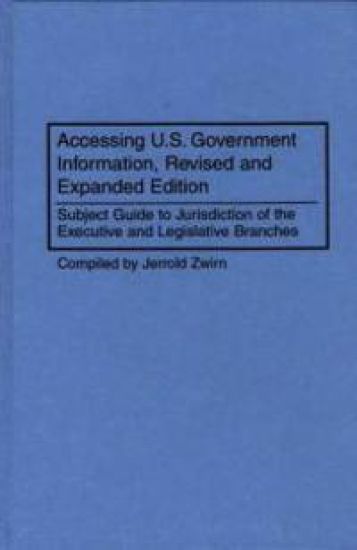
This much revised and expanded edition guides researchers to sources that provide information about the general and specific subjects which form the jurisdiction of the U.S. Government. A tool that correlates legal authorities, principal offices, and financial resources and clarifies their patterns of interaction, the book points out the most appropriate methods and authors for accessing all fields of federal data. Students, teachers, public administrators, policy analysts and citizen activists will find that this easy-to-use guide reliably maps out the jurisdictions of government business and policymaking.This much revised and expanded edition guides researchers to sources that provide information about the general and specific subjects which form the jurisdiction of the U.S. Government. A tool that correlates legal authorities, principal offices, and financial resources and clarifies their patterns of interaction, the book points out the most appropriate methods and authors for accessing all fields of federal data.This research aid translates the universe of public responsibilities into topical categories that chart the structure and functions of the policymaking branches and their various subunits. By helping students, teachers, public administrators, policy analysts, and citizen activists to understand the role of jurisdiction in the business of government, it enables them to develop their own best research strategies.

Talking to a Loved One with Borderline Personality Disorder
Jerold J Kreisman
ReadHowYouWant
2020
pokkari
Communicating with a loved one who has borderline personality disorder (BPD) can be fraught with explosive emotions and intense conflict. In this compassionate guide, Jerold Kreisman-bestselling author of I Hate You, Don't Leave Me-offers a powerful set of tools to help the loved ones of people with BPD express themselves, be heard, and have a productive conversation without playing the blame game.

"Jerold Kayden has contributed to the renaissance of writing on New York City and its architecture of recent years an extraordinarily detailed and sensible account of the hundreds of open spaces that have sprouted around skyscrapers in the wake of the zoning reform of 1961. It is a remarkable book and every lover of New York City will want to consult it."Nathan Glazer, Professor of Sociology and Education Emeritus, Harvard University "This is an indispensable guide to New York Citys 500-plus privately owned public spaces. The books marathon undertaking is required reading for anyone interested in the history and development of modern New York."Laurie Beckelman, Vice President, World Monuments Fund "New York City has 40 years of experience in creating public spaces on private property through zoning. This book covers it allfrom sorry examples to brilliant successes. Other cities should learn from this experience."Con Howe, Director of Planning, City of Los Angeles