Kirjojen hintavertailu. Mukana 11 244 527 kirjaa ja 12 kauppaa.

Kirjahaku

Etsi kirjoja tekijän nimen, kirjan nimen tai ISBN:n perusteella.

1000 tulosta hakusanalla Jerold S. Auerbach

Against the Grain: A Historian's Journey

Against the Grain: A Historian's Journey

Jerold S. Auerbach

Quid Pro, LLC
2012
nidottu
Against the Grain is a collection of challenging and insightful essays from a reflective historian. Jerold Auerbach, Professor Emeritus at Wellesley College (where he taught for 40 years), writes in the Foreword how his academic career and his time in Israel "each in its own distinctive way converged to liberate me from my past as a non-Jewish Jew." He adds: "Regardless of the subject-law, modern American history, Pueblo Indians, American Judaism, Israel-deference to the conventional wisdom never had been my style. I always enjoyed the stimulation of writing against the grain: discovering hidden meanings, challenging historical and political pieties, and exposing the self-serving ideology that often lurked beneath self-evident truths. Providing intellectual catnip, it also enabled me to reach readers far beyond the narrow confines of academic journals. "My creative work always was done in the solitude of my study, my sanctum within my home. Enclosed within the treasured artifacts, maps, photographs, prints, and books accumulated during decades of research and travel, I explored the historical past that both inspired and reflected my own intellectual trajectory. Virtually every book I have written, to my genuine surprise, contained within it the seed of its successor. That, of course, is discernible only with hindsight-which, after all, is the distinctive attribute of a historian. I invite my family, friends, and interested readers to accompany me to some favorite destinations during my journey." A new book in Quid Pro's Journeys & Memoirs Series, Against the Grain presents this distinctive hindsight in essays and excerpts targeted to a general audience interested in such issues, in addition to historians and college students. Many of the essays were first published in non-academic periodicals and are accessible to this broader audience, though they are nonetheless supported with the prodigious research, evocative prose, and candor of a widely published writer.
Justice without Law

Justice without Law

Jerold S. Auerbach

Oxford University Press Inc
1986
nidottu
Describes the disadvantages of litigation, looks at what the American legal system suggests about our society, and discusses arbitration, mediation, and conciliation, alternatives to our adversary approach to justice
Hebron Jews

Hebron Jews

Jerold S. Auerbach

Rowman Littlefield Publishers
2009
sidottu
In this first comprehensive history in English of the Jews of Hebron, Jerold S. Auerbach explores one of the oldest and most vilified Jewish communities in the world. Spanning three thousand years, from the biblical narrative of Abraham's purchase of a burial cave for Sarah to the violent present, it offers a controversial analysis of a community located at the crossroads of the Israeli-Palestinian struggle over national boundaries and the internal Israeli struggle over the meaning of Jewish statehood. Hebron Jews sharply challenges conventional Zionist historiography and current media understanding by presenting a community of memory deeply embedded in Zionist history and Jewish tradition. Auerbach shows how the blending of religion and nationalism—Orthodoxy and Zionism—embodied in Hebron Jews is at the core of the struggle within Israel to define the meaning of a Jewish state.
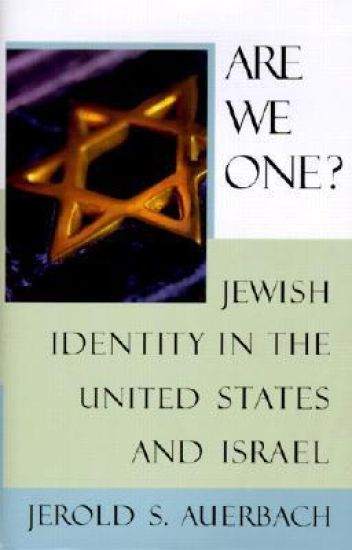
Are We One?

Are We One?

Jerold S. Auerbach

Rutgers University Press
2001
sidottu
What binds together Jews of Israel and the United States? Amid the hope and frustration generated by the Middle East peace process, the meaning of Jewish statehood is more vigorously contested than ever before. A secular democratic Israel, responsive to Western liberal values, is prepared to make peace with the Palestinians by sacrificing its own historic homeland. But a covenantal Israel, which draws its Jewish identity from divine promise and the biblical narrative, refuses to surrender to modern imperatives. As the very nature of Jewish statehood has become ever more polarized, American Jewish life has been profoundly affected by this fateful Zionist contradiction.In Are We One? Jerold S. Auerbach presents a surprising new interpretation of this contemporary Jewish dilemma. The modern Jewish impulse to embrace Western values, he writes, exacts a terrible price. He offers a critical reassessment of Zionism, a challenging analysis of the sources of the identification of American Jews with Israel—and a gloomy prognosis of the future of Jewish life, both in Israel and the United States.In a ringing indictment that is sure to spark controversy, he states that the eagerness of secular Israelis to import American culture reflects their sweeping rejection of Jewish and Zionist values. Indeed, the diminishing number of Israelis who actually remain faithful to Jewish religious and historical imperatives are denigrated as fundamentalist zealots by Israeli and American Jews alike. Present-day Israel now exhibits such Jewish self-loathing, he states, that it has depleted its own ability to inspire world Jewry.In a groundbreaking book that draws upon original historical analysis and extensive personal experience in Israel, Auerbach invites readers to consider the debilitating consequences of an adulterated Jewish identity in Israel and in the United States for the very future of Judaism.
Jewish State, Pariah Nation: Israel and the Dilemmas of Legitimacy
Jewish statehood was restored in 1948 amid a struggle over legitimacy that has persisted in Israel ever since: Who rules? Who decides? Antagonism between the political left and right erupted into bloody violence over the Altalena. Secular-religious discord even made defining who is a Jew in a Jewish state contentious. After the Six-Day War, the return of religious Zionist settlers to biblical Judea and Samaria reframed the struggle over legitimacy. Who decides where in the Land of Israel Jews may live: settlers and rabbis or the government? Israel's invasion of Lebanon in 1982 provoked the first significant eruption of military disobedience, undermining the authority of the Israel Defense Forces with competing claims of personal conscience. Ever since the United Nations declared Zionism to be "a form of racism," Israel has confronted an escalating international assault on its legitimacy. In political, academic, media, and cultural circles it has been demonized as an "apartheid," even "Nazi," state that much of the world despises. These conflicts are explored in this illuminating study of the dilemmas of legitimacy in the world's only Jewish state and most reviled pariah nation. A new addition to the Contemporary Society Series from Quid Pro Books.
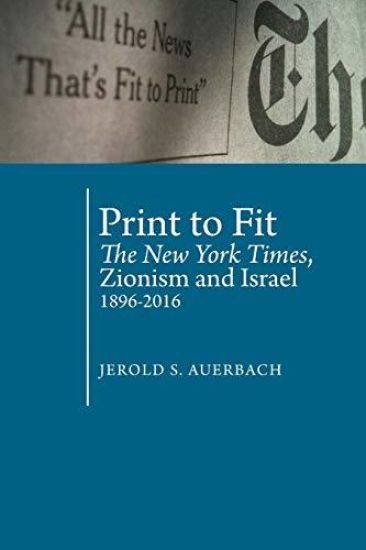
Print to Fit

Print to Fit

Jerold S. Auerbach

Academic Studies Press
2019
sidottu
After Adolph Ochs purchased The New York Times in 1896, Zionism and the eventual reality of the State of Israel were framed within his guiding principle, embraced by his Sulzberger family successor, that Judaism is a religion and not a national identity. Apprehensive lest the loyalty of American Jews to the United States be undermined by the existence of a Jewish state, they embraced an anti-Zionist critique that remained embedded in its editorials, on the Opinion page and in its news coverage. Through the examination of evidence drawn from its own pages, this book analyzes how all the news “fit to print” became news that fit the Times’ discomfort with the idea, and since 1948 the reality, of a thriving democratic Jewish state in the historic homeland of the Jewish people.
Print to Fit

Print to Fit

Jerold S. Auerbach

Academic Studies Press
2019
pokkari
After Adolph Ochs purchased The New York Times in 1896, Zionism and the eventual reality of the State of Israel were framed within his guiding principle, embraced by his Sulzberger family successor, that Judaism is a religion and not a national identity. Apprehensive lest the loyalty of American Jews to the United States be undermined by the existence of a Jewish state, they embraced an anti-Zionist critique that remained embedded in its editorials, on the Opinion page and in its news coverage. Through the examination of evidence drawn from its own pages, this book analyzes how all the news “fit to print” became news that fit the Times’ discomfort with the idea, and since 1948 the reality, of a thriving democratic Jewish state in the historic homeland of the Jewish people.
Privately Owned Public Space

Privately Owned Public Space

Jerold S. Kayden

John Wiley Sons Inc
2000
sidottu
"Jerold Kayden has contributed to the renaissance of writing on New York City and its architecture of recent years an extraordinarily detailed and sensible account of the hundreds of open spaces that have sprouted around skyscrapers in the wake of the zoning reform of 1961. It is a remarkable book and every lover of New York City will want to consult it."–Nathan Glazer, Professor of Sociology and Education Emeritus, Harvard University "This is an indispensable guide to New York City’s 500-plus privately owned public spaces. The book’s marathon undertaking is required reading for anyone interested in the history and development of modern New York."–Laurie Beckelman, Vice President, World Monuments Fund "New York City has 40 years of experience in creating public spaces on private property through zoning. This book covers it all–from sorry examples to brilliant successes. Other cities should learn from this experience."–Con Howe, Director of Planning, City of Los Angeles