

Kirjahaku
Etsi kirjoja tekijän nimen, kirjan nimen tai ISBN:n perusteella.
1000 tulosta hakusanalla Jerry A Fogel

Keeping Up With Jerry: A collection of scenes based upon personal recollections and reflections from the life of somebody who has cerebral pa
Joe Leroy Hemphill
Createspace Independent Publishing Platform
2010
nidottu
This collection of new and previously published essays reflects the major research and thought of one of today's preeminent philosophers of mind.This collection of new and previously published essays reflects the major research and thought of one of today's preeminent philosophers of mind. The first seven essays are philosophical pieces that focus on mental representation and the foundations of intentionality; these are followed by four psychological essays on cognitive architecture. In his eloquent introduction Fodor shows how the two areas are thematically united and epistemologically related, highlighting his concern in finding alternatives to holistic accounts of mental content. Fodor's philosophical essays develop an informational view of semantics that offers the possibility of atomism about meaning; his psychological essays present a modular view of cognitive architecture that offers the possibility of atomism about perception. These ideas, he points out, are joined in epistemology in way that the books last essay begins to explore. Taken together, the essays represent Fodor's lively attempt to knock the underpinnings from the currently popular relativism to show that the arguments for semantic and psychological holism are insubstantial and that important alternatives exist to be explored.

A Practical Approach to Anesthesia Equipment
Jerry A. Dorsch; Susan E. Dorsch
Lippincott Williams and Wilkins
2010
pokkari
This paperback, full-color book is ideally suited for anesthesiologists, residents, and nurse anesthetists who need a concise, practical, easily accessible reference on anesthesia equipment. Written by the authors of the definitive text Understanding Anesthesia Equipment , A Practical Approach to Anesthesia Equipment covers the most commonly used machines and devices and addresses common problems and pitfalls that affect clinical situations. The book is written in outline format and thoroughly illustrated with full-color photographs and line drawings.

Chamberlain's Navy: A Story of the American Civil War Off Shore
Jerry A. Davis
Createspace Independent Publishing Platform
2011
nidottu
It's 1861 and the secession crisis has come to a head. The people of the United States of America are divided like never before. The story begins in Norfolk, Virginia, the location of one of the largest Navy yards in the United States. Norfolk is also home to the fictional Chamberlain family.Brothers John and Richard Chamberlain, both recent graduates of the Naval Academy, are torn apart by the war. One sides with his father, George, a retired Navy petty officer. The other brother sides with his pro-Confederate mother and her extended family. With the Chamberlain house divided, one brother remains in the Union navy while the other flees in the dark of night to serve in the new Confederate navy. "Chamberlain's Navy" is historical fiction, with the events surrounding John and Richard Chamberlain related to the real people and real events of the war. Using naval records, memoirs, and archives, the author weaves narratives of two brothers. John Chamberlain joins the Union's blockading fleet and then helps develop the new ironclad, the USS Monitor. Richard Chamberlain serves aboard the CSS Sumter, the first commerce raider to break out of the Union blockade and successfully inaugurate the Confederacy's controversial campaign of commerce raiding on the high seas.With this volume, we meet our characters as the war begins and takes hold of the two opposing societies.

Plan-Based Investing: Why a Financial Plan is the Key to Investment Success
Jerry a. Ganz Cfp
Createspace Independent Publishing Platform
2014
nidottu

Chasing Caterpillars: A Late Life Metamorphosis to Triathlete (and how you can do it!)
Jerry a. Kyckelhahn
Createspace Independent Publishing Platform
2013
nidottu
Marti Lives: A Visual Imaginarium
Jerry a. Sierra
Createspace Independent Publishing Platform
2015
nidottu

To Lenorah, With Love: Letters from a Small-Town Soldier Stationed in Germany, 1964-1967
Jerry a. Hildreth
Publimetry
2019
nidottu
"Like the rain, once again I return late, but not too late. So I set to sprinkle a few misspelled, mispronounced words into trickles which are supposed to be sentences but fail most of the time. These come together to make streams, or paragraph, but instead turn into a rampage and make little sense. As you can see from the above." In To Lenorah, With Love, we discover letters between a son stationed in Germany during the Vietnam War and his mother. These letters trace the journey of an American soldier from a small West Texas town to the U.S. Army. Photos show post-war Germany and show some of the damage, reconstruction, countryside, and life.

This book is a ""journey book."" Sitting down at a computer and producing the story has been a grand trek. I have learned that there is a principle in nature that some things need to mellow, calm down, and soak in. The refusal of winemakers to take a wine before its time is a notion I am coming to understand. It works with writers as well. Like a fetus signaling its mother that it is time to head for the hospital, a literary work stays in the mind until its time. In my education, I have read of the battles of great Church leaders who were eventually thrown out of their churches. In my denominational education, I was largely led to see them as heretics, rebels, eccentrics, revolutionaries, apostates, and as generally representing a lower form of spirituality. Church education often asked me to surrender my biases in favor of accepting a new set of assumptions--my denominational ones. We were to be critical of everything except our organization. I submit that there is danger in that. This book will cover incidents from the first forty years of my life as a religious addict. You may find something here that you can identify with.

This book is a ""journey book."" Sitting down at a computer and producing the story has been a grand trek. I have learned that there is a principle in nature that some things need to mellow, calm down, and soak in. The refusal of winemakers to take a wine before its time is a notion I am coming to understand. It works with writers as well. Like a fetus signaling its mother that it is time to head for the hospital, a literary work stays in the mind until its time. In my education, I have read of the battles of great Church leaders who were eventually thrown out of their churches. In my denominational education, I was largely led to see them as heretics, rebels, eccentrics, revolutionaries, apostates, and as generally representing a lower form of spirituality. Church education often asked me to surrender my biases in favor of accepting a new set of assumptions--my denominational ones. We were to be critical of everything except our organization. I submit that there is danger in that. This book will cover incidents from the first forty years of my life as a religious addict. You may find something here that you can identify with.
"Coyne's knowledge of evolutionary biology is prodigious, his deployment of it as masterful as his touch is light." -Richard Dawkins In the current debate about creationism and intelligent design, there is an element of the controversy that is rarely mentioned-the evidence. Yet the proof of evolution by natural selection is vast, varied, and magnificent. In this succinct and accessible summary of the facts supporting the theory of natural selection, Jerry A. Coyne dispels common misunderstandings and fears about evolution and clearly confirms the scientific truth that supports this amazing process of change. Weaving together the many threads of modern work in genetics, paleontology, geology, molecular biology, and anatomy that demonstrate the "indelible stamp" of the processes first proposed by Darwin, Why Evolution Is True does not aim to prove creationism wrong. Rather, by using irrefutable evidence, it sets out to prove evolution right.
What the Doctor Didn't Say
Jerry A. Menikoff; Edward P. Richards
Oxford University Press Inc
2006
sidottu
Most people know precious little about the risks and benefits of participating in a "clinical trial" - a medical research study involving some innovative treatment for a medical problem. Yet millions of people each year participate anyway. What the Doctor Didn't Say explains the reality: that our current system intentionally hides much of the information people need to make the right choice about whether to participate. Witness the following scenarios: -Hundreds of patients with colon cancer undergo a new form of keyhole surgery at leading cancer centers - never being told that 85% of colorectal surgeons, worried that it increases the risk of the cancer returning, would not themselves undergo that procedure -Tens of thousands of women at high risk of developing breast cancer are asked to participate in a major research study. They are told about the option of having both breasts surgically removed - but not told about the option of taking a standard osteoporosis pill that might cut the risk of getting breast cancer by one half or more What the Doctor Didn't Say, written by two prominent experts in the field, is the first book to reveal the secrets that many in the research establishment have fought long and hard to keep from patients. It shows why options not commonly known - including getting a new treatment outside of a research study - can often be the best choice. It explains how patients can make good decisions even if there is only limited information about a treatment's effect. And it does this through the eye-opening of what is happening daily to thousands of people. Day after day, we are learning how little we know about what really works. Headlines regularly announce that a previously unquestioned treatment - hormane replacement therapy, drugs such as Vioxx or Celebrex - may now be much riskier than we thought. The latest in a surge of recent books criticising the medical establishment (but the first to look at clinical trials specifically), What the Doctor Didn't Tell You helps to empower patients to survive in a world of medical uncertainty, and makes positive recommendations for systemic reform.
Oxford Cognitive Science Series General Editors: Martin Davies, Wilde Reader in Mental Philosophy, University of Oxford, UK, James Higginbotham, Professor of General Linguistics, University of Oxford, UK, John O'Keefe, Professor of Cognitive Neuroscience, University College, London, UK, Christopher Peacocke, Waynflete Professor of Metaphysical Philosophy, University of Oxford, UK, and Kim Plunkett, University Lecturer in Psychology, University of Oxford, UK The Oxford Cognitive Science series is a forum for the best contemporary work in this flourishing field, where various disciplines--cognitive psychology, philosophy, linguistics, cognitive neuroscience, and computational theory--join forces in the investigation of thought, awareness, understanding, and associated workings of the mind. Each book will represent an original contribution to its subject, but will be accessible beyond the ranks of specialists, so as to reach a broad interdisciplinary readership. The series will be carefully shaped and steered by the general editors, with the aim of representing the most important developments in the field and bringing together its constituent disciplines. About this book The renowned philosopher Jerry Fodor, who has been a leading figure in the study of the mind for more than twenty years, presents a strikingly original theory of the basic constituents of thought. He suggests that the heart of a cognitive science is its theory of concepts, and that cognitive scientists have gone badly wrong in many areas because their assumptions about concepts have been seriously mistaken. Fodor argues compellingly for an atomistic theory of concepts, deals out witty and pugnacious demolitions of the rival theories that have prevailed in recent years, and suggests that future work on human cognition should build upon new foundations. This lively, conversational, and surprisingly accessible book is the first volume in the Oxford Cognitive Science Series, where the best original work in this field will be presented to a broad readership. Concepts will fascinate anyone interested in contemporary work on mind and language. Cognitive science will never be the same again.
Oxford Cognitive Science Series General Editors: Martin Davies, Wilde Reader in Mental Philosophy, University of Oxford, UK, James Higginbotham , Professor of General Linguistics, University of Oxford, UK, John O'Keefe, Professor of Cognitive Neuroscience, University College, London, UK, Christopher Peacocke, Waynflete Professor of Metaphysical Philosophy, University of Oxford, UK, and Kim Plunkett, University Lecturer in Psychology, University of Oxford, UK The Oxford Cognitive Science series is a forum for the best contemporary work in this flourishing field, where various disciplines--cognitive psychology, philosophy, linguistics, cognitive neuroscience, and computational theory--join forces in the investigation of thought, awareness, understanding, and associated workings of the mind. Each book will represent an original contribution to its subject, but will be accessible beyond the ranks of specialists, so as to reach a broad interdisciplinary readership. The series will be carefully shaped and steered by the general editors, with the aim of representing the most important developments in the field and bringing together its constituent disciplines. About this book The renowned philosopher Jerry Fodor, who has been a leading figure in the study of the mind for more than twenty years, presents a strikingly original theory of the basic constituents of thought. He suggests that the heart of a cognitive science is its theory of concepts, and that cognitive scientists have gone badly wrong in many areas because their assumptions about concepts have been seriously mistaken. Fodor argues compellingly for an atomistic theory of concepts, deals out witty and pugnacious demolitions of the rival theories that have prevailed in recent years, and suggests that future work on human cognition should build upon new foundations. This lively, conversational, accessible book is the first volume in the Oxford Cognitive Science Series, where the best original work in this field will be presented to a broad readership. Concepts will fascinate anyone interested in contemporary work on mind and language. Cognitive science will never be the same again.
For all the discussion in the media about creationism and 'Intelligent Design', virtually nothing has been said about the evidence in question - the evidence for evolution by natural selection. Yet, as this succinct and important book shows, that evidence is vast, varied, and magnificent, and drawn from many disparate fields of science. The very latest research is uncovering a stream of evidence revealing evolution in action - from the actual observation of a species splitting into two, to new fossil discoveries, to the deciphering of the evidence stored in our genome. Why Evolution is True weaves together the many threads of modern work in genetics, palaeontology, geology, molecular biology, anatomy, and development to demonstrate the 'indelible stamp' of the processes first proposed by Darwin. It is a crisp, lucid, and accessible statement that will leave no one with an open mind in any doubt about the truth of evolution.

Hume? Yes, David Hume, that's who Jerry Fodor looks to for help in advancing our understanding of the mind. Fodor claims his Treatise of Human Nature as the foundational document of cognitive science: it launched the project of constructing an empirical psychology on the basis of a representational theory of mind. Going back to this work after more than 250 years we find that Hume is remarkably perceptive about the components and structure that a theory of mind requires. Careful study of the Treatise helps us to see what's amiss with much twentieth-century philosophy of mind, and to get on the right track. Hume says in the Treatise that his main project is to construct a theory of human nature and, in particular, a theory of the mind. Hume Variations examines his account of cognition and how it is grounded in his 'theory of ideas'. Fodor discusses such key topics as the distinction between 'simple' and 'complex' ideas, the thesis that an idea is some kind of picture, and the roles that 'association' and 'imagination' play in cognitive processes. He argues that the theory of ideas, as Hume develops it, is both historically and ideologically continuous with the representational theory of mind as it is now widely endorsed by cognitive scientists. This view of Hume is explicitly opposed to recent discussions by critics who hold that the theory of ideas is the Achilles heel of his philosophy and that he would surely have abandoned it if only he had read Wittgenstein carefully. You don't have to know much about Hume to enjoy this inventively argued, provocative, and stimulating defence of the representational theory of mind--which is looking increasingly hard to resist. LINES OF THOUGHT Philosophy books don't need to be hundreds of pages long to make a substantial contribution to the subject. This new series presents original works by leading philosophers at an affordable price and a readable length. Series Editors Peter Ludlow (University of Michigan, Ann Arbor) Scott Sturgeon (Birkbeck College, London)
Jerry A. Fodor presents a new development of his famous Language of Thought hypothesis, which has since the 1970s been at the centre of interdisciplinary debate about how the mind works. Fodor defends and extends the groundbreaking idea that thinking is couched in a symbolic system realized in the brain. This idea is central to the representational theory of mind which Fodor has established as a key reference point in modern philosophy, psychology, and cognitive science. The foundation stone of our present cognitive science is Turing's suggestion that cognitive processes are not associations but computations; and computation requires a language of thought. So the latest on the Language of Thought hypothesis, from its progenitor, promises to be a landmark in the study of the mind. LOT 2 offers a more cogent presentation and a fuller explication of Fodor's distinctive account of the mind, with various intriguing new features. The central role of compositionality in the representational theory of mind is revealed: most of what we know about concepts follows from the compositionality of thoughts. Fodor shows the necessity of a referentialist account of the content of intentional states, and of an atomistic account of the individuation of concepts. Not least among the new developments is Fodor's identification and persecution of pragmatism as the leading source of error in the study of the mind today. LOT 2 sees Fodor advance undaunted towards the ultimate goal of a theory of the cognitive mind, and in particular a theory of the intentionality of cognition. No one who works on the mind can ignore Fodor's views, expressed in the coruscating and provocative style which has delighted and disconcerted countless readers over the years.
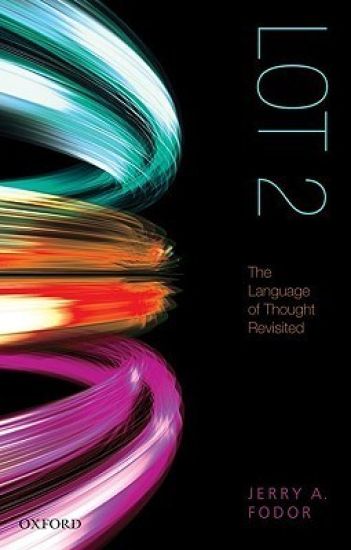
Jerry Fodor presents a new development of his famous Language of Thought hypothesis, which has since the 1970s been at the centre of interdisciplinary debate about how the mind works. Fodor defends and extends the groundbreaking idea that thinking is couched in a symbolic system realized in the brain. This idea is central to the representational theory of mind which Fodor has established as a key reference point in modern philosophy, psychology, and cognitive science. The foundation stone of our present cognitive science is Turing's suggestion that cognitive processes are not associations but computations; and computation requires a language of thought. So the latest on the Language of Thought hypothesis, from its progenitor, promises to be a landmark in the study of the mind. LOT 2 offers a more cogent presentation and a fuller explication of Fodor's distinctive account of the mind, with various intriguing new features. The central role of compositionality in the representational theory of mind is revealed: most of what we know about concepts follows from the compositionality of thoughts. Fodor shows the necessity of a referentialist account of the content of intentional states, and of an atomistic account of the individuation of concepts. Not least among the new developments is Fodor's identification and persecution of pragmatism as the leading source of error in the study of the mind today. LOT 2 sees Fodor advance undaunted towards the ultimate goal of a theory of the cognitive mind, and in particular a theory of the intentionality of cognition. No one who works on the mind can ignore Fodor's views, expressed in the coruscating and provocative style which has delighted and disconcerted countless readers over the years.
Calls for closer connections among disciplines can be heard throughout the world of scholarly research, from major universities to the National Institutes of Health. In Defense of Disciplines presents a fresh and daring analysis of the argument surrounding interdisciplinarity. Challenging the belief that blurring the boundaries between traditional academic fields promotes more integrated research and effective teaching, Jerry Jacobs contends that the promise of interdisciplinarity is illusory and that critiques of established disciplines are often overstated and misplaced. Drawing on diverse sources of data, Jacobs offers a new theory of liberal arts disciplines such as biology, economics, and history that identifies the organizational sources of their dynamism and breadth. Illustrating his thesis with a wide range of case studies, including the diffusion of ideas between fields, the creation of interdisciplinary scholarly journals, and the rise of new fields that spin off from existing ones, Jacobs upends many of the existing criticisms to mount a powerful defense of the enduring value of liberal arts disciplines. This will become one of the anchors of the case against interdisciplinarity for years to come.