
Kirjahaku
Etsi kirjoja tekijän nimen, kirjan nimen tai ISBN:n perusteella.
1000 tulosta hakusanalla Joan H Carter






During the late 1970s and 1980s, "cancer" underwent a remarkable transformation. In one short decade, what had long been a set of heterogeneous diseases marked by uncontrolled cell growth became a disease of our genes. How this happened and what it means is the story Joan Fujimura tells in a rare inside look at the way science works and knowledge is created. A dramatic study of a new species of scientific revolution, this book combines a detailed ethnography of scientific thought, an in-depth account of science practiced and produced, a history of one branch of science as it entered the limelight, and a view of the impact of new genetic technologies on science and society. The scientific enterprise that Fujimura unfolds for us is proto-oncogene cancer research--the study of those segments of DNA now thought to make normal cells cancerous. Within this framework, she describes the processes of knowledge construction as a social enterprise, an endless series of negotiations in which theories, material technologies, and practices are co-constructed, incorporated, and refashioned. Along the way, Fujimura addresses long-standing questions in the history and philosophy of science, culture theory, and sociology of science: How do scientists create "good" problems, experiments, and solutions? What are the cultural, institutional, and material technologies that have to be in place for new truths and new practices to succeed? Portraying the development of knowledge as a multidimensional process conducted through multiple cultures, institutions, actors, objects, and practices, this book disrupts divisions among sociology, history, anthropology, and the philosophy of science, technology, and medicine.
Child Behavior and Development
Joan H. Cantor; Charles C. Spiker; Lewis P. Lipsitt
Praeger Publishers Inc
1991
sidottu
Considers the education of future scholars of child behavior and development in light of issues that are arising from changing conditions and values in the field. Among the 11 essays are discussions of various specialities, general perspectives, and proposals for changes in graduate programs. Annota
News from Dead Mule Swamp: Anastasia Raven is running from the pain of a failed marriage and hopes to hide from the world in an old farmhouse she has purchased at the edge of Dead Mule Swamp. When a hundred-year-old newspaper she finds inside a wall is stolen by Cliff Sorenson and then Cliff disappears, Ana is convinced that the paper holds the key to the mystery. But what old news could be important enough to put Cliff in danger?The Hollow Tree at Dead Mule Swamp: Anastasia Raven finds a secret hidden in a hollow tree near Dead Mule Swamp. She thinks she's seeing things, as the discovery appears to have come straight from a Nancy Drew story. With some simple sleuthing, Ana catches Jimmie Mosher, whose grandfather used to own the house she has recently purchased. But what else does Jimmie have to hide?These two stories introduce the primary characters and where they live. If you enjoy rural and small town series, these books are for you


Anastasia Raven opens a box containing a bloody hatchet, apparently sent as some sort of warning to her friend Cora and Cora's ex-husband. When a hacked-up body is discovered in the Petite Sauble River at the small village of Jalmari, everyone is stunned at the victim's identity. Continued puzzling discoveries just don't add up. Ana also agrees to participate in a zany conspiracy with a tall and handsome man.
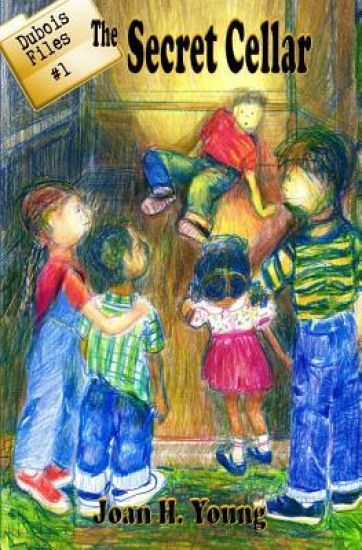
The Moshers can't prove the mortgage was paid. Granny May had the proof, but her mind is slipping. Will Jimmie's family be homeless? Set in the 1950s, Cora Dubois, Jimmie Mosher and their friends, Laszlo, George, and Ruby, discover they have a talent for getting to the bottom of local mysteries. In this heartwarming, introductory volume you'll meet the children and find out what life was like in their rural county, somewhere "up north." This series consists of early chapter books, with each book moving forward in time by a month. The Secret Cellar takes place in June, 1953, just after school has let out for the summer. Each book includes a "forgotten" craft or skill, and may address social/moral issues of the mid-twentieth century. In The Secret Cellar (Dubois Files book #1), Jimmie's family is in danger of losing their farm to the bank. Old Granny May seems to be trying to tell them something, but maybe she's just losing her mind. Enjoyed by readers ages 6-12.

Set in the 1950s, Cora Dubois, Jimmie Mosher and their friends, Laszlo, George, and Ruby, discover they have a talent for getting to the bottom of local mysteries. Each book includes a "forgotten" craft or skill, and may address social/moral issues of the mid-twentieth century. In The Hitchhiker (Dubois Files book #2), Cora's family gives a hitchhiker a ride. He didn't seem to speak English, and Cora's mother thought he was ill. Then Jimmie went exploring and found more than he expected. The hitchhiker was not only sick, but he wanted the children to help him. If only they could have understood what he was saying It took four of them to solve his problem.Enjoyed by readers ages 6-12.


Jonathan Tibbet was born in 1856 near the San Gabriel Mission and considered himself a true Californian. Several indian villages were located on the family rancho and this is where young Jonathan acquired a life-long relationship with Native Americans.This individualist was a shrewd businessman who made numerous enemies. However, he and his wife, Emma, were well-known for their frequent gatherings and warm hospitality. Their home on Prospect Avenue had been developed into a pleasing private garden covering some three acres.During the 1920s, Mission Indian Federation conferences were held on the Tibbet property and surrounding streets, where hundreds of indian families camped for a week twice a year.