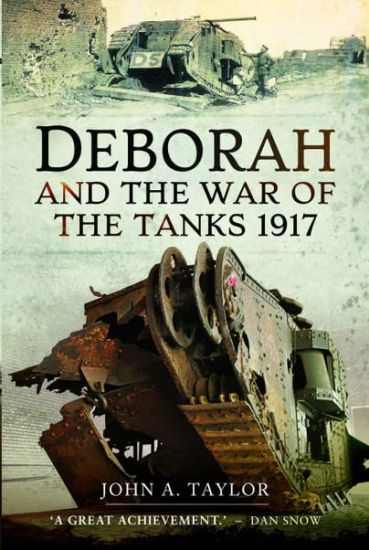
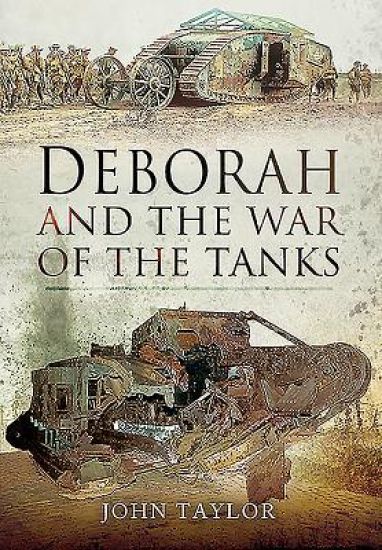
Deborah is a British First World War tank that rose from the grave after taking part in one of the most momentous battles in history. In November 1917 she played a leading role in the first successful massed tank attack at Cambrai. Eighty years later, in a remarkable feat of archaeology, the tank's buried remains were rediscovered and excavated, and are now preserved as a memorial to the battle and to the men who fought in it. John Taylor's book tells the tale of the tank and her crew and tracks down their descendants to uncover a human story every bit as compelling as the military one. A great achievement. One of the most remarkable treasures of First World War archaeology receives the treatment it deserves in this hugely detailed yet highly readable new history. Dan Snow
'A great achievement. One of the most remarkable treasures of First World War archaeology receives the treatment it deserves in this hugely detailed yet highly readable new history.' Dan SnowDeborah is a British First World War tank that rose from the grave after taking part in one of the most momentous battles in history. In November 1917 she played a leading role in the first successful massed tank attack at Cambrai. Eighty years later, in a remarkable feat of archaeology, the tank's buried remains were rediscovered and excavated, and are now preserved as a memorial to the battle and to the men who fought in it. John Taylor's book tells the tale of the tank and her crew and tracks down their descendants to uncover a human story every bit as compelling as the military one.
Sir John A is an uproariously funny and sharply inquisitive new play from one of Canada's leading Indigenous playwrights. Bobby Rabbit, the play's Anishnawbe main character, convinces his friend Hugh to accompany him on a "sojourn of justice" to dig up the bones of Canada's infamous first prime minister and hold them for ransom. Decades before, a medicine pouch belonging to Bobby's grandfather was taken away by the staff of the residential school where he was detained. The precious object was sent to a British Museum exhibition room for conservation - and now Bobby wants it repatriated. Along the way the pair pick up Anya, a bright, opinionated young woman who is fleeing a bad breakup and holds conflicting ideas about Sir John A.'s place in Canadian history. Not to be left out of the argument, Sir John A. himself, broadcasting live from nineteenth-century Ottawa and full of patriarchal contempt for those "strange and perplexing Indians," shows up with opinions of his own. Taylor's twenty-seventh play, Sir John A: Acts of a Gentrified Ojibway Rebellion explores the possibility of reconciliation and urgently questions past and contemporary forms of Canadian colonialism. A contemporary classic
The public display of grief that accompanied the funeral of the late Princess of Wales drew attention to the many Britons who had found an affinity with Diana. Seeking an explanation for this affinity, Taylor argues that, during Diana's brief time in the world spotlight, Britain underwent a change in values and a shift in national identity from a system based almost exclusively on household and family values to one more accepting of individual autonomy and self-interest. Accustomed to royalty as symbols of national values and identity, persons of resentment (women, people of color, and homosexuals) found the divorced princess an apt symbol of their transvalued values. These groups declared ignoble the Queen, Prince Charles, and others who had previously been the patterns for nobility in British society, and they held up Diana as one truly noble. The British monarchy had come to symbolize household and family, but disaffected groups found themselves excluded from this model. While royal adultery and divorces were long characterized by a double standard, the Princess of Wales was able to win over considerable public sympathy to her plight. By the 1990s, British household size and structure had changed so dramatically that a challenge to a traditionally based family value system was well timed. Women, people of color, and homosexuals saw in Diana's life their own transformation in identity that now found greater acceptance in the larger society.
Will the British retain the monarchy and the English church establishment into the 21st century? The preservation of the monarchy and of the establishment of the church of England is a matter that cuts deep in fact and theory. The monarchy and the church are symbols of civil liberty, and as such they carry the freight of British national identity. Yet it is difficult to take those institutions seriously now because Britons give too little consideration to serious reforms of any kind for the monarchy or the church. This book suggests possible reforms.
Gregory King (1648-1712) was an engraver, herald, surveyor, and Secretary to the Commissioners for the Public Accounts, but he is best known for his 1696 estimates of the wealth and population of England. Writing in 1696, but calculating for the year 1688, he put the population at approximately 5.5 million. Historians have recently doubted the accuracy of these estimates. In this book, John A. Taylor argues that King was an honest compiler of statistics, and that his eccentric calculations based on the available 1696 data were motivated by the problems he faced. Because he used only empiricism and shop arithmetic, the 1696 estimates were probably as accurate as anyone in the 17th century could have made them. Gregory King (1648-1712) was an engraver, herald, surveyor, and Secretary to the Commissioners for the Public Accounts, but he is best known for his 1696 estimates of the wealth and population of England. Writing in 1696, but calculating for the year 1688, he put the population at approximately 5.5 million. Historians have recently doubted the accuracy of these estimates. In this book, John A. Taylor argues that King was an honest compiler of data whose eccentric calculations of the 1696 data available to him were motivated by the problems he faced. Because he used only empiricism and shop arithmetic, the 1696 estimates were probably as accurate as anyone in the 17th century could have made them. This first book-length study of King's work positions his successes and shortcomings as a statistician within the context of the whole ongoing failure of statisticians to construct a method of exact prediction about human society. In addition to this valuable commentary, Taylor also includes reprints of several scarce but very important documents by or about King, including King's 1696 estimates of national population and wealth, his autobiography, his essay on the naval trade of England, his letter on Queen Anne's Bounty, and the life of King written by George Chalmers.
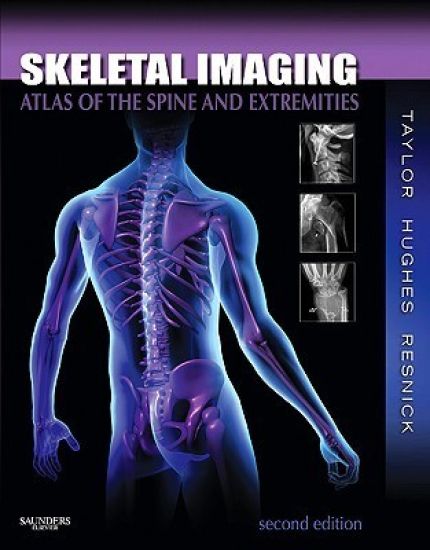
Use this atlas to accurately interpret images of musculoskeletal disorders! Taylor, Hughes, and Resnick's Skeletal Imaging: Atlas of the Spine and Extremities, 2nd Edition covers each anatomic region separately, so common disorders are shown within the context of each region. This allows you to examine and compare images for a variety of different disorders. A separate chapter is devoted to each body region, with coverage of normal developmental anatomy, developmental anomalies and normal variations, and how to avoid a misdiagnosis by differentiating between disorders that appear to be similar. All of the most frequently encountered musculoskeletal conditions are included, from physical injuries to tumors to infectious diseases. Over 2,100 images include radiographs, radionuclide studies, CT scans, and MR images, illustrating pathologies and comparing them with other disorders in the same region. Organization by anatomic region addresses common afflictions for each region in separate chapters, so you can see how a particular region looks when affected by one condition as compared to its appearance with other conditions. Coverage of each body region includes normal developmental anatomy, fractures, deformities, dislocations, infections, hematologic disorders, and more. Normal Developmental Anatomy sections open each chapter, describing important developmental landmarks in various regions of the body from birth to skeletal maturity. Practical tables provide a quick reference to essential information, including normal developmental anatomic milestones, developmental anomalies, common presentations and symptoms of diseases, and much more. 400 new and replacement images are added to the book, showing a wider variety of pathologies. More MR imaging is added to each chapter. Up-to-date research includes the latest on scientific advances in imaging. References are completely updated with new information and evidence.
One-liner: Addresses the impact of changing skills required of fighter, mobility, bomber, and Special Operations Forces pilots on decisions about replacing or extending service lives of trainer aircraft. 450-character abstract: This monograph examines how the skills needed to perform future military missions might affect the capabilities required of new pilot training systems. In the next few years, the Air Force must decide to replace or extend the lives of two of its trainer aircraft. This monograph addresses which skills should be taught in undergraduate flying training, which are so different that they cannot be taught in current training aircraft, and what impact these issues have on decisions to replace or extend the lives of the aircraft.
The number of fighter aircraft in the Air Force inventory is decreasing, but the demand for experienced fighter pilots is increasing. The authors use a dynamic mathematical model to show that, to keep from damaging fighter unit readiness, fighter pilot production in the active Air Force must be reduced and new approaches to developing and managing personnel with fighter pilot-like skills must be adopted.
What qualifications determine whether a fighter pilot is experienced? Surveys of expert pilots revealed that, while flying time is an element of the experience needed for both combat and staff jobs, other things are also important. The Air Force needs to measure and credit different types of experience-including time spent in advanced simulator systems-when revising its definitions of pilot experience.