Kirjojen hintavertailu. Mukana 12 390 323 kirjaa ja 12 kauppaa.

Kirjahaku

Etsi kirjoja tekijän nimen, kirjan nimen tai ISBN:n perusteella.

1000 tulosta hakusanalla John Armstrong; Craig Roberts

The History of the Island of Minorca. By John Armstrong,

The History of the Island of Minorca. By John Armstrong,

John Armstrong

Gale Ecco, Print Editions
2018
sidottu
The 18th century was a wealth of knowledge, exploration and rapidly growing technology and expanding record-keeping made possible by advances in the printing press. In its determination to preserve the century of revolution, Gale initiated a revolution of its own: digitization of epic proportions to preserve these invaluable works in the largest archive of its kind. Now for the first time these high-quality digital copies of original 18th century manuscripts are available in print, making them highly accessible to libraries, undergraduate students, and independent scholars.Rich in titles on English life and social history, this collection spans the world as it was known to eighteenth-century historians and explorers. Titles include a wealth of travel accounts and diaries, histories of nations from throughout the world, and maps and charts of a world that was still being discovered. Students of the War of American Independence will find fascinating accounts from the British side of conflict. ++++The below data was compiled from various identification fields in the bibliographic record of this title. This data is provided as an additional tool in helping to insure edition identification: ++++British LibraryT112617With a half-title. Reissued twice in 1756, the second reissue containing an additional 'Letter from an officer in Minorca' dated 1755 (Eddy, 'Samuel Johnson: book reviewer', pp.33-5).London: printed for C. Davis, 1752. xxvii, 1],260p., plates: map; 8
The Miscellaneous Works of John Armstrong, M.D. In Verse and Prose.
The 18th century was a wealth of knowledge, exploration and rapidly growing technology and expanding record-keeping made possible by advances in the printing press. In its determination to preserve the century of revolution, Gale initiated a revolution of its own: digitization of epic proportions to preserve these invaluable works in the largest archive of its kind. Now for the first time these high-quality digital copies of original 18th century manuscripts are available in print, making them highly accessible to libraries, undergraduate students, and independent scholars.Western literary study flows out of eighteenth-century works by Alexander Pope, Daniel Defoe, Henry Fielding, Frances Burney, Denis Diderot, Johann Gottfried Herder, Johann Wolfgang von Goethe, and others. Experience the birth of the modern novel, or compare the development of language using dictionaries and grammar discourses. ++++The below data was compiled from various identification fields in the bibliographic record of this title. This data is provided as an additional tool in helping to insure edition identification: ++++British LibraryT100254Includes: 'Sketches and essays on various subjects. By Launcelot Temple', pseudonym of John Armstrong. 'The art of preserving health' was also issued separately, with an added titlepage. The final unnumbered leaves contain the 'Postscript' and an index.Dublin: printed for L. Flin, 1767. 4], xxiv,208, 4]p.; 12
Miscellanies; By John Armstrong, M.D. in Two Volumes. ... of 2; Volume 2
The 18th century was a wealth of knowledge, exploration and rapidly growing technology and expanding record-keeping made possible by advances in the printing press. In its determination to preserve the century of revolution, Gale initiated a revolution of its own: digitization of epic proportions to preserve these invaluable works in the largest archive of its kind. Now for the first time these high-quality digital copies of original 18th century manuscripts are available in print, making them highly accessible to libraries, undergraduate students, and independent scholars.This collection reveals the history of English common law and Empire law in a vastly changing world of British expansion. Dominating the legal field is the Commentaries of the Law of England by Sir William Blackstone, which first appeared in 1765. Reference works such as almanacs and catalogues continue to educate us by revealing the day-to-day workings of society.++++The below data was compiled from various identification fields in the bibliographic record of this title. This data is provided as an additional tool in helping to insure edition identification: ++++British LibraryT039447A collected edition of the author's works. Includes: 'The muncher's and guzzler's diary: ... the Universal almanac. By Noureddin Ali, ... First printed in the year MDCCXLVIII' with a separate titlepage.London: printed for T. Cadell, (successor to Mr. Millar), 1770. 2v.; 8
The art of Preserving Health. A Poem. By John Armstrong, M.D
The 18th century was a wealth of knowledge, exploration and rapidly growing technology and expanding record-keeping made possible by advances in the printing press. In its determination to preserve the century of revolution, Gale initiated a revolution of its own: digitization of epic proportions to preserve these invaluable works in the largest archive of its kind. Now for the first time these high-quality digital copies of original 18th century manuscripts are available in print, making them highly accessible to libraries, undergraduate students, and independent scholars.Western literary study flows out of eighteenth-century works by Alexander Pope, Daniel Defoe, Henry Fielding, Frances Burney, Denis Diderot, Johann Gottfried Herder, Johann Wolfgang von Goethe, and others. Experience the birth of the modern novel, or compare the development of language using dictionaries and grammar discourses. ++++The below data was compiled from various identification fields in the bibliographic record of this title. This data is provided as an additional tool in helping to insure edition identification: ++++British LibraryT022476Dublin: printed for James Rudd, 1756. 72p.; 12
John Armstrong's The Art of Preserving Health

John Armstrong's The Art of Preserving Health

Adam Budd

Ashgate Publishing Limited
2011
sidottu
John Armstrong's 2000-line poem The Art of Preserving Health was among the most popular works of eighteenth-century literature and medicine. It was among the first to popularize Scottish medical ideas concerning emotional and anatomical sensibility to British readers, doing so through the then-fashionable georgic style. Within three years of its publication in 1744, it was in its third edition, and by 1795 it commanded fourteen editions printed in London, Edinburgh, Dublin, and Benjamin Franklin's shop in Philadelphia. Maintaining its place amongst more famous works of the Enlightenment, this poem was read well into the nineteenth century, remaining in print in English, French, and Italian. It remained a tribute to sustained interest in eighteenth-century sensibility, long after its medical advice had become obsolete and the nervous complaints it depicted became unfashionable. Adam Budd's critical edition includes a comprehensive biographical and textual introduction, and explanatory notes highlighting the contemporary significance of Armstrong's classical, medical, and social references. Included in his introduction are discussions of Armstrong's innovative medical training in charity hospitals and his close associations with the poet James Thomson and the bookseller Andrew Millar, evidence for the poem's wide appeal, and a compelling argument for the poem's anticipation of sensibility as a dominant literary mode. Budd also offers background on the 'new physiology' taught at Edinburgh, as well as an explanation for why a Scottish-trained physician newly arrived in London was forced to write poetry to supplement his medical income. This edition also includes annotated excerpts from the key literary and medical works of the period, including poetry, medical prose, and georgic theory. Readers will come away convinced of the poem's significance as a uniquely engaging perspective on the place of poetry, medicine, the body, and the book trade in the literary history of eighteenth-century sensibility.
John Armstrong's The Art of Preserving Health
John Armstrong's 2000-line poem The Art of Preserving Health was among the most popular works of eighteenth-century literature and medicine. It was among the first to popularize Scottish medical ideas concerning emotional and anatomical sensibility to British readers, doing so through the then-fashionable georgic style. Within three years of its publication in 1744, it was in its third edition, and by 1795 it commanded fourteen editions printed in London, Edinburgh, Dublin, and Benjamin Franklin's shop in Philadelphia. Maintaining its place amongst more famous works of the Enlightenment, this poem was read well into the nineteenth century, remaining in print in English, French, and Italian. It remained a tribute to sustained interest in eighteenth-century sensibility, long after its medical advice had become obsolete and the nervous complaints it depicted became unfashionable. Adam Budd's critical edition includes a comprehensive biographical and textual introduction, and explanatory notes highlighting the contemporary significance of Armstrong's classical, medical, and social references. Included in his introduction are discussions of Armstrong's innovative medical training in charity hospitals and his close associations with the poet James Thomson and the bookseller Andrew Millar, evidence for the poem's wide appeal, and a compelling argument for the poem's anticipation of sensibility as a dominant literary mode. Budd also offers background on the 'new physiology' taught at Edinburgh, as well as an explanation for why a Scottish-trained physician newly arrived in London was forced to write poetry to supplement his medical income. This edition also includes annotated excerpts from the key literary and medical works of the period, including poetry, medical prose, and georgic theory. Readers will come away convinced of the poem's significance as a uniquely engaging perspective on the place of poetry, medicine, the body, and the book trade in the literary history of eighteenth-century sensibility.
John Armstrong: Paintings 1938-1958

John Armstrong: Paintings 1938-1958

Piano Nobile

Piano Nobile Publications
2015
sidottu
First published to accompany the exhibition at Piano Nobile, John Armstrong: Paintings 1938-1958; An Enchanted Distance is a fully illustrated catalogue re-establishing John Armstrong A.R.A. as a pre-eminent Surrealist. Propelled to the forefront of British Modernism as a member of Unit One, Armstrong later rejected the confinement of artistic groups yet was at the heart of inter-war and post-war British art. Consistently producing prophetic, dreamlike paintings of emotional and political insight, Armstrong’s works speak of the universal through his own individual language. The most significant exhibition of Armstrong's works in over thirty years, the catalogue focuses on two decades of immense productivity, creativity and innovation.
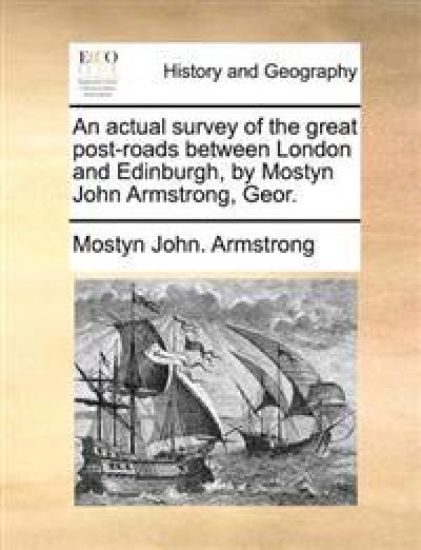
An Actual Survey of the Great Post-roads Between London and Edinburgh, by Mostyn John Armstrong, Geor
The 18th century was a wealth of knowledge, exploration and rapidly growing technology and expanding record-keeping made possible by advances in the printing press. In its determination to preserve the century of revolution, Gale initiated a revolution of its own: digitization of epic proportions to preserve these invaluable works in the largest archive of its kind. Now for the first time these high-quality digital copies of original 18th century manuscripts are available in print, making them highly accessible to libraries, undergraduate students, and independent scholars.Rich in titles on English life and social history, this collection spans the world as it was known to eighteenth-century historians and explorers. Titles include a wealth of travel accounts and diaries, histories of nations from throughout the world, and maps and charts of a world that was still being discovered. Students of the War of American Independence will find fascinating accounts from the British side of conflict. ++++The below data was compiled from various identification fields in the bibliographic record of this title. This data is provided as an additional tool in helping to insure edition identification: ++++British LibraryT129636The titlepage is engraved. 44 engraved road maps, and a frontispiece road map, with 44 leaves of letterpress description.London: printed for, and sold by the author and the booksellers Published according to act of Parliament 1st. of June, 1776. 4],6, 2]p.,44 leaves, plates: maps; 12
A Memoir of John Armstrong

A Memoir of John Armstrong

T T Carter

Anatiposi Verlag
2023
pokkari
Reprint of the original, first published in 1859. The publishing house Anatiposi publishes historical books as reprints. Due to their age, these books may have missing pages or inferior quality. Our aim is to preserve these books and make them available to the public so that they do not get lost.
A Memoir of John Armstrong

A Memoir of John Armstrong

T T Carter

Anatiposi Verlag
2023
sidottu
Reprint of the original, first published in 1859. The publishing house Anatiposi publishes historical books as reprints. Due to their age, these books may have missing pages or inferior quality. Our aim is to preserve these books and make them available to the public so that they do not get lost.
The Court-Martial of Captain John Armstrong

The Court-Martial of Captain John Armstrong

Ellen Denning Smith

Xlibris Us
2022
sidottu
John Armstrong was destined to be a humble farmer on the Pennsylvania frontier until the American Revolution changed his life. Rising from private soldier to an officer in the Continental Army, he later served in the First American Regiment, foreruner of the U.S. Army, that was tasked to facilitate the settlement of the Northwest Territory. He endured the fledgling army's growing pains, was selected for a covert operation in Spanish territory to explore the Missouri River, and fought Native Americans in two disastrous military campaigns. The army subsequently evolved into a successful fighting force despite its second-in-command's quest to destroy the career of its commander, Maj. Gen. Anthony Wayne. Armstrong became an unwitting pawn in a treacherous game crafted by Brig. Gen. James Wilkinson, of whom Theodore Roosevelt once wrote, "He had no conscience and no scruples . . . In all our history there is no more despicable character." Rebuilding his life in Ohio and Indiana, Armstrong became a noted government official, militia officer, land speculator, and pioneer.