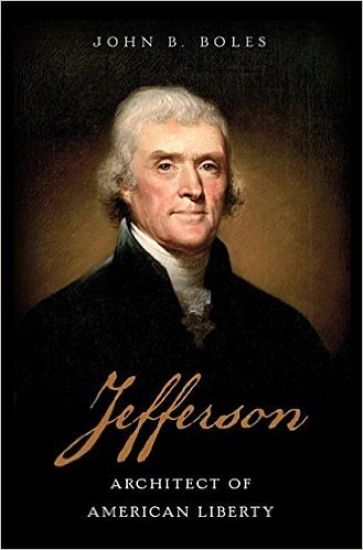
Not since Merrill Peterson's Thomas Jefferson and the New Nation has a scholar attempted to write a comprehensive biography of the most complex Founding Father. In Jefferson, John B. Boles plumbs every facet of Thomas Jefferson's life, all while situating him amid the sweeping upheaval of his times. We meet Jefferson the politician and political thinker-as well as Jefferson the architect, scientist, bibliophile, paleontologist, musician, and gourmet. We witness him drafting of the Declaration of Independence, negotiating the Louisiana Purchase, and inventing a politics that emphasized the states over the federal government - a political philosophy that shapes our national life to this day. Boles offers new insight into Jefferson's actions and thinking on race. His Jefferson is not a hypocrite, but a tragic figure - a man who could not hold simultaneously to his views on abolition, democracy, and patriarchal responsibility. Yet despite his flaws, Jefferson's ideas would outlive him and make him into nothing less than the architect of American liberty.
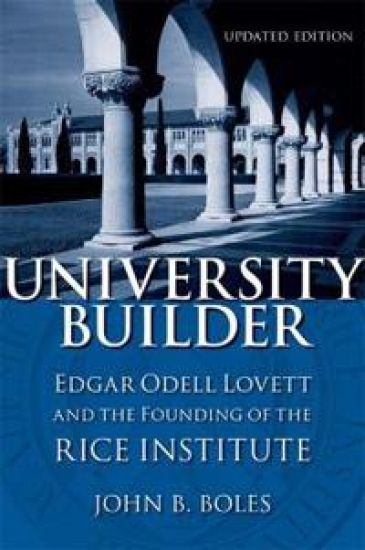
Rice University, one of America's preeminent institutions of higher education, grew out of the vision, direction, and leadership of one man: Edgar Odell Lovett (1871- 1957). University Builder is the fascinating story of this extraordinary educator and the unique school he created. Widely acknowledged, almost from its founding in 1912, as one of America's best universities, Rice is distinguished as both the smallest and the youngest institution in the top tier of American universities. In telling the tale of Lovett and his innovative, enduring vision for Rice, John Boles provides both a compelling biographical narrative and a refreshing new view of American higher education in the first half of the twentieth century.Lovett was not a Texan; he was not even a southerner. Rather, with two Ph.D.'s in hand, he was a rising star at Princeton University when the trustees of the newly founded Rice Institute--chartered in 1891 by wealthy Houston merchant William Marsh Rice--called him in 1907 to be the school's first president. Working with a significant endowment, a vague charter, a supportive board, and a visionary's gift for planning, Lovett set out on a fact-finding tour of educational institutions around the globe. He transformed the idea of the Institute into a complete university, one that emphasized research as much as teaching and aspired to world-class status. He sought the best architect available to design the campus, lured distinguished faculty from leading universities across the globe to Texas, and constructed a far-reaching vision of a small, carefully planned, elite university that incorporated the most advanced educational practices and shaped Rice's development for the next century.Lovett served as president of Rice for nearly forty years, proving himself to be an exemplary and charismatic leader who inspired two generations of students. He was the creator of Rice University in practically every way. Indeed, perhaps no other American university has been so shaped by its founder's vision. Boles's exceptional account of Lovett's remarkable academic achievement is a vital contribution to the legacy of Rice University and an important addition to the historiography of education in the early twentieth-century South.
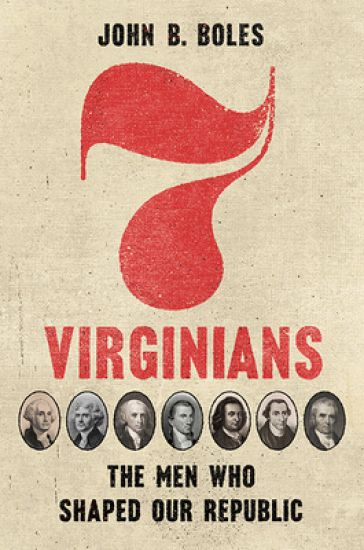
Seven Virginians, the culmination of a lifetime of erudition by one of America’s leading historians, reveals the integral role played by seven major Virginians before, during, and after the American Revolution: George Washington, Thomas Jefferson, James Madison, James Monroe, George Mason, Patrick Henry, and John Marshall.Most accounts of the founding generation focus only on the activities of the "big three"—Washington, Jefferson, and Madison—but Boles incorporates the key contributions of these other four important figures to the political and legal structures that govern the United States to this day. At the same time, Boles is clear-eyed about the Revolutionary generation’s problems and their fading from the scene, inaugurating the beginnings of Virginia’s political decline in the early nineteenth century. In so doing, Boles provides the crucial Virginian piece to the ongoing reevaluation of the United States’ founding moment.
Unto a Good Land offers a distinctive narrative history of the American people -- from the first contacts between Europeans and North America's native inhabitants, through the creation of a modern nation, to the standing of the United States as a world power. Written by a team of distinguished historians led by David Edwin Harrell, Jr. and Edwin S. Gaustad, this textbook shows how grasping the uniqueness of the bAmerican experimentb depends on understanding the role of religion as well as social, cultural, political, and economic factors in shaping U.S. history.A common shortcoming of most United States history textbooks is that while, in recent decades, they have expanded their coverage of social and cultural history, they still tend to shortchange the role of religious ideas, practices, and movements in the American past. Unto a Good Land addresses this shortcoming in a balanced way. The authors recognize that religion is only one of many factors that have influenced our past -- one, however, that has often been neglected in textbook accounts. This volume gives religion its appropriate place in the story.Unprecedented coverage of the forces that have shaped the history of the United StatesWhile none of America's rich history is left out, this volume is the first U.S. history textbook to give serious attention to the religious dimension of American life. This textbook is not a religious history; instead, it offers an account of American history that includes religious ideas, practices, and movements whenever they played a shaping role.Comprehensive and currentThis volume traces the American story from the earliest encounters between the first North Americaninhabitants and Europeans through the 2004 presidential election. Complete and balanced treatment is also given to issues of gender, race, and ethnicity, as well as cultural, political, and economic forces.A clear and compelling narrativeThe authors are more than expert historians; they are also talented writers who recognize history to be the retelling of human life. United by a seamless narrative structure, these chapters restore the bstoryb to history.Multiple formats specially designed for flexible classroom useUnto a Good Land is available as a single hardcover edition or as two paperback volumes, offering maximum flexibility when adapting curriculum for one- and two-semester courses in U.S. history. The two paperback volumes can be used for U.S. history survey courses divided at 1865 or 1900 -- or at any date in between.Informative special features to complement the textIn addition to the book's exceptional narrative, an array of special features enhances the instructional value of the text and points students to resources for further study.Includes assistance for teaching and test preparationThe instructor's manual for Unto a Good Land provides helpful suggestions for lesson plans and assignments, and the test bank provides multiple-choice and essay questions for use as study aids, quizzes, or tests.Suitable for instruction at both secular and religious colleges and universitiesDrawing on their experience in both secular and religious schools, the authors have ensured that this textbook is suitable for U.S. history classes in a wide variety of settings.
Introducing a New U.S. History Text That Takes Religion SeriouslyUnto a Good Land offers a distinctive narrative history of the American people -- from the first contacts between Europeans and North America's native inhabitants, through the creation of a modern nation, to the 2004 presidential election. Written by a team of highly regarded historians, this textbook shows how grasping the uniqueness of the -American experiment- depends on understanding not only social, cultural, political, and economic factors but also the role that religion has played in shaping U. S. history. While most United States history textbooks in recent decades have expanded their coverage of social and cultural history, they still tend to shortchange the role of religious ideas, practices, and movements in the American past. Unto a Good Land restores the balance by giving religion its appropriate place in the story. This readable and teachable text also features a full complement of maps, historical illustrations, and -In Their Own Words- sidebars with excerpts from primary source documents.
Improving Community Response to Crime Victims is a thoughtful and well-organized outline of steps and considerations for those who are serious about starting and maintaining an interagency team effort to respond to almost any type of serious interpersonal crime. Their commitment to victims is evident as the driving force throughout. They recognize that even small and relatively isolated communities have an impressive wealth of resources that can be marshalled to improve interagency coordination. And even communities with a tradition of good interdisciplinary cooperation can benefit from the process described here and enhance their response to victims, while achieving improved case outcomes. --from the Foreword by Patricia A. Toth, J.D. Use of interdisciplinary teams has been lauded as the most effective and successful approach to investigating and prosecuting physical and sexual abuse cases. However, such teams are often difficult to create and maintain. Improving Community Response to Crime Victims demystifies the process of establishing teams with an eight-step model called the "protocol development cycle." Informed by their extensive contact with a wide variety of professionals and communities, authors Anita B. Boles and John C. Patterson provide accessible and well-organized guidelines for those who are serious about starting and maintaining an interagency team to respond to almost any type of interpersonal crime. The book includes exercises and training materials along with sample letters, forms, press releases, and other documents designed to better aid community teams in assessing the response to crime and identifying any gaps in service. Presented in a practical and hands-on style, the information here will aid in the ongoing process of team protocol assessment, evaluation, review, and revision. Improving Community Response to Crime Victims skillfully addresses the challenge of interdisciplinary efforts and is an integral resource for therapists, investigators, prosecutors, medical personnel, government representatives, victim service providers, and others concerned with coordinating interagency assistance to victims of crime.
The Life of Blessed John B. Marie Vianney, Cur of Ars: With a Novena and Litany to this Zealous Worker in the Vineyard of the Lord, has been acknowledged as a major work throughout human history, and we have taken precautions to assure its preservation by republishing this book in a modern manner for both present and future generations. This book has been completely retyped, revised, and reformatted. The text is readable and clear because these books are not created from scanned copies.
This work has been selected by scholars as being culturally important and is part of the knowledge base of civilization as we know it.This work is in the public domain in the United States of America, and possibly other nations. Within the United States, you may freely copy and distribute this work, as no entity (individual or corporate) has a copyright on the body of the work.Scholars believe, and we concur, that this work is important enough to be preserved, reproduced, and made generally available to the public. To ensure a quality reading experience, this work has been proofread and republished using a format that seamlessly blends the original graphical elements with text in an easy-to-read typeface.We appreciate your support of the preservation process, and thank you for being an important part of keeping this knowledge alive and relevant.