Kirjojen hintavertailu. Mukana 11 244 527 kirjaa ja 12 kauppaa.

Kirjahaku

Etsi kirjoja tekijän nimen, kirjan nimen tai ISBN:n perusteella.

1000 tulosta hakusanalla John Bardes

The Carceral City

The Carceral City

John Bardes

THE UNIVERSITY OF NORTH CAROLINA PRESS
2024
sidottu
Americans often assume that slave societies had little use for prisons and police because slaveholders only ever inflicted violence directly or through overseers. Mustering tens of thousands of previously overlooked arrest and prison records, John Bardes demonstrates the opposite: in parts of the South, enslaved and free people were jailed at astronomical rates. Slaveholders were deeply reliant on coercive state action. Authorities built massive slave prisons and devised specialized slave penal systems to maintain control and maximize profit. Indeed, in New Orleans—for most of the past half-century, the city with the highest incarceration rate in the United States—enslaved people were incarcerated at higher rates during the antebellum era than are Black residents today. Moreover, some slave prisons remained in use well after Emancipation: in these forgotten institutions lie the hidden origins of state violence under Jim Crow.With powerful and evocative prose, Bardes boldly reinterprets relations between slavery and prison development in American history. Racialized policing and mass incarceration are among the gravest moral crises of our age, but these crises are not new: slavery, the prison, and race are deeply interwoven into the history of American governance.
The Carceral City

The Carceral City

John Bardes

THE UNIVERSITY OF NORTH CAROLINA PRESS
2024
pokkari
Americans often assume that slave societies had little use for prisons and police because slaveholders only ever inflicted violence directly or through overseers. Mustering tens of thousands of previously overlooked arrest and prison records, John Bardes demonstrates the opposite: in parts of the South, enslaved and free people were jailed at astronomical rates. Slaveholders were deeply reliant on coercive state action. Authorities built massive slave prisons and devised specialized slave penal systems to maintain control and maximize profit. Indeed, in New Orleans—for most of the past half-century, the city with the highest incarceration rate in the United States—enslaved people were incarcerated at higher rates during the antebellum era than are Black residents today. Moreover, some slave prisons remained in use well after Emancipation: in these forgotten institutions lie the hidden origins of state violence under Jim Crow.With powerful and evocative prose, Bardes boldly reinterprets relations between slavery and prison development in American history. Racialized policing and mass incarceration are among the gravest moral crises of our age, but these crises are not new: slavery, the prison, and race are deeply interwoven into the history of American governance.
John Baldessari Catalogue Raisonné
The second in a projected four-volume series of the complete catalogue of works by John Baldessari Compiling four-hundred-plus unique works of art, this volume traces the shifts and developments in conceptual artist John Baldessari’s work from 1975-86. It covers his photo-based works such as the “Strobe,” “Word Chain,” and “Pathetic Fallacy” series from 1975; the “Violent Space” and the seminal “Concerning Diachronic/Synchronic Time: Above, On, Under (With Mermaid),” from 1976; and the “Blasted Allegories” series from 1977-78, which drew heavily from the artist’s vast collection of photo stills taken from commercial television.In the 1980s, Baldessari’s art took a different direction, beginning with the expansive “Fugitive Essays” triptychs from 1980 and leading to 1982’s photographic interpretations of Grimm’s Fairy Tales. Building on these themes, Baldessari began producing a body of work that was inspired in part by dreams, psychology, film, and popular culture. Ensuing works were more formal, elaborate, and large-scale. From 1984 to 1986 Baldessari created a number of works that employed his soon-to-be-signature colored discs painted over people’s faces in the photos.An introductory essay will provide a close reading of selected works and a historical context for understanding Baldessari’s art from this period. A detailed chronology and exhibition history and bibliography are also included. This is the second of a projected four-volume catalogue raisonné.Published in association with Marian Goodman Gallery
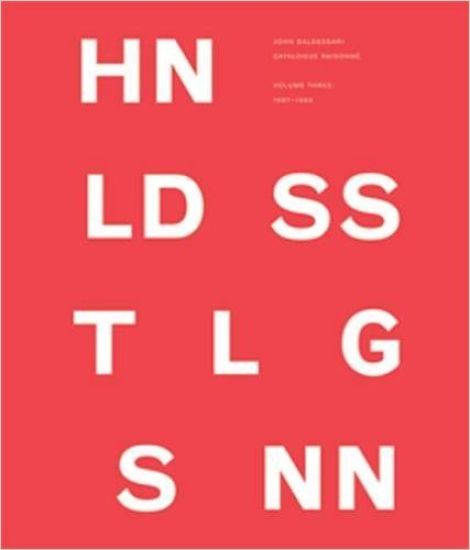
John Baldessari Catalogue Raisonné
A comprehensive look at works made by Baldessari between the years 1987 and 1993 This handsome volume, the third of the John Baldessari (b. 1931) catalogue raisonné project, compiles 400-plus unique works of art made by the influential conceptual artist from 1987 through 1993. Here we see the artist’s large-scale photo-based works, many of which employed his signature colored discs painted over the faces of people in the photos, accompanied by entries that trace the shifts and developments in Baldessari’s work as his collaged photo narratives achieved maturity and mastery. A critical essay by Briony Fer provides a close reading of selected works, giving historical context for Baldessari’s art from this period. In addition to a detailed chronology, complete exhibition history, and bibliography, this volume notably features a previously unpublished conversation between Baldessari and the artist Ed Ruscha, which was undertaken specifically for this publication. In the conversation, the artists discuss their early careers in Southern California and the shared thematic concerns in their work. The artworks in this volume demonstrate Baldessari’s ability to express—and, in many cases, combine—the narrative potential of images and the associative power of language within the boundaries of a single piece. Published in association with Marian Goodman Gallery
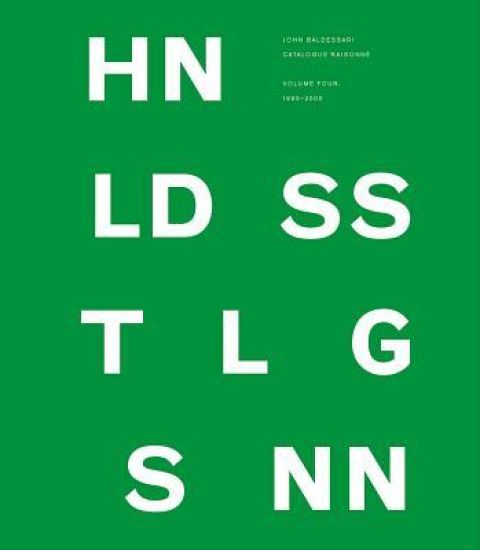
John Baldessari Catalogue Raisonné
The fourth volume of the John Baldessari Catalogue Raisonné comprises approximately 370 works that represent the activity of this iconic conceptual artist between 1994 and 2004. Here, John Baldessari (b. 1931) continues to interrogate the possibilities of photographic appropriation, further developing his unique strategies for the production of meaning and narrative within the picture frame. Included in this crucial volume is the landmark Goya series, which shows the artist revisiting his characteristic photo-text pieces established early in his career. In the serial trio Overlap, Intersection,and Junction, produced between 2000 and 2002, Baldessari riffs on the notion of pictorial space, with each series building on the preceding one. Along with a full chronology, an essay contributed by the eminent critic Robert Storr closely examines a selection of these works, articulating their place within the evolution of the artist’s career and their much broader historical climate. Published in association with Marian Goodman Gallery
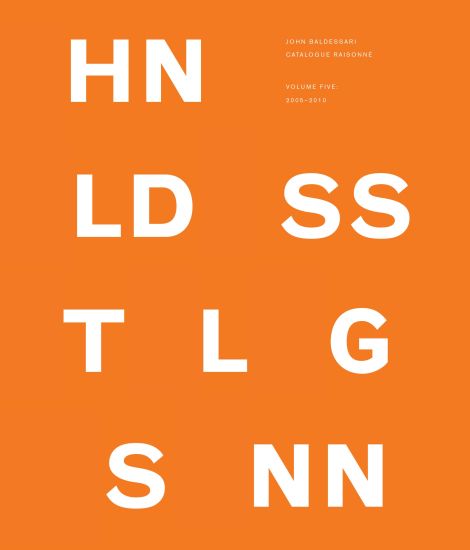
John Baldessari Catalogue Raisonné
The fifth volume of the John Baldessari Catalogue Raisonné compiles the approximately 367 works made by the influential American conceptual artist (b. 1931) from 2005 through 2010. During these years, the artist undertook a number of series, including the shaped erasures of “Blockage”; the word-and-image juxtapositions of “Prima Facie”; the explorations of the face in “Nose and Ears, Etc.” and “Raised Eyebrows/Furrowed Foreheads”; and the muted, spare “Sediment” works on canvas. Catalogue entries allow readers to trace the shifts and developments in Baldessari’s work during these years, a time of continued experimentation and aesthetic distillation that is further explored in a conversation between Baldessari and fellow artist David Salle. A critical essay by Hannah B. Higgins provides a close reading of selected works and gives a historical context for understanding Baldessari’s art from this period. Published in association with Marian Goodman Gallery
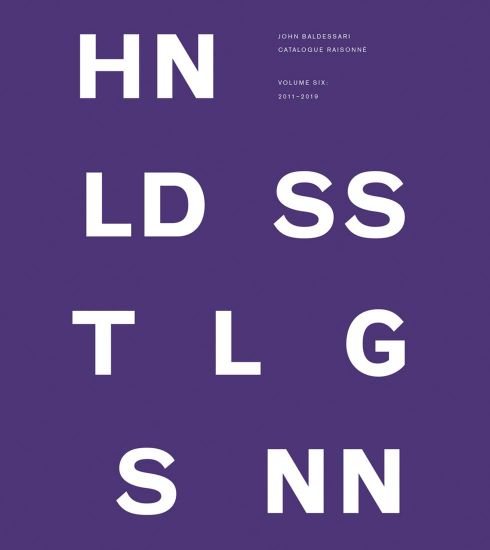
John Baldessari Catalogue Raisonne
The sixth and final volume documenting the work of an iconic American artist The sixth and final volume of this exceptional catalogue raisonné project features over 360 works made by John Baldessari (1931–2020) between 2011 and 2019. Here, Baldessari continues his longstanding tradition of borrowing from artists as varied as David Hockney, Giotto, Gustave Courbet, Maria Lassnig, Lucas Cranach the Elder, Giorgio Morandi, and Jackson Pollock. Many of the works in this volume are a testament to the artist’s fascination and engagement with art from previous eras. In one example, Baldessari’s 2012 series “Double Bill” combines scenes from pairs of paintings, such as a Willem de Kooning face atop a Jean Dubuffet body, with the words, “…And Dubuffet” painted beneath: Baldessari is effectively collaborating with artists he has revered for years. This volume also surveys Baldessari’s complete film and video output, from 1968 to 2004, as well as the artist’s books he made, from 1972 to 2019. Additionally, an appendix catalogues works, mostly pre-1974, that were unknown at the time Volume 1 was published.Published in association with Marian Goodman Gallery
John Baldessari & Naomi Shohan

John Baldessari & Naomi Shohan

Campany David; Cappellazzo Amy

JRP Ringier
2011
nidottu
"PA" is an annual artist's magazine devoted to artists that use photography. For each issue, an artist is asked to invite a collaborator to engage in a dialogue about their practice. For this latest issue, American artist John Baldessari chose film set designer Naomi Shohan, and the two collaborated on a brilliant and witty elaboration of Baldessari's treatment of found photography. The book juxtaposes Hollywood film stills from the outsider's viewpoint--Baldessari's take on Hollywood--with film stills from the insider's viewpoint-- that of Shohan the set designer, who has worked on major film productions such as "American Beauty," "Constantine," "The Replacement Killers" and "The Sorcerer's Apprentice." Baldessari is well known for his enjoyment of collaboration, but this volume constitutes his most intriguing venture to date. Also included is a conversation with the artists by Amy Cappellazzo.
John Baldessari

John Baldessari

JRP Ringier
2011
nidottu
This second volume of JRP-Ringier's complete John Baldessari writings traces the genesis and development of the artist's understanding of art in the early 1960s through to the present. "More Than You Wanted to Know About John Baldessari" presents Baldessari as storyteller, moralist, teacher and occasional gadfly, always concerned to accomplish what he describes as the central task of art making: to communicate in a way that people can understand. These writings address everything from matters of color in sculpture, to the dilemmas of art students in need of ideas, to the art world's ever-conflicted relationship with money, while always returning to Baldessari's love of language and his longstanding investigation into the tensions of word and image. With numerous never-before-published texts and facsimiles of original documents, this long-anticipated collection will prove essential reading for anyone involved in contemporary art.
John Baldessari

John Baldessari

Baldessari John; Bickerton Ashley; Liz Craft; Cranston Meg; Gonzalez Julieta; Hammonds Kit; Mullican Matt; Oursler Tony; Salle David

JRP Ringier
2017
sidottu
As ludic and nonauthoritarian as John Baldessari's art, this new monograph on the "father of conceptual art" is dedicated to his practice as an artist and a teacher, and the many ways in which they intertwine. Having been trained as an arts educator, John Baldessari (born 1931) is renowned for his work as much as for his innovative class at CalArts, Los Angeles, where he has formed many generations of artists and helped shape the West Coast art scene. Organized alphabetically, Learning to Read with John Baldessari--which accompanies a retrospective at Museo Jumex, Mexico City--includes an essay on the artist's approaches to art-making and teaching; a biography of the artist as a teacher; artworks reproduced thematically; and stories and anecdotes from former students such as Liz Craft, Ed Henderson, Matt Mullican, Tony Oursler and David Salle, about their years at CalArts.
John Baldessari

John Baldessari

Hirmer Verlag
2016
sidottu
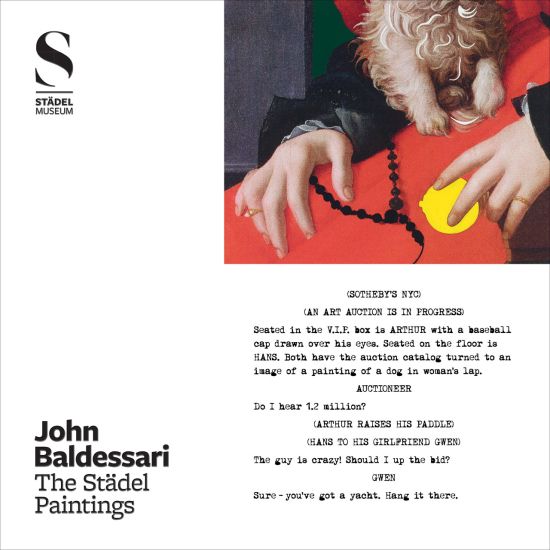
John Baldessari is an important American conceptual artists and the last member of the American postwar avant-garde. His large collages, created for the Frankfurt exhibition, draw on masterpieces at the Städel, from Lucas Cranach the Elder to Maria Lassnig. A multifaceted opposition and juxtaposition of old and new art is revealed by the texts and photographs. By destroying all of his paintings created from 1953 to 1966 in 1970, John Baldessari (*1931) paved the way for an independent and unmistakeable pictorial style between painting and photography, text and image. He employs classic Modernist pictorial strategies such as montage and the integration of everyday elements in order to confront these with artistic practices of the post-war avant-gardes, such as discourses on consumerism and the media. Baldessari intertwines media and materials and thereby combines entirely distinct groups of artistic subjects. In the process, the unambiguousness of the pictorial language has given way to a multi-layered readability.
John Baldessari

John Baldessari

Barbara Bloom; Russel Ferguson; Hans Ulrich Obrist; David Salle

Walther Koenig
2021
sidottu
The Space Between. When youre looking at two things, dont look at them, look between them ... The space between two things, thats very important. John BaldessariThe Space Between celebrates John Baldessaris final painting series 30 paintings on canvas that explore the gaps in meaning between word and image, foreground and background, photography and painting, presence and absence.Quintessentially Baldessarian in their witty, sometimes absurd pairings of objects and text, they feature imagery from film stills and found photographs, partially covered by gestural fields of white and black paint that direct our attention to
More Than You Wanted to Know About John Baldessari
This first volume of JRP-Ringier's complete John Baldessari writings project traces the genesis and development of the artist's understanding of art in the early 1960s. "More Than You Wanted to Know About John Baldessari" presents Baldessari as storyteller, moralist, teacher and occasional gadfly, always concerned to accomplish what he describes as the central task of art making: to communicate in a way that people can understand. These writings address everything from matters of color in sculpture, to the dilemmas of art students in need of ideas, to the art world's ever-conflicted relationship with money, while always returning to Baldessari's love of language and his longstanding investigation into the tensions of word and image. With numerous never-before-published texts and facsimiles of original documents, this long-anticipated collection will prove essential reading for anyone involved in contemporary art.
Fit2besick: The side effects of perfection
Most people think exercise is healthy-and for the most part, they're right. However, it is possible to have too much of a good thing.John Badessa is perhaps one of the most motivated people on the planet. In his memoir, Fit2BeSick: The Side Effects of Perfection, he chronicles his run as a world-champion BMX racer and his complicated relationship with fitness.After conquering BMX, he got into auto racing, weight lifting, and road cycling. There were many bumps in the road, but Badessa stayed the course, constantly striving for perfection. However, he would come to learn that as one draws near perfection, it only retreats further into the distance.In addition to chronicling Badessa's journey to the top echelons of BMX and road cycling, Fit2BeSick serves as a warning to athletes who push themselves too far. Badessa learned too late that overtraining can be counterproductive; he thought he was pushing himself to the edge, but instead he hit a wall. His story is an important one for anyone who has his or her sights set on the highest level of physical achievement. Sometimes you've got to hold something back before you can go all the way.
A-Z of Conwy

A-Z of Conwy

John Barden Davies

Amberley Publishing
2017
nidottu
The popular medieval town of Conwy in North Wales, dominated by its thirteenth-century castle, has a long and often violent history. There are many stories behind the town’s ancient castle and walls, its streets and buildings, and its residents, past and present, famous and infamous. These are told here, by local author John Barden Davies, as he takes the reader on their very own A-Z tour around the town’s history, exploring its nooks and crannies, and along the way relating many a fascinating tale of the most interesting people and places. Fully illustrated with photographs, this new A-Z guide to the town’s history will appeal to residents and visitors alike.