Kirjojen hintavertailu. Mukana 11 244 527 kirjaa ja 12 kauppaa.

Kirjahaku

Etsi kirjoja tekijän nimen, kirjan nimen tai ISBN:n perusteella.

1000 tulosta hakusanalla John Baxter Pike

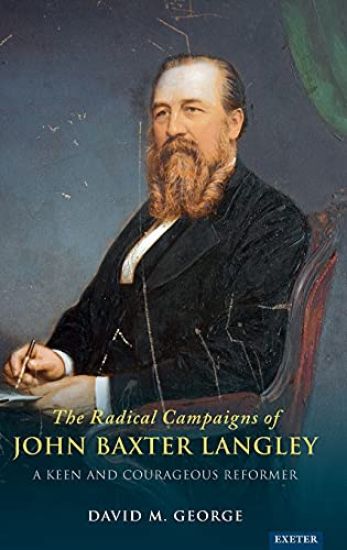
The Radical Campaigns of John Baxter Langley

The Radical Campaigns of John Baxter Langley

David George

University of Exeter Press
2021
sidottu
Once notorious but now largely forgotten, the political idealist and radical John Baxter Langley was typical of the well-educated and ethical Victorians who struggled to create a fairer, more equal society. Through a long and wide-ranging career of political agitation he was a journalist, editor and owner of several newspapers, was prominent in the call for franchise reform, and opposed religious legislation that prevented Sunday entertainment and education for working men and women. Langley was also integral to the founding of a trade union, campaigned for an end to public executions and built affordable housing in Battersea. Internationally, he condemned the Second Opium War, exposed British brutality in India and worked covertly for Lincoln’s administration. He was a fellow-traveller for many other key radicals of the day, while his founding of the ‘Church of the Future’ garnered the support of Charles Darwin, James Martineau and John Stuart Mill. Through a chronological narrative of Langley's activities, this book provides an overview of many of the most significant political causes of the mid- to late nineteenth century. These include electoral reform, feminism, slavery, racism, trade unionism, workers' rights, the free press, leisure, prostitution, foreign relations and espionage. A neglected but important figure in the history of nineteenth-century radicalism, this work gives John Baxter Langley the attention he deserves and reveals the breadth of his legacy. DOI: https://doi.org/10.47788/LVPH3819
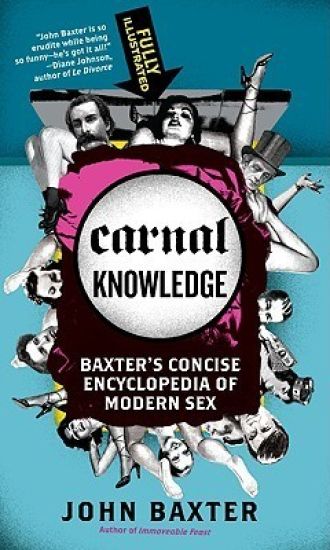
Carnal Knowledge: Baxter's Concise Encyclopedia of Modern Sex
Averitable smorgasbord of sin, John Baxter's Carnal Knowledge is a delightfully unabashed education in sex and erotic culture. Would you ever consent to a knee-trembler at a love hotel? Would you enjoy a hot lunch while watching kinbaku? Would you consider wearing a French tickler, a merkin, a strap-on, or pasties . . . or would you rather just go commando at the Mine Shaft? From Deep Throat to Debbie Does Dallas, from the mile-high club to the Emperor's Club, John Baxter explains it all to you in this decadently definitive work on the many ins and outs of s-e-x, guaranteed to tantalize, edify, and titillate whether you're a novice or an expert in the arts of eros.
The First Constitution of St. John's Church

The First Constitution of St. John's Church

St John's Evangelical Lutheran Churc; John Baxter Moose

Hassell Street Press
2021
nidottu
This work has been selected by scholars as being culturally important and is part of the knowledge base of civilization as we know it.This work is in the public domain in the United States of America, and possibly other nations. Within the United States, you may freely copy and distribute this work, as no entity (individual or corporate) has a copyright on the body of the work.Scholars believe, and we concur, that this work is important enough to be preserved, reproduced, and made generally available to the public. To ensure a quality reading experience, this work has been proofread and republished using a format that seamlessly blends the original graphical elements with text in an easy-to-read typeface.We appreciate your support of the preservation process, and thank you for being an important part of keeping this knowledge alive and relevant.
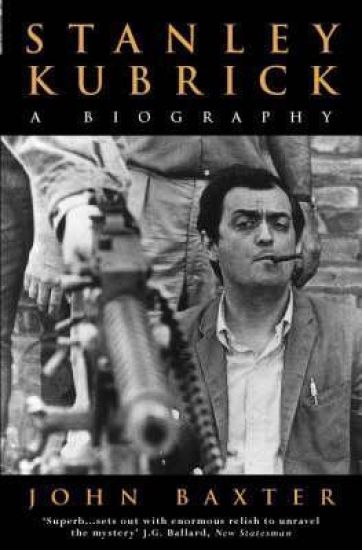
Stanley Kubrick

Stanley Kubrick

John Baxter

HARPERCOLLINS PUBLISHERS
1998
pokkari
The most complete account yet of one of the most original and stimulating film-makers of the post-war years: Paths of Glory, Dr Strangelove, Lolita, 2001: A Space Odyssey, A Clockwork Orange, The Shining, Barry Lindon, Full Metal Jacket â?¦
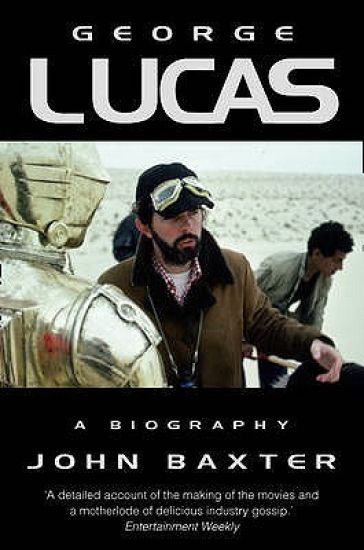
George Lucas

George Lucas

John Baxter

HarperCollins Entertainment
2000
nidottu
The first major biography (since 1983) of the great movie mogul George Lucas, whose marketing techniques have transformed the film business. His fourth Star Wars film, The Phantom Menace, released in 1999, was perhaps the most eagerly awaited cinematic event of all time. George Lucas is one of the most innovative bigtime players on the movie scene. His three Star Wars films and the trio featuring the action hero Indiana Jones (all six of which Lucas conceived, produced and co-wrote) comprise the most popular group of films ever made. To finance them, he masterminded a revolutionary redrawing of the financial agreements under which films were produced in Hollywood, snatching away control of funding, intellectual content and the distribution of profits from studios, and placing them in the hands of the film-makers themselves. Yet Lucas remains (like Stanley Kubrick, the subject of John Baxter’s recent biography) an enigma and a recluse. He has specially built the Skywalker Ranch a long way from Hollywood – a Victorian village community in a redwood forest where he and his friends can work in splendid isolation, free of studio pressure but with the highest technology.
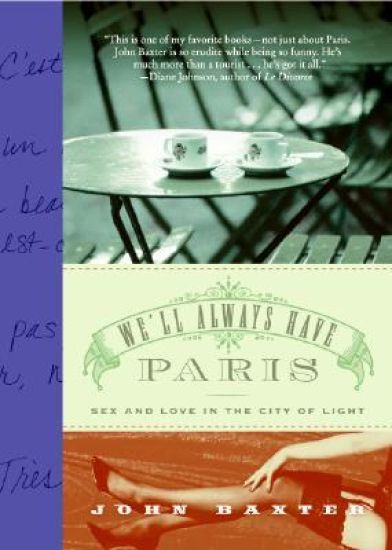
We'll Always Have Paris: Sex and Love in the City of Light
For more than a century, pilgrims from all over the world seeking romance and passion have made their way to the City of Light. The seductive lure of Paris has long been irresistible to lovers, artists, epicureans, and connoisseurs of the good life. Globe-trotting film critic and writer John Baxter heard her siren song and was bewitched. Now he offers readers a witty, audacious, scandalous behind-the-scenes excursion into the colorful all-night show that is Paris -- interweaving his own experience of falling in love, with a delightfully salacious tour of the sultry Parisian corners most guidebooks ignore: from the literary caf s of Hemingway, Fitzgerald, and de Beauvoir to the brothels where Dietrich and Duke Ellington held court, where Salvador Dali sated his fantasies, and Edward VII kept a sumptuous champagne bath for his favorite girls.
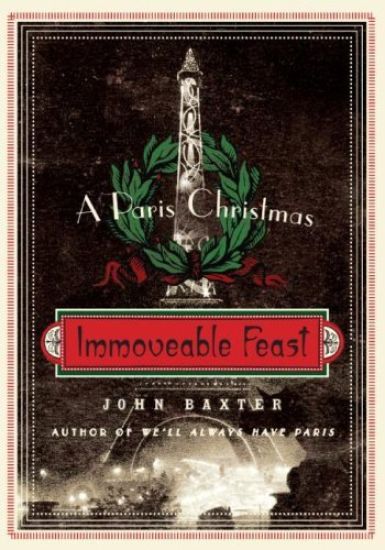
Immoveable Feast: A Paris Christmas

Immoveable Feast: A Paris Christmas

John Baxter

HARPER PERENNIAL
2008
nidottu
A witty cultural and culinary education, Immoveable Feast is the charming, funny, and improbable tale of how a man who was raised on white bread--and didn't speak a word of French--unexpectedly ended up with the sacred duty of preparing the annual Christmas dinner for a venerable Parisian family.Ernest Hemingway called Paris "a moveable feast"--a city ready to embrace you at any time in life. For Los Angeles-based film critic John Baxter, that moment came when he fell in love with a French woman and impulsively moved to Paris to marry her. As a test of his love, his skeptical in-laws charged him with cooking the next Christmas banquet--for eighteen people in their ancestral country home. Baxter's memoir of his yearlong quest takes readers along his misadventures and delicious triumphs as he visits the farthest corners of France in search of the country's best recipes and ingredients. Irresistible and fascinating, Immoveable Feast is a warmhearted tale of good food, romance, family, and the Christmas spirit, Parisian style.
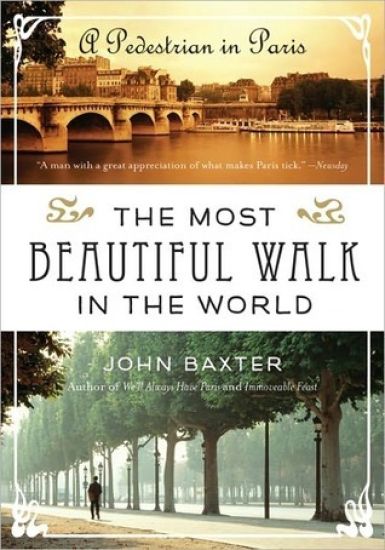
The Most Beautiful Walk in the World

The Most Beautiful Walk in the World

John Baxter

HarperCollins
2011
nidottu
"Aman with a great appreciation of what makes Paris tick." --NewsdayFromthe author of Immoveable Feast and We'll Always Have Paris comes aguided tour of the most beautiful walks through the City of Light, includingthe favorite walking routes of the many of the acclaimed artists and writerswho have called Paris their home. Baxter highlights hidden treasures along theSeine, treasured markets at Place d'Aligre, thefavorite ambles of Ernest Hemingway, Gertrude Stein, and Sylvia Beach, andmore, in a series of intimate vignettes that evoke the best parts of Paris'smany charms. Baxter's unforgettable chronicle reveals how walking is the bestway to experience romance, history, and pleasures off the beaten path . . . notonly of La Ville-Lumiere, but also, perhaps, of life itself.
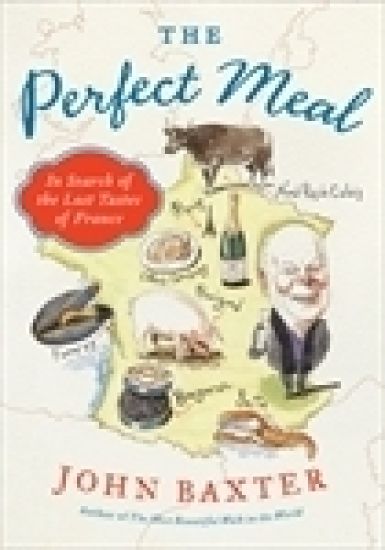
The Perfect Meal

The Perfect Meal

John Baxter

HarperPerennial
2013
nidottu
Just as species of plants and animals are expiring at an alarming rate, so are the traditional ingredients and techniques of classic cooking and eating. Nowhere is this trend more evident than in France, where the heart of the world's most revered and complex national cuisine is in danger of disappearing, as old ways of agriculture, butchering, and cooking are withering - leaving us with only a small fraction of the astonishing delights and surprises French cuisine has to offer. In this charming culinary travel memoir, the bestselling author of "The Most Beautiful Walk in the World" goes on the hunt for the most delicious and bizarre endangered foods of France, including: Ortolans - Tiny birds, drowned in armagnac, sauteed in butter and eaten whole, bones and all, ideally with a large napkin draped over your head to conserve the aroma; Bouillabaisse - Seafood stew that only tastes right if you eat it by the Mediterranean. The secret is an ugly fish called the rascasse that lurks around wrecks; 100 Year-Old Cognac - The old stuff never gets to the shops, but Baxter's wife is friendly with one of the big distillers, so readers get a taste tour of what only millionaires can afford to drink; Confiture Vieux Garcon - Literally, Old Boy's Preserves. Soft fruit in season is placed in a crock, covered in brandy and left to marinate for a year. Traditionally served on ice cream, but a few spoonsful in the morning really set you up. Ox. The book culminates in Baxter's participation in a traditional ox roast, in which an enormous whole ox is cooked on a spit over coals. The recipe begins on a practical note: First, catch your ox...
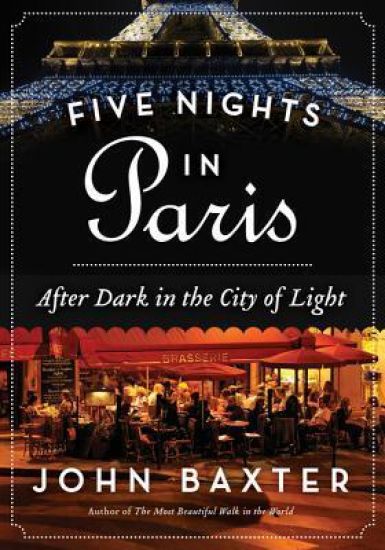
Five Nights in Paris

Five Nights in Paris

John Baxter

HarperPerennial
2015
nidottu
The preeminent expat writer on Paris and author of The Most Beautiful Walk in the World takes you on an unforgettable nocturnal stroll through five iconic Parisian neighborhoods and his own memories. John Baxter enchanted readers with his literary tour of Paris in The Most Beautiful Walk in the World. Now, this expat who has lived in the City of Light for more than twenty years introduces you to the city's streets after dark, revealing hidden treasures and unexpected delights. As he takes you through five of the city's greatest neighborhoods-Montmartre, Montparnasse, the Marais, and more-Baxter shares pithy anecdotes about his life in France, as well as fascinating knowledge he has gleaned from leading literary tours of the city by dark. With Baxter as your guide, you will discover the City of Light as never before, walking in the ghostly footsteps of Marcel Proust, the quintessential night owl for whom memory was more vivid than reality; Hungarian photographer Gyula Halasz, known as Brassai, who prowled the midnight streets, camera in hand, with his friend Henry Miller; Louis Aragon and Philippe Soupault, who shared the Surrealists' taste for the city's shadowed, secret world; and Josephine Baker and other African-American performers who dazzled adventurous Parisians at late-night jazz clubs. A feast for the mind and the senses, Five Nights in Paris takes you through the haunts of Paris's most storied artists and writers to the scenes of its most infamous crimes in a lively off-the-beaten-path tour not found in any guidebook.
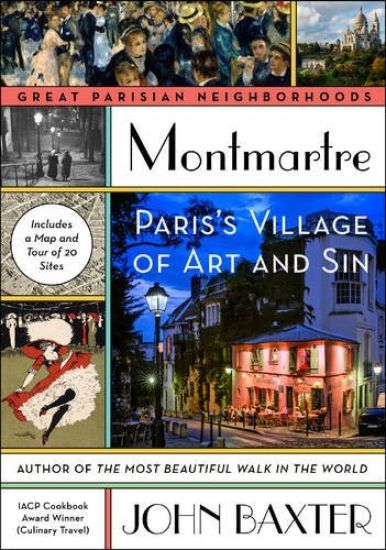
Montmartre

Montmartre

John Baxter

HarperPerennial
2017
nidottu
In the second portrait of his series Great Parisian Neighborhoods, award-winning raconteur John Baxter leads us on a whirlwind tour of Montmartre, the hill-top village that fired the greatest achievements of modern art while also provoking bloody revolution and the sexual misbehavior that made Paris synonymous with sin High on the northern edge of Paris, Montmartre has always attracted bohemians, political radicals, the searchers for artistic inspiration as well as those hungry for pleasure. In its winding, windmill-shadowed streets, which, only fifty years before, saw the anarchist rising of the Commune, Renoir, Picasso and van Gogh seized a similar freedom to remake painting, while, in the tenderloin of Pigalle, Toulouse-Lautrec drew the cancan dancers of the Moulin Rouge, celebrating a hedonism that titillated the world, In Montmartre, bestselling author and IACP Award winner John Baxter lifts the curtain on a district that visitors to Paris seldom see. From the tumbledown workshops of the Bateau Lavoir in which Picasso and Braque created Cubism to Clichy's Cabaret of Nothingness where guests dined at coffins under lamps of human bones, the whole of this mysterious enclave is ours to explore. For visitors and armchair travelers alike, Montmartre captures the excitement and scandal of a fascinating quarter that condenses the elusive perfumes, colors and songs of Paris.
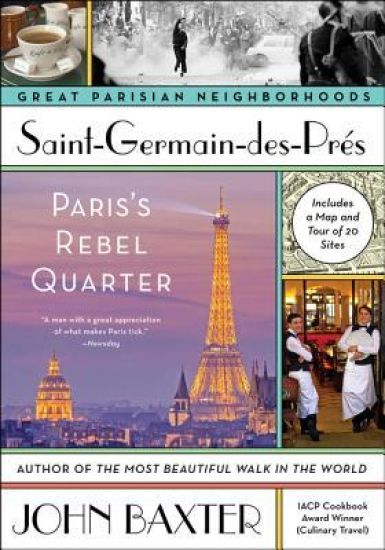
Saint-Germain-des-Pres

Saint-Germain-des-Pres

John Baxter

HarperPerennial
2016
nidottu
The award-winning chronicler of life in Paris reveals the secrets of his home quarter, Saint-Germain-des-Pres A unique blend of history, memoir, and sightseeing essentials, Saint-Germain-des-Pres is a captivating "narrative guidebook" to one of Paris's iconic quarters by John Baxter, bestselling author of The Most Beautiful Walk in the World. Occupying less than a square mile along Paris's Left Bank, Saint-Germain-des-Pres, originally an independent village centered around the medieval abbey that lends the quarter its name, has for centuries been home to rebels of all stripes. Within its boundaries, the French Revolution was plotted, the guillotine invented, and in 1968 students revolted and clashed with police. Philosopher Descartes is buried here (sans skull), while Sartre, Camus, and de Beauvoir birthed existentialism around the tables of the legendary Cafe de Flore. Saint-Germain sheltered and inspired such artistic rebels as Picasso, Rimbaud, Hemingway, and scores of jazz musicians. Today, the neighborhood, with its cobblestone streets, iconic cafes, and unique shopping destinations, is one of Paris's premier tourist attractions. And yet it retains its rebel soul-if you know where to look. In this first book in his "Great Parisian Neighborhoods" series, Baxter, an expat who has called Saint-Germain home for more than two decades, guides readers on an off-the-beaten-path journey through the quarter's history, landmarks, and delights.
Montparnasse

Montparnasse

John Baxter

HarperPerennial
2018
nidottu
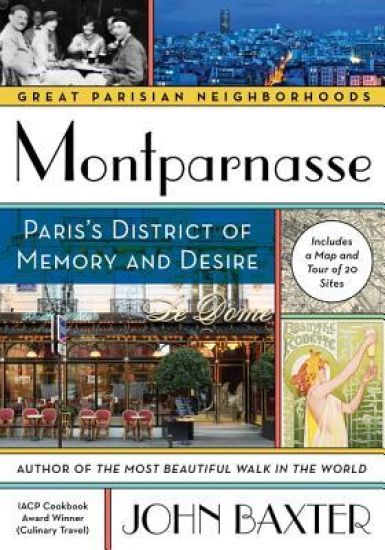
In the third portrait of his series Great Parisian Neighborhoods, award-winning raconteur John Baxter takes readers on a dazzling excursion of Montparnasse. By the IACP Award-winning author of the national bestseller The Most Beautiful Walk in the World, MONTPARNASSE reveals the history and present delights of the iconic neighborhood that is best associated with the vibrant 1920-30s-era Paris-a romantic time and place evoked in Hemingway's memoir A Moveable Feast and Henry Miller's Tropic of Cancer. From the first meeting of Hemingway and F. Scott Fitzgerald to their friendship's bitter conclusion; from the courage of the anti-Nazi resistance to the clubs where German generals partied; from the attempted murder of Samuel Beckett to the rise of Josephine Baker to stardom; from the high life of the Coupole and the Cafe du Dome to the bawdy music halls of rue de la Gaite; no Paris quarter has witnessed more tumultuous events than Montparnasse. In a ground-breaking reappraisal of this most glamorous of Paris's districts, Baxter looks beyond the nostalgia to the secret history of Montparnasse, a district where desire effaced memory and every taste could be satisfied-even those which were unexpressed. If, as Oscar Wilde suggested, all good Americans went to Paris when they died, it was Montparnasse that brought them back to life.
A Year in Paris

A Year in Paris

John Baxter

HarperPerennial
2019
nidottu
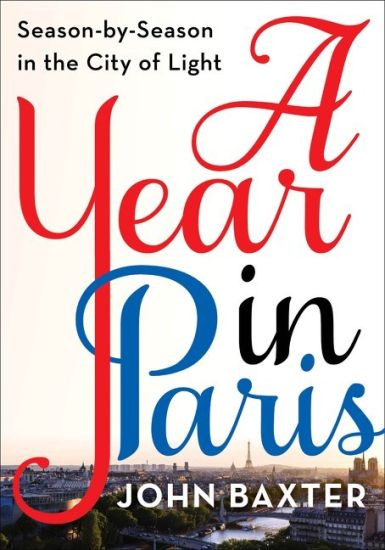
A NEW YORK TIMES "SUMMER READING" PICK!From the incomparable John Baxter, award-winning author of the bestselling The Most Beautiful Walk in the World, a sumptuous and definitive portrait of Paris through the seasons, highlighting the unique tastes, sights, and changing personality of the city in spring, summer, fall, and winter.When the common people of France revolted in 1789, one of the first ways they chose to correct the excesses of the monarchy and the church was to rename the months of the year. Selected by poet and playwright Philippe-Francois-Nazaire Fabre, these new names reflected what took place at that season in the natural world; Fructidor was the month of fruit, Floréal that of flowers, while the winter wind (vent) dominated Ventôse. Though the names didn’t stick, these seasonal rhythms of the year continue to define Parisians, as well as travelers to the city. As acclaimed author and long-time Paris resident John Baxter himself recollects, “My own arrival in France took place in Nivôse, the month of snow, and continued in Pluviôse, the season of rain. To someone coming from Los Angeles, where seasons barely existed, the shock was visceral. Struggling to adjust, I found reassurance in the literature, music, even the cuisine of my adoptive country, all of which marched to the inaudible drummer of the seasons.”Devoting a section of the book to each of Fabre’s months, Baxter draws upon Paris’s literary, cultural and artistic past to paint an affecting, unforgettable portrait of the city. Touching upon the various ghosts of Paris past, from Hemingway and Zelda Fitzgerald, to Claude Debussy to MFK Fisher to Francois Mitterrand, Baxter evokes the rhythms of the seasons in the City of Light, and the sense of wonder they can arouse for all who visit and live there.A melange of history, travel reportage, and myth, of high culture and low, A Year in Paris is vintage John Baxter: a vicarious thrill ride for anyone who loves Paris.
A Pound of Paper

A Pound of Paper

John Baxter

St Martin's Press
2005
nidottu
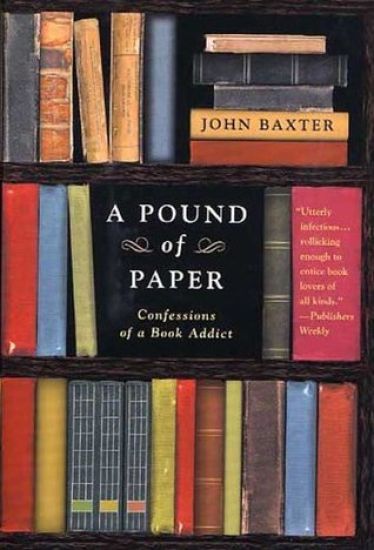
In the rural Australia of the fifties where John Baxter grew up, reading books was disregarded with suspicion, owning and collecting them with utter incomprehension. Despite this, by the age of eleven Baxter had 'collected' his first book - "The Poems of Rupert Brooke." He'd read the volume often, but now he had to own it. This was the beginning of what would become a major collection and a lifelong obsession.His book-hunting would take him all over the world, but his first real find was in London in 1978, when he spotted a rare copy of a Graham Greene children's book while browsing on a stall in Swiss Cottage. It was going for 5 pence. This would also, fortuitously, be the day when he first encountered one of the legends of the book-selling world: Martin Stone. At various times pothead, international fugitive from justice, and professional rock musician, he would become John's mentor and friend.In this brilliantly readable and funny book, John Baxter brings us into contact with such literary greats as Graham Greene, Kingsley Amis, J.G. Ballard and Ray Bradbury. But he also shows us how he penetrated the secret fraternity of 'runners' or book scouts - sleuths who use bluff and guile to hunt down their quarry - and joined them in scouring junk shops, markets, auction rooms and private homes for rarities.In the comic tradition of Clive James's "Unreliable Memoirs," "A Pound of Paper" describes how a boy from the bush came to be living in a Paris penthouse with a library worth millions. It also explores the exploding market in first editions. What treasures are lying unnoticed in your garage?
Shakespeare's Poetic Styles

Shakespeare's Poetic Styles

John Baxter

Routledge
2004
sidottu
First published in 1980. At their most successful, Shakespeare's styles are strategies to make plain the limits of thought and feeling which define the significance of human actions. John Baxter analyses the way in which these limits are reached, and also provides a strong argument for the idea that the power of Shakespearean drama depends upon the co-operation of poetic style and dramatic form. Three plays are examined in detail in the text: The Tragedy of Mustapha by Fulke Greville and Richard II and Macbeth by Shakespeare.
Shakespeare's Poetic Styles

Shakespeare's Poetic Styles

John Baxter

Routledge
2013
nidottu
First published in 1980. At their most successful, Shakespeare's styles are strategies to make plain the limits of thought and feeling which define the significance of human actions. John Baxter analyses the way in which these limits are reached, and also provides a strong argument for the idea that the power of Shakespearean drama depends upon the co-operation of poetic style and dramatic form. Three plays are examined in detail in the text: The Tragedy of Mustapha by Fulke Greville and Richard II and Macbeth by Shakespeare.
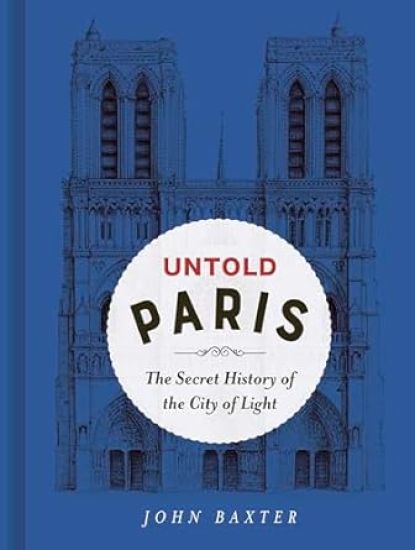
Untold Paris

Untold Paris

John Baxter

Quarto Publishing Plc
2024
sidottu
Nobody knows the city of light like Paris resident and travel writer John Baxter – and nobody is able to write about its culture quite so intriguingly. Let him guide you around the Paris you’ve always wanted to know. How was Ernest Hemingway received by the city he wrote so much about, and where did he rub shoulders with other literary greats? Are Parisian waiters really as rude as their reputation, and why do they race each other down the street in the annual Course des Garcons de Café? And where can you find fascinating remnants of the city’s history of violent revolution, jazz music, and bold artistic movements? From the reality of the city’s café culture and its literary luminaries, to some of its more curious landmarks, obscure events and unusual inhabitants, Untold Paris will give the first-time visitor a vivid impression of the city and offer seasoned travellers a new vision of the city they love. The people, the quirks, peculiarities, charms and eccentricities; the history and secrets. Welcome to the untold Paris.Praise for John Baxter's previous work:We'll Always Have Paris: Sex and Love in the City of Light – "towers above most recent memoirs of life abroad" Sunday Times.The Perfect Meal: In Search of the Lost Tastes of France – International Association of Culinary Professionals Award, “Full of humor, insight, and mouth-watering details… a delightful tour of traditional French culture and cuisine.” Travel and Leisure. Eating Eternity: Food and Wine in the Art and Literature of France – "Gorgeous" New York Times
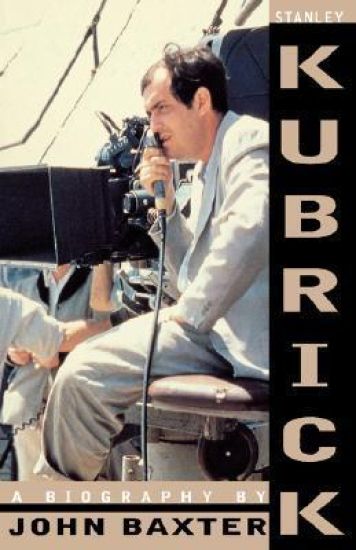
Stanley Kubrick

Stanley Kubrick

John Baxter

Carroll Graf Publishers Inc
1997
pokkari
For decades, the films of Stanley Kubrick have staked out a claim at the core of the cultural landscape. In the 1950s he was one of the few American filmmakers, with Paths of Glory, to achieve the gravitas of European cinema. To 1960s audiences he was the man who made Dr. Strangelove, the influential anti-war movie, and the counterculture favorite 2001: A Space Odyssey. In the 1970s he created his hymn to urban violence, A Clockwork Orange, and in the 1980s distilled the nature of private madness and collective insanity in The Shining and Full Metal Jacket.Yet little is still known of the man and the influence exerted by his private life on his public art. Born in the Bronx, Kubrick has lived since 1961 in seclusion in rural England. From in-depth interviews with a range of people who have known the man best, from his childhood to the present, John Baxter has extracted the most complete account available of Kubrick's life: the conflicts with partners and stars, the failure to make Napoleon, the failed marriages and broken friendships, the use and abuse of writers and other creative collaborators.Kubrick emerges from this detailed and complex telling as a man both sensitive and ruthless, petulant and generous: a man who adulates reason but whose films reflect the wildest excesses of passion and who, above all, has dared to live life on his terms, whatever the price.