Kirjojen hintavertailu. Mukana 11 717 486 kirjaa ja 12 kauppaa.

Kirjahaku

Etsi kirjoja tekijän nimen, kirjan nimen tai ISBN:n perusteella.

1000 tulosta hakusanalla John Brooks; Brian Conduit

Dartmoor

Dartmoor

John Brooks; Brian Conduit

Ordnance Survey
2016
pokkari
28 circular, graded walks all tried and tested by seasoned walkers. The routes range from extended strolls to exhilarating hikes, so there is something for everyone.
Cotswolds

Cotswolds

John Brooks; Brian Conduit; Nick Channer

Ordnance Survey
2016
pokkari
28 circular, graded walks all tried and tested by seasoned walkers. The routes range from extended strolls to exhilarating hikes, so there is something for everyone.
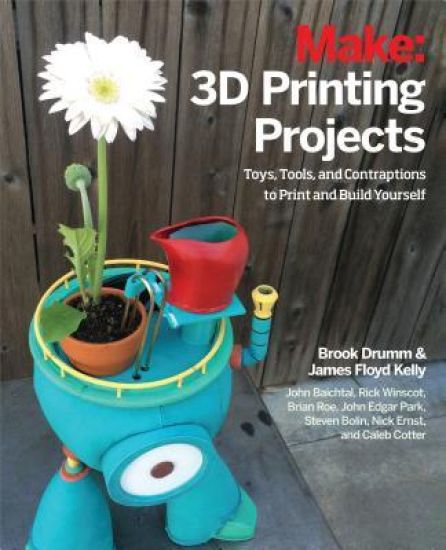
3D Printing Projects

3D Printing Projects

Brook Drumm; James Floyd Kelly; Matt Stultz; Rick Winscot; John Edgar Park; John Baichtal; Brian Roe; Nick Ernst; Steven Bolin; Mark Mathews; Caleb Cotter

O'Reilly Media, Inc, USA
2015
nidottu
Even if you've never touched a 3D printer, these projects will excite and empower you to learn new skills, extend your current abilities, and awaken your creative impulses. Each project uses a unique combination of electronics, hand assembly techniques, custom 3D-printed parts, and software, while teaching you how to think through and execute your own ideas. Written by the founder of Printrbot, his staff, and veteran DIY authors, this book of projects exemplifies the broad range of highly personalized, limit-pushing project possibilities of 3D printing when combined with affordable electronic components and materials. In Make: 3D Printing Projects, you'll: Print and assemble a modular lamp that's suitable for beginners--and quickly gets you incorporating electronics into 3D-printed structures. Learn about RC vehicles by fabricating--and driving--your own sleek, shiny, and fast Inverted Trike. Model a 1950s-style Raygun Pen through a step-by-step primer on how to augment an existing object through rapid prototyping. Fabricate a fully functional, battery-powered screwdriver, while learning how to tear down and reconstruct your own tools. Get hands-on with animatronics by building your own set of life-like mechanical eyes. Make a Raspberry Pi robot that rides a monorail of string, can turn corners, runs its own web server, streams video, and is remote-controlled from your phone. Build and customize a bubble-blowing robot, flower watering contraption, and a DIY camera gimbal.
The Freshwater Algal Flora of the British Isles

The Freshwater Algal Flora of the British Isles

David M. John; Brian A. Whitton; Alan J. Brook

Cambridge University Press
2021
sidottu
Building on the success of the first edition and featuring contributions from leading experts in the field, this expanded and thoroughly revised second edition provides an indispensable guide to the freshwater and terrestrial algae of the British Isles. It is an up-to-date account of and identification tool for more than 2400 algal species (excluding diatoms), highlighting their wider distribution around the world. Detailed descriptions are fully illustrated with clear line drawings and photographs including 190 full-page plates, eight of which are full colour. In addition, user-friendly keys enable the accurate identification of specimens to the level of genus and species. This edition includes expanded information on ecology and the implications of recent molecular research, along with coverage of 200 extra species. The accompanying online material provides a colour photo catalogue, highly illustrated articles and video clips, making this the comprehensive reference tool for both researchers and professionals in the field.
John Henry Brookes

John Henry Brookes

Brown Bryan

Oxford Brookes University
2015
sidottu
This is a well-researched and highly-illustrated biography of one of the most influential educational leaders of the 20th century. John Henry Brookes was a driving force in the development of education throughout the city of Oxford. Determined, kind and visionary, his ideas and energy profoundly affected many lives, and Oxford Brookes University was named in his honour. The book describes his early life, the influential thinkers that shaped his views, his arts and crafts career, and his long struggle that led to the Headington campus of what is now the highly-respected Oxford Brookes University. With photography dating form the early years of the 20th century, and beautiful colour reproductions of artwork produced by Brookes, the biography will provide a compelling insight into the life of a man who was determined to change education for young people in Oxford.
The Racial Unfamiliar

The Racial Unfamiliar

John Brooks

Columbia University Press
2022
sidottu
The works of African American authors and artists are too often interpreted through the lens of authenticity. They are scrutinized for “positive” or “negative” representations of Black people and Black culture or are assumed to communicate some truth about Black identity or the “Black experience.” However, many contemporary Black artists are creating works that cannot be slotted into such categories. Their art resists interpretation in terms of conventional racial discourse; instead, they embrace opacity, uncertainty, and illegibility.John Brooks examines a range of abstractionist, experimental, and genre-defying works by Black writers and artists that challenge how audiences perceive and imagine race. He argues that literature and visual art that exceed the confines of familiar conceptions of Black identity can upend received ideas about race and difference. Considering photography by Roy DeCarava, installation art by Kara Walker, novels by Percival Everett and Paul Beatty, drama by Suzan-Lori Parks, and poetry by Robin Coste Lewis, Brooks pinpoints a shared aesthetic sensibility. In their works, the devices that typically make race feel familiar are instead used to estrange cultural assumptions about race. Brooks contends that when artists confound expectations about racial representation, the resulting disorientation reveals the incoherence of racial ideologies. By showing how contemporary literature and art ask audiences to question what they think they know about race, The Racial Unfamiliar offers a new way to understand African American cultural production.
The Racial Unfamiliar

The Racial Unfamiliar

John Brooks

Columbia University Press
2022
pokkari
The works of African American authors and artists are too often interpreted through the lens of authenticity. They are scrutinized for “positive” or “negative” representations of Black people and Black culture or are assumed to communicate some truth about Black identity or the “Black experience.” However, many contemporary Black artists are creating works that cannot be slotted into such categories. Their art resists interpretation in terms of conventional racial discourse; instead, they embrace opacity, uncertainty, and illegibility.John Brooks examines a range of abstractionist, experimental, and genre-defying works by Black writers and artists that challenge how audiences perceive and imagine race. He argues that literature and visual art that exceed the confines of familiar conceptions of Black identity can upend received ideas about race and difference. Considering photography by Roy DeCarava, installation art by Kara Walker, novels by Percival Everett and Paul Beatty, drama by Suzan-Lori Parks, and poetry by Robin Coste Lewis, Brooks pinpoints a shared aesthetic sensibility. In their works, the devices that typically make race feel familiar are instead used to estrange cultural assumptions about race. Brooks contends that when artists confound expectations about racial representation, the resulting disorientation reveals the incoherence of racial ideologies. By showing how contemporary literature and art ask audiences to question what they think they know about race, The Racial Unfamiliar offers a new way to understand African American cultural production.
Dreadnought Gunnery and the Battle of Jutland
This new book reviews critically recent studies of fire control, and describes the essentials of naval gunnery in the dreadnought era.With a foreword by Professor Andrew Lambert, it shows how, in 1913, the Admiralty rejected Arthur Pollen's Argo system for the Dreyer fire control tables. Many naval historians now believe that, consequently, British dreadnoughts were fitted with a system that, despite being partly plagiarised from Pollen's, was inferior: and that the Dreyer Tables were a contributory cause in the sinking of Indefatigable and Queen Mary at Jutland. This book provides new and revisionist accounts of the Dreyer/Pollen controversy, and of gunnery at Jutland. In fire control, as with other technologies, the Royal Navy had been open, though not uncritically, to innovations. The Dreyer Tables were better suited to action conditions (particularly those at Jutland). Beatty's losses were the result mainly of deficient tactics and training: and his battlecruisers would have been even more disadvantaged had they been equipped by Argo. It follows the development of the Pollen and Dreyer systems, refutes the charges of plagiarism and explains Argo's rejection. It outlines the German fire control system: and uses contemporary sources in a critical reassessment of Beatty's tactics throughout the Battle of Jutland.
Once in Golconda

Once in Golconda

John Brooks

John Wiley Sons Inc
1999
nidottu
Once in Golconda "In this book, John Brooks—who was one of the most elegant of all business writers—perfectly catches the flavor of one of history’s best-known financial dramas: the 1929 crash and its aftershocks. It’s packed with parallels and parables for the modern reader." —From the Foreword by Richard Lambert Editor-in-Chief, The Financial Times Once in Golconda is a dramatic chronicle of the breathtaking rise, devastating fall, and painstaking rebirth of Wall Street in the years between the wars. Focusing on the lives and fortunes of some of the era’s most memorable traders, bankers, boosters, and frauds, John Brooks brings to vivid life all the ruthlessness, greed, and reckless euphoria of the ’20s bull market, the desperation of the days leading up to the crash of ’29, and the bitterness of the years that followed. Praise for Once in Golconda "A fast-moving, sophisticated account embracing the stock-market boom of the twenties, the crash of 1929, the Depression, and the coming of the New Deal. Its leitmotif is the truly tragic personal history of Richard Whitney, the aristocrat Morgan broker and head of the Stock Exchange, who ended up in Sing Sing." —Edmund Wilson, writing in the New Yorker "As Mr. Brooks tells this tale of dishonor, desperation, and the fall of the mighty, it takes on overtones of Greek tragedy, a king brought down by pride. Whitney’s sordid history has been told before .But in Mr. Brooks’s hands, the drama becomes freshly shocking." —Wall Street Journal "It’s all there in Once in Golconda—the avarice of an era that favored the rich; and the later anguish of myriads of speculators doomed by a bloated market, easy credit, and their own cupidity and stupidity." —Saturday Review
Once in Golconda

Once in Golconda

John Brooks

John Wiley Sons Inc
1999
sidottu
"In this book, John Brooks—who was one of the most elegant of all business writers—perfectly catches the flavor of one of history’s best-known financial dramas: the 1929 crash and its aftershocks. It’s packed with parallels and parables for the modern reader." —Richard Lambert Editor-in-Chief, The Financial Times Praise for Once in Golconda "A fast-moving, sophisticated account embracing the stock-market boom of the twenties, the crash of 1929, the Depression, and the coming of the New Deal. Its leitmotif is the truly tragic personal history of Richard Whitney, the aristocrat Morgan broker and head of the Stock Exchange, who ended up in Sing Sing." —Edmund Wilson, writing in the New Yorker "As Mr. Brooks tells this tale of dishonor, desperation, and the fall of the mighty, it takes on overtones of Greek tragedy, a king brought down by pride. Whitney’s sordid history has been told before. But in Mr. Brooks’s hands, the drama becomes freshly shocking." —Wall Street Journal "It’s all there in Once in Golconda: the avarice of an era that favored the rich; and the later anguish of myriads of speculators doomed by a bloated market, easy credit, and their own cupidity and stupidity. The book, which is great reading, has a real message, especially for a generation of speculators that know neither the pangs and privations of a depression nor of blue chip stocks that drop fifty points in a single day’s trading." —Saturday Review "Mr. Brooks has convinced me, absolutely, that Richard Whitney ranks in the highest pantheon of American symbols—like Lincoln and Bryan and Melville and Hemingway and Yellow Kid Weft, Buffalo Bill, and Horatio Alger and even Babe Ruth. In him, the upper-class con crested—and America’s last chance to do it right the first time ended." —Harper’s
Dreadnought Gunnery and the Battle of Jutland
This new book reviews critically recent studies of fire control, and describes the essentials of naval gunnery in the dreadnought era.With a foreword by Professor Andrew Lambert, it shows how, in 1913, the Admiralty rejected Arthur Pollen's Argo system for the Dreyer fire control tables. Many naval historians now believe that, consequently, British dreadnoughts were fitted with a system that, despite being partly plagiarised from Pollen's, was inferior: and that the Dreyer Tables were a contributory cause in the sinking of Indefatigable and Queen Mary at Jutland. This book provides new and revisionist accounts of the Dreyer/Pollen controversy, and of gunnery at Jutland. In fire control, as with other technologies, the Royal Navy had been open, though not uncritically, to innovations. The Dreyer Tables were better suited to action conditions (particularly those at Jutland). Beatty's losses were the result mainly of deficient tactics and training: and his battlecruisers would have been even more disadvantaged had they been equipped by Argo. It follows the development of the Pollen and Dreyer systems, refutes the charges of plagiarism and explains Argo's rejection. It outlines the German fire control system: and uses contemporary sources in a critical reassessment of Beatty's tactics throughout the Battle of Jutland.
Broken

Broken

John Brooks

Independently Published
2019
nidottu
No one in history, no matter their place on the ladder of society, has ever been free from trouble. Struggles, frustration, failing, poor choices, bad breaks.........they are all a part of the human condition. When we made the decision to turn our backs on the One who gave us life and stand in our own strength we began a dark legacy that has both followed and continues to proceed us through history.God loved us in such a way that He simply could not and would not let this war against our very souls go unanswered. He made the only decision that would make the difference needed to rescue us. He chose to pay what we owed........to forgive our lack of gratitude and unfaithfulness, and to love us unconditionally.
The Battle of Jutland

The Battle of Jutland

John Brooks

Cambridge University Press
2016
sidottu
This is a major new account of the Battle of Jutland, the key naval battle of the First World War in which the British Grand Fleet engaged the German High Seas Fleet off the coast of Denmark in 1916. Beginning with the building of the two fleets, John Brooks reveals the key technologies employed, from ammunition, gunnery and fire control, to signalling and torpedoes, as well as the opposing commanders' tactical expectations and battle orders. In describing Jutland's five major phases, he offers important new interpretations of the battle itself and how the outcome was influenced by technology, as well as the tactics and leadership of the principal commanders, with the reliability of their own accounts of the fighting reassessed. The book draws on contemporary sources which have rarely been cited in previous accounts, including the despatches of both the British and German formations, along with official records, letters and memoirs.