Kirjojen hintavertailu. Mukana 11 244 527 kirjaa ja 12 kauppaa.

Kirjahaku

Etsi kirjoja tekijän nimen, kirjan nimen tai ISBN:n perusteella.

1000 tulosta hakusanalla John Bunyan

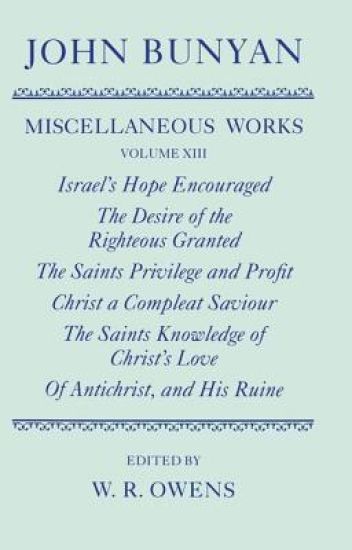
The Miscellaneous Works of John Bunyan: Volume XIII: Israel's Hope Encouraged; The Desire of the Righteous Granted; The Saints Privilege and Profit; Christ a Compleat Saviour; The Saints Knowledge of Christ's Love; Of Antichrist, and His Ruine
The six treatises which make up this concluding volume of Bunyan's Miscellaneous Works were all published posthumously, in the 1692 Folio edited by Charles Doe. Most of them seem to have been composed in the final ten years of his life, while he was the height of his fame as a preacher and writer. They are characteristic Bunyan productions, designed to edify, exhort, and comform the saints, and brimful of his conviction that the Christian pilgrimage is a strenuous affair, calling for constant vigilence, self-examination and courage. The theme of endurance under persecution is prominent, and in a late millenarian work, Of Antichrist, and His Ruine, Bunyan offers a sombre, but eloquent account of the approaching downfall of the great enemy of the ture church, the Antichrist. Unlike many of his contemporaries, Bunyan is careful not to name dates, or interpret the apocalyptic texts too literally, but a striking feature of this work is his belief that kings would be God's chosen intruments in the destruction of Antichrist.
The Miscellaneous Works of John Bunyan: Volume I: Some Gospel-Truths Opened; A Vindication of Some Gospel-Truths Opened; A Few Sighs from Hell
A scholarly edition of The Miscellaneous Works of John Bunyan: Some Gospel Truths Opened; Vindication of "Some Gospel Truths Opened" and Few Sighs from Hell by T. L. Underwood and Roger Sharrock. The edition presents an authoritative text, together with an introduction, commentary notes, and scholarly apparatus.
The Miscellaneous Works of John Bunyan: The Miscellaneous Works of John Bunyan
As defender of the faith and protector of his flock, at a time of great dissent on matters of theology and religious practice, Bunyan spent much of his energies on disputes, both in person and on the printed page. It was, indeed, such issues that had originally launched him into print in 1656-7 (see Volume I in this series). Six of Bunyan's controversial works, from a much later period of his life, are presented in the present volume. Bunyan directed the earliest of these works, A Defence of the Doctrine of Justification, by Faith (1672) at the latitudinarian rector Edward Fowler. A long-term dispute with some Baptists over open membership resulted in his A Confession of my Faith, and A Reason of my Practice (1672), Differences in Judgment About Water-Baptism, No Bar to Communion (1673) and Peaceable Principles and True (1674). Controversies concerning the status of women and the correct day for Sabbath observance led him to write A Case of Conscience Resolved (1683) and Questions About the Nature and Perpetuity of the Seventh-Day-Sabbath (1685). These polemical works display something of the rough and tumble world of the mechanick preachers of Bunyan's time. They add to our understanding of Bunyan's background, religious stance, and imaginative power and technique. They also reveal some of his personal human foibles.
The Miscellaneous Works of John Bunyan: Volume VII: Solomon's Temple Spiritualized, The House of the Forest of Lebanon, The Water of Life
These treatises from Bunyan's last year, 1688, are edited from the first editions, one of which was published in his lifetime, and the other two posthumously. All three are variations on the traditional typological method of biblical interpretation, and reflect similar variations practised in the work of other nonconformist theologians and preachers of the day. They are of interest both to students of Bunyan's theology and the struggles of `the Church in the wilderness', and to students of his art - the methods he explored to embody his ideas imaginatively and to intensify the appeal of his teaching.
The Miscellaneous Works of John Bunyan: Volume VIII: Instruction for the Ignorant; Light for them that sit in Darkness; Saved by Grace; Come, and Welcome to Jesus Christ
A scholarly edition of The Miscellaneous Works of John Bunyan: Instruction for the Ignorant; Light for Them That Sit in Darkness; Saved by Grace; Come and Welcome to Jesus Christ by Richard L. Greaves. The edition presents an authoritative text, together with an introduction, commentary notes, and scholarly apparatus.
The Miscellaneous Works of John Bunyan: Volume X: Seasonable Counsel and A Discourse upon the Pharisee and the Publicane
The treatises in this volume were first published when the persecution of nonconformists was reaching a fierce climax. Seasonable Counsel, subtitled Advice to Sufferers, presents Bunyan's reflections on how believers were to understand and respond to this experience. His own sufferings are reflected in his essentially practical discussion of the many issues raised and in the vigorous speech-based language of the mature preacher and writer. A Discourse upon the Pharisee and the Publicane is an exposition of the parable in Luke xviii. The work gives Bunyan's ultimate thoughts on justification by faith, which show a development from his earlier position. There is a shrewd analysis of the characters, with a lively and original discussion of body language. The introduction to this volume relates Bunyan's arguments and experience to their context, including contemporary ideas on persecution and toleration and on the connection between faith and justification.
The Miscellaneous Works of John Bunyan: The Miscellaneous Works of John Bunyan
Bunyan died in August 1688 from a fever contracted while riding to London in heavy rain. He had made the journey to deliver the manuscript of his latest work, The Acceptable Sacrifice to the press, and to preach to a Dissenting congregation in Whitechapel. Perhaps surprisingly, in view of his enormous popularity as a writer, Bunyan left unpublished a considerable number of manuscripts. These eventually passed into the hands of his close friend and disciple, Charles Doe, a comb-maker from Southwark who, in 1692, published twelve of them, together with ten other works, in a folio volume. Apart from The Acceptable Sacrifice and the Last Sermon, which are edited from first editions of 1689, texts of the other six works in the present volume are based on those in Doe's 1692 Folio. The most ambitious of these is a lengthy commentary on the first ten chapters of Genesis. No book of the Bible had attracted more attention from learned exegates, and the middle of the seventeenth century saw fierce controversies over its interpretation. Bunyan, though clearly aware of these great debates, seldom enters into them. Instead he offers a typological reading, enabling him to draw out the contemporary significance of the Genesis story for persecuted Dissenters.
John Bunyan

John Bunyan

Tamsin Spargo

Liverpool University Press
2004
nidottu
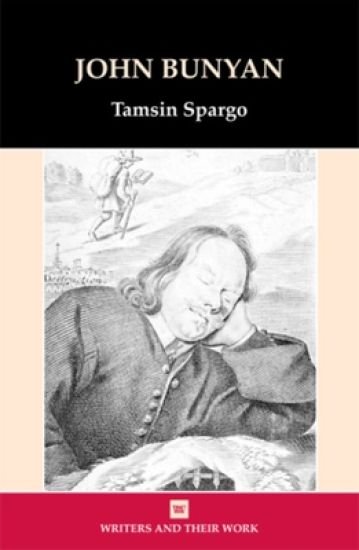
John Bunyan (1628-88) lived and wrote through some of the most turbulent years of political, social, and religious change in British history from civil war, through Commonwealth and Protectorate to the Restoration. Imprisoned for unlicensed preaching as a Nonconformist, Bunyan turned to writing to sustain his pastoral mission and composed some of the best-known, and most critically acclaimed, seventeenth-century texts, from his intensely moving spiritual autobiography, Grace bounding to the Chief of Sinners, to the world famous allegory The Pilgrim's Progress. Bunyan’s style fused vivid depiction of the everyday world of ordinary men and women with powerful narratives to dramatise his religious convictions. This accessible study of his life, times, and writing introduces all his key works within the contexts of their original moment and later international impact and argues that Bunyan is a writer whose work continues to reward readers of all ages, beliefs, and nationalities.
John Bunyan

John Bunyan

E. Beatrice Batson

TAYLOR FRANCIS LTD
2025
sidottu
First published in 1984, John Bunyan: Allegory and Imagination is informed not only by an enthusiasm for Bunyan but by an understanding of the literary and theological currents of the time. Criticism of John Bunyan has generally presented him as ‘an artist in spite of himself’, an unreflective writer who chanced on a vein of untutored genius. It is hard to believe that a work like the Pilgrim's Progress, which has gripped readers through the centuries, came to being entirely by chance. In this book Professor Batson draws on the Augustinian tradition, prevalent in the Middle Ages, that literature reveals truth by similitudes, and enhances spiritual understanding.Without suggesting that Bunyan had a scholarly acquaintance with scholastic theory, she shows how his writing embodies the approaches implicit in this attitude. By lucid and penetrating analysis of each of the major works in turn, she demonstrates Bunyan’s skill in structuring his narrative, his skill in dialogue, his ability to demonstrate various levels of meaning, his handling of the dream phenomenon, and his emphasis on metaphor and memory. She also shows how the allegory of the major works operates at a level of continuous metaphor. This is a must read for scholars and researchers of English literature.