John C. Calhoun remains a striking and central figure in American history. From 1811 to 1850 he served as representative from South Carolina, secretary of war, vice president, secretary of state, and senator. During the same period he was twice contender for the presidency of the United States. From the beginning to the end of his career, Calhoun arrested public attention and influenced public opinion, having major influence on every issue of the period. A champion of state rights, he is an important figure in the drama of expansion ad conflict that is at the heart of American history in the nineteenth-century.
This volume contains John C. Calhoun's major works, the Disquisition on Government as well as the Discourse on the Constitution and Government of the United States, accompanied by some more minor works, including the Southern Address, and some speeches.
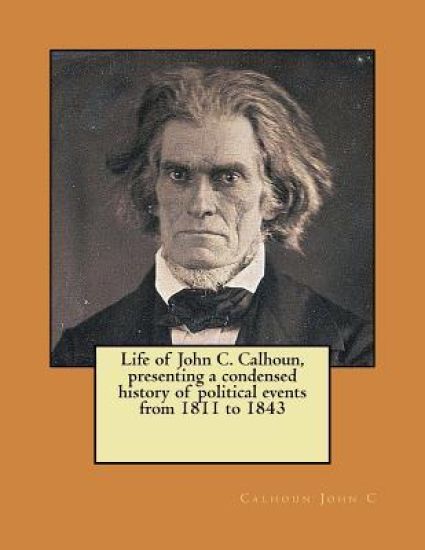
John Caldwell Calhoun March 18, 1782 - March 31, 1850) was an American statesman and political theorist from South Carolina, and the seventh Vice President of the United States from 1825 to 1832. He is remembered for strongly defending slavery and for advancing the concept of minority rights in politics, which he did in the context of defending white Southern interests from perceived Northern threats. He began his political career as a nationalist, modernizer, and proponent of a strong national government and protective tariffs. By the late 1820s, his views reversed and he became a leading proponent of states' rights, limited government, nullification, and opposition to high tariffs-he saw Northern acceptance of these policies as the only way to keep the South in the Union. His beliefs and warnings heavily influenced the South's secession from the Union in 1860-1861.
Cralle, Richard K. (Richard Kenner), 1800-1864 Editor of the works of John C. Calhoun..... John Caldwell Calhoun ( March 18, 1782 - March 31, 1850) was an American statesman and political theorist from South Carolina, and the seventh Vice President of the United States from 1825 to 1832. He is remembered for strongly defending slavery and for advancing the concept of minority rights in politics, which he did in the context of defending white Southern interests from perceived Northern threats. He began his political career as a nationalist, modernizer, and proponent of a strong national government and protective tariffs. By the late 1820s, his views reversed and he became a leading proponent of states' rights, limited government, nullification, and opposition to high tariffs-he saw Northern acceptance of these policies as the only way to keep the South in the Union. His beliefs and warnings heavily influenced the South's secession from the Union in 1860-1861. Calhoun began his political career with election to the House of Representatives in 1810. As a prominent leader of the war hawk faction, Calhoun strongly supported the War of 1812 to defend American honor against British infractions of American independence and neutrality during the Napoleonic Wars. He then served as Secretary of War under President James Monroe, and in this position reorganized and modernized the War Department. Calhoun was a candidate for the presidency in the 1824 election. After failing to gain support, he let his name be put forth as a candidate for vice president. The Electoral College elected Calhoun for vice president by an overwhelming majority. He served under John Quincy Adams and continued under Andrew Jackson, who defeated Adams in the election of 1828. Calhoun had a difficult relationship with Jackson primarily due to the Nullification Crisis and the Petticoat affair. In contrast with his previous nationalism, Calhoun vigorously supported South Carolina's right to nullify federal tariff legislation he believed unfairly favored the North, putting him into conflict with unionists such as Jackson. In 1832, with only a few months remaining in his second term, he resigned as vice president and entered the Senate. He sought the Democratic nomination for the presidency in 1844, but lost to surprise nominee James K. Polk, who went on to become president. Calhoun served as Secretary of State under John Tyler from 1844 to 1845. As Secretary of State, he supported the annexation of Texas as a means to extend the slave power, and helped settle the Oregon boundary dispute with Britain. He then returned to the Senate, where he opposed the Mexican-American War, the Wilmot Proviso, and the Compromise of 1850 before his death in 1850. Calhoun often served as a virtual party-independent who variously aligned as needed with Democrats and Whigs. Later in life, Calhoun became known as the "cast-iron man" for his rigid defense of white Southern beliefs and practices. His concept of republicanism emphasized approval of slavery and minority rights, as particularly embodied by the Southern states-he owned "dozens of slaves in Fort Hill, South Carolina". Calhoun also asserted that slavery, rather than being a "necessary evil", was a "positive good", benefiting both slaves and slave owners.To protect minority rights against majority rule, he called for a concurrent majority whereby the minority could sometimes block proposals that it felt infringed on their liberties. To this end, Calhoun supported states' rights and nullification, through which states could declare null and void federal laws that they viewed as unconstitutional. Calhoun was one of the "Great Triumvirate" or the "Immortal Trio" of Congressional leaders, along with his Congressional colleagues Daniel Webster and Henry Clay. In 1957, a Senate Committee headed by Senator John F. Kennedy selected Calhoun as one of the five greatest United States Senators of all time.....................
This volume details the importance of two themes that dominated Calhoun's concerns: the efforts of the Northern majority to exclude the South from territories being won in battle; and his continuing campaign to curb American imperialism, which Calhoun thought boded ill for republican virtue.