Kirjojen hintavertailu. Mukana 11 230 651 kirjaa ja 12 kauppaa.

Kirjahaku

Etsi kirjoja tekijän nimen, kirjan nimen tai ISBN:n perusteella.

1000 tulosta hakusanalla John Clark

General View of the Agriculture of the County of Brecknock, With Observations on the Means of its Improvement. By Mr. John Clark, Steward to ... Viscount Hereford. Drawn up for the Consideration of the Board of Agriculture and Internal Improvement
The 18th century was a wealth of knowledge, exploration and rapidly growing technology and expanding record-keeping made possible by advances in the printing press. In its determination to preserve the century of revolution, Gale initiated a revolution of its own: digitization of epic proportions to preserve these invaluable works in the largest archive of its kind. Now for the first time these high-quality digital copies of original 18th century manuscripts are available in print, making them highly accessible to libraries, undergraduate students, and independent scholars.Medical theory and practice of the 1700s developed rapidly, as is evidenced by the extensive collection, which includes descriptions of diseases, their conditions, and treatments. Books on science and technology, agriculture, military technology, natural philosophy, even cookbooks, are all contained here.++++The below data was compiled from various identification fields in the bibliographic record of this title. This data is provided as an additional tool in helping to insure edition identification: ++++British LibraryT040616With a half-title.London: printed by J. Smeeton, 1794. 55, 1]p.; 4
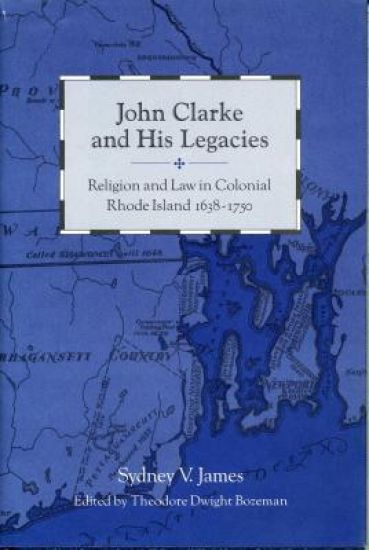
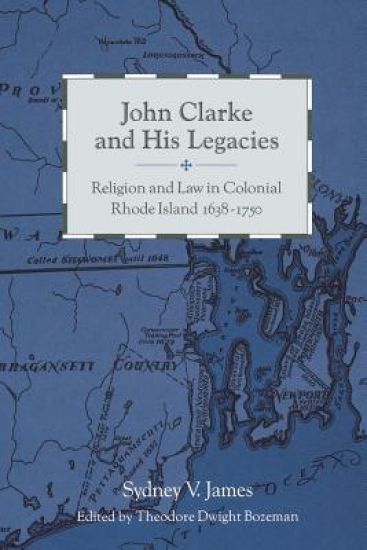
John Clarke and His Legacies

John Clarke and His Legacies

Sydney James

Pennsylvania State University Press
1999
sidottu
John Clarke and His Legacies is the first full-length biography of John Clarke (1609–76), a principal founder of colonial Rhode Island. Although Roger Williams usually gets most of the attention, Sydney James shows that Clarke made a lasting contribution to the colony—perhaps more so than Williams. Williams was the first Baptist minister in America, but he left his church after a very short time. And although Williams won the first charter for Rhode Island, the charter soon had to be replaced. Clarke, however, founded the first Baptist church in Newport, where he continued to contribute to the Baptist community. And in 1663 he procured the royal charter that would remain the foundation of government in Rhode Island until 1842.This inquiry into Clarke's life engages a variety of intriguing topics. It surveys a formative stage in American Baptist history, one that spurned dependency upon government more thoroughly than any part of the United States does today. Through the experience of Clark, we see pioneering American religious volunteerism, problems of church-state relations, and the peculiar nature of colonial relations with the parent country.
John Clarke and His Legacies

John Clarke and His Legacies

Sydney James

Pennsylvania State University Press
1999
pokkari
John Clarke and His Legacies is the first full-length biography of John Clarke (1609–76), a principal founder of colonial Rhode Island. Although Roger Williams usually gets most of the attention, Sydney James shows that Clarke made a lasting contribution to the colony—perhaps more so than Williams. Williams was the first Baptist minister in America, but he left his church after a very short time. And although Williams won the first charter for Rhode Island, the charter soon had to be replaced. Clarke, however, founded the first Baptist church in Newport, where he continued to contribute to the Baptist community. And in 1663 he procured the royal charter that would remain the foundation of government in Rhode Island until 1842.This inquiry into Clarke's life engages a variety of intriguing topics. It surveys a formative stage in American Baptist history, one that spurned dependency upon government more thoroughly than any part of the United States does today. Through the experience of Clark, we see pioneering American religious volunteerism, problems of church-state relations, and the peculiar nature of colonial relations with the parent country.
An Essay Upon Study. Wherein Directions are Given for the due Conduct Thereof, and the Collection of a Library, Proper for the Purpose, Consisting of the Choicest Books ... By John Clarke,
The 18th century was a wealth of knowledge, exploration and rapidly growing technology and expanding record-keeping made possible by advances in the printing press. In its determination to preserve the century of revolution, Gale initiated a revolution of its own: digitization of epic proportions to preserve these invaluable works in the largest archive of its kind. Now for the first time these high-quality digital copies of original 18th century manuscripts are available in print, making them highly accessible to libraries, undergraduate students, and independent scholars.The Age of Enlightenment profoundly enriched religious and philosophical understanding and continues to influence present-day thinking. Works collected here include masterpieces by David Hume, Immanuel Kant, and Jean-Jacques Rousseau, as well as religious sermons and moral debates on the issues of the day, such as the slave trade. The Age of Reason saw conflict between Protestantism and Catholicism transformed into one between faith and logic -- a debate that continues in the twenty-first century.++++The below data was compiled from various identification fields in the bibliographic record of this title. This data is provided as an additional tool in helping to insure edition identification: ++++British LibraryT108173Also issued as a part of: 'An essay upon the education of youth in grammar-schools', Dublin, 1736.Dublin: printed by S. Powell, for Edward Exshaw, 1736. vi,146p.; 12
A Sermon Delivered at the Church in Brattle-Street, January 2, 1784. At the Interment of the Rev. Samuel Cooper, D.D. who Expired, December 29, 1783. By John Clarke, A.M. Junior Pastor of the First Church in Boston. [Two Lines From Samuel]
The 18th century was a wealth of knowledge, exploration and rapidly growing technology and expanding record-keeping made possible by advances in the printing press. In its determination to preserve the century of revolution, Gale initiated a revolution of its own: digitization of epic proportions to preserve these invaluable works in the largest archive of its kind. Now for the first time these high-quality digital copies of original 18th century manuscripts are available in print, making them highly accessible to libraries, undergraduate students, and independent scholars.The Age of Enlightenment profoundly enriched religious and philosophical understanding and continues to influence present-day thinking. Works collected here include masterpieces by David Hume, Immanuel Kant, and Jean-Jacques Rousseau, as well as religious sermons and moral debates on the issues of the day, such as the slave trade. The Age of Reason saw conflict between Protestantism and Catholicism transformed into one between faith and logic -- a debate that continues in the twenty-first century.++++The below data was compiled from various identification fields in the bibliographic record of this title. This data is provided as an additional tool in helping to insure edition identification: ++++British LibraryW029137Half-title: Mr. Clarke's sermon, at the interment of the Rev. Dr. Cooper. Page 35 misnumbered 53 in some copies.Boston: Printed by John Gill, M, DCC, LXXXIV. 1784]. 35, 1] p.; 8