Kirjojen hintavertailu. Mukana 11 244 527 kirjaa ja 12 kauppaa.

Kirjahaku

Etsi kirjoja tekijän nimen, kirjan nimen tai ISBN:n perusteella.

1000 tulosta hakusanalla John Dewey

The Philosophy of John Dewey

The Philosophy of John Dewey

John Dewey

University of Chicago Press
1981
nidottu
John J. McDermott's anthology, The Philosophy of John Dewey, provides the best general selection available of the writings of America's most distinguished philosopher and social critic. This comprehensive collection, ideal for use in the classroom and indispensable for anyone interested in the wide scope of Dewey's thought and works, affords great insight into his role in the history of ideas and the basic integrity of his philosophy. This edition combines in one book the two volumes previously published separately. Volume 1, "The Structure of Experience," contains essays on metaphysics, the logic of inquiry, the problem of knowledge, and value theory. In volume 2, "The Lived Experience," Dewey's writings on pedagogy, ethics, the aesthetics of the "live creature," politics, and the philosophy of culture are presented. McDermott has prefaced each essay with a helpful explanatory note and has written an excellent general introduction to the anthology.
John Dewey

John Dewey

Steven Rockefeller

Columbia University Press
1991
sidottu
Combining ?biography and intellectual history, Steven Rockefeller offers an illuminating introduction to the philosophy of John Dewey, with special emphasis on the evolution of the religious faith and moral vision at the heart of his thought. This study pays particular attention to Dewey's radical democratic reconstruction of Christianity and his many contributions to the American tradition of spiritual democracy. Rockefeller presents the first full exploration of Dewey's religious thought, including its mystical dimension. Covering Dewey's entire intellectual life, the author provides a clear introduction to Dewey's early neo-Hegelian idealism as well as to his later naturalistic metaphysics, epistemology, theory of education, theory of evaluation, and philosophy of religion. The author tells the story of the evolution of this faith and philosophical vision, offering fresh insight into the enduring value of the thought of America's foremost philosopher.
John Dewey

John Dewey

Steven Rockefeller

Columbia University Press
1994
pokkari
Combining ?biography and intellectual history, Steven Rockefeller offers an illuminating introduction to the philosophy of John Dewey, with special emphasis on the evolution of the religious faith and moral vision at the heart of his thought. This study pays particular attention to Dewey's radical democratic reconstruction of Christianity and his many contributions to the American tradition of spiritual democracy. Rockefeller presents the first full exploration of Dewey's religious thought, including its mystical dimension. Covering Dewey's entire intellectual life, the author provides a clear introduction to Dewey's early neo-Hegelian idealism as well as to his later naturalistic metaphysics, epistemology, theory of education, theory of evaluation, and philosophy of religion. The author tells the story of the evolution of this faith and philosophical vision, offering fresh insight into the enduring value of the thought of America's foremost philosopher.
John Dewey
Draws together 96 articles to form a comprehensive critical commentary on Dewey's work for those who need to assess his vital contributions to psychology, education, political theory, ethics, epistemology, aesthetics or metaphysics.
John Dewey

John Dewey

Raymond D. Boisvert

State University of New York Press
1997
pokkari
A concise, eminently readable introduction to the thought of America's most prominent philosopher.CHOICE 1997 Outstanding Academic BooksWritten in a manner accessible to non-specialists, this book provides an introduction to all areas central to John Dewey's philosophy: aesthetics, social and political philosophy, education, the philosophy of religion, and theory of knowledge. Boisvert situates Dewey as a thinker who could appreciate the advance of science while remaining an "empirical naturalist" committed to the revelatory powers of lived experience.
The Collected Works of John Dewey V. 2; 1887, Psychology

The Collected Works of John Dewey V. 2; 1887, Psychology

John Dewey

Southern Illinois University Press
1967
sidottu
Psychology, John Dewey's first book, is an appropriate choice for the first volume in the Southern Illinois University series The Early Works of John Dewey, 1882-1898. With an original publi-cation date of 1887, Psychology is volume 2 of The Early Works. It appears first in the series to introduce scholars and general readers to the use of modern textual criticism in a work outside the literary field. Designed as a scholar's reading edition, the volume presents the text of Dewey's work as the author intended, clear of editorial footnotes. All apparatus is conveniently arranged in ap-pendix form. As evidence of its wide adoption and use as a college textbook, Psychology had a publishing history of twenty-six print-ings. For two of the reprintings, Dewey made extensive revisions in content to incorporate developments in the field of psychology as well as in his own thinking. The textual appendices include a thorough tabulation of these changes. In recognition of the high quality and scholarly standards of the textual criticism, this edition of Psychology is the first non-literary work awarded the Seal of the Modern Language Associa-tion Center for Editions of American Authors. By applying to the work of a philosopher the procedures used in modern textual editions of American writers such as Hawthorne, the Southern Illinois University Dewey project is establishing a pattern for future col-lected writing of philosophers.
The Collected Works of John Dewey V. 1; 1882-1888, Early Essays and Leibniz's New Essays Concerning the Human Understanding
Volume 1 of The Early Works of John Dewey, 1882-1898 is entitled Early Essays and Leibniz's New Essays Concerning the Human Understanding, 1882-1888. Included here are all Dewey's earliest writings, from his first published article through his book on Leibniz. The materials in this volume provide a chronological record of Dewey's early development--beginning with the article he sent to the Journal of Speculative Philosophy in 1881 while he was a high-school teacher in Oil City, Pennsylvania, and closing with his widely-acclaimed work on Leibniz in the Grigg's Series of German Philosophical Classics, written when he was an Assistant Professor at the University of Michigan. During these years be-tween 1882 and 1888, Dewey's life course was established: he decided to follow a career in philosophy, completed doctoral studies at Johns Hopkins University, became an Instructor at the University of Michigan, was promoted to Assistant Professor, and accepted a position as Chairman of the Department of Philosophy at the University of Minnesota. With the publication of Psychology, he became well known among scholars in this country; a series of articles in the British journal Mind brought him prominence in British philosophical circles. His articles were abstracted in the Revue philosophique. None of the articles collected in this volume was reprinted during the author's lifetime. For the first time, it is now possible for Dewey scholars to study consecutively in one publication all the essays which originally appeared in many periodicals.
The Collected Works of John Dewey V. 3; 1889-1892, Essays and Outlines of a Critical Theory of Ethics
This third volume in the definitive edition of Dewey's early work opens with his tribute to George Sylvester Morris, the former teacher who had brought Dewey to the University of Michigan. Morris's death in 1889 left vacant the Department of Philosophy chairmanship and led to Dewey's returning to fill that post after a year's stay at Minnesota. Appearing here, among all his writings from 1889 through 1892, are Dewey's earliest comprehensive statements on logic and his first book on ethics. Dewey's marked copy of the galley-proof for his important article The Present Position of Logical Theory, recently discovered among the papers of the Open Court Publishing Company, is used as the basis for the text, making available for the first time his final changes and corrections. The textual studies that make The Early Works unique among American philosophical editions are reported in detail. One of these, A Note on Applied Psychology, documents the fact that Dewey did not co-author this book frequently attributed to him. Six brief unsigned articles written in 1891 for a University of Michigan student publication, the Inlander, have been identified as Dewey's and are also included in this volume. In both style and content, these articles reflect Dewey's conviction that philosophy should be used as a means of illuminating the contemporary scene; thus they add a new dimension to present knowledge of his early writing.
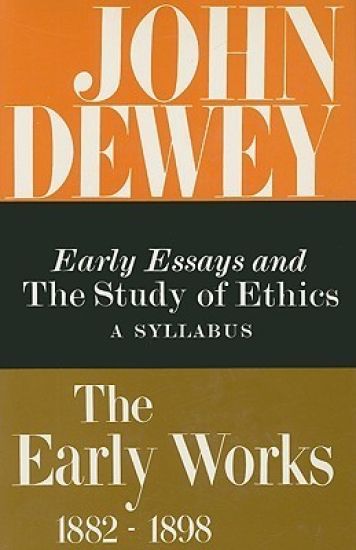
The Collected Works of John Dewey V. 4; 1893-1894, Early Essays and the Study of Ethics: a Syllabus
Volume 4 of' The Early Works series covers the period of Dewey's last year and one-half at the University of Michigan and his first half-year at the University of Chicago. In addition to sixteen articles the present volume contains Dewey's reviews of six books and three articles, verbatim reports of three oral statements made by Dewey, and a full-length book, The Study of Ethics. Like its predecessors in this series, this volume presents a clear text, free of interpretive or reference material. Apparatus, including references, corrections, and emendations, is confined to appendix material. Fredson Bowers, the Consulting Textual Editor, has provided an essay on the textual principles and procedures, and Wayne A. R. Leys, Professor of Philosophy at Southern Illinois University, has written an Introduction discussing the relationship between Dewey's writings of this period and his later work. That Dewey's scholarship and writing was at an especially high level during 1893 and 1894 may be considered an index to the significance of this two-year period.
The Collected Works of John Dewey V. 5; 1895-1898, Early Essays

The Collected Works of John Dewey V. 5; 1895-1898, Early Essays

John Dewey

Southern Illinois University Press
1972
sidottu
This fifth and concluding volume of The Early Works of John Dewey is the only one of the series made up entirely of essays. The appear-ance during the four-year period, 1895-98, of thirty-eight items amply indicates that Dewey continued to maintain a high level of published out-put. These were the years of Dewey's most extensive work and involvement at the University of Chicago. Like its predecessors in this series, this volume presents a clear text, free of interpretive or reference material. Apparatus, including references, corrections, and emendations, is confined to appendix material. Fredson Bowers, the Consulting Textual Editor, has provided an essay on the textual principles and procedures, and William P. McKenzie, Professor of Philoso-phy and Education at Southern Illinois University, has written an introduc-tion identifying the thread connecting the apparently diffuse material in the many articles of this volume--Dewey's attempt to unite philosophy with psychology and sociology and with education.
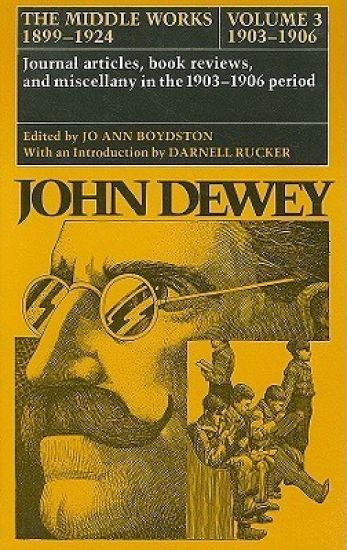
The Collected Works of John Dewey v. 3; 1903-1906, Journal Articles, Book Reviews, and Miscellany in the 1903-1906 Period
Spanning the crucial years of Dewey's move from the University of Chicago to Columbia University, Volume 3 col lects thirty-six essays and reviews pub lished at the very time Dewey deter mined that his professional future would lie in the field of philosophy. After resigning from Chicago, Dewey seriously considered a career in univer sity administration before finally decid ing to accept a professorship in the Department of Philosophy at Columbia, where he was to remain the rest of his professional life.
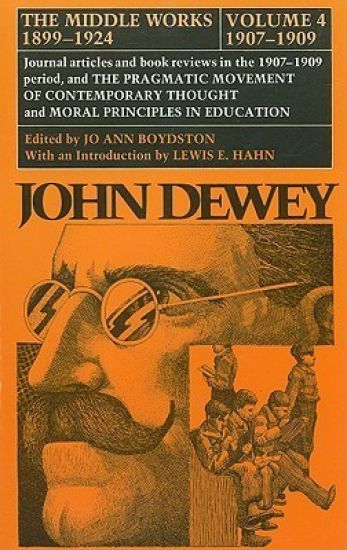
The Collected Works of John Dewey v. 4; 1907-1909, Journal Articles and Book Reviews in the 1907-1909 Period, and the Pragmatic Movement of Contemporary Thought and Moral Principles in Education
By 1907, the first of the three years em braced by Volume 4, Dewey had aban doned thoughts of a possible career in the administration of higher education and was firmly established as a leading member of the Department of Phi losophy at Columbia. As Lewis Hahn points out in his Introduction, these were "very productive years for Dewey. In addition to numerous lectures and speaking engagements and participa tion in professional meetings, he pub lished fifteen or so substantial articles, almost as many shorter things, a syl labus on The Pragmatic Movement of Contemporary Thought, a monograph on Moral Principles in Education, and, with J. H. Tufts, the first edition of a very popular textbook, Ethics."
The Poems of John Dewey

The Poems of John Dewey

John Dewey

Southern Illinois University Press
1977
sidottu
A literary discovery of considerable magnitude, these 98 previously unpub lished poems by John Dewey, written principally in the 1910- 18 period, illu minate an emotive aspect in his intel lectual life often not manifest in the prose works. Rumors of the existence of the poems have circulated among students of Dewey's life and writings since 1957, when Mrs. Roberta Dewey gained pos session of them from the Columbia University Columbiana collection. But except for the few persons who saw copies made by the French scholar Deladelle five years after Dewey's death, the poems have remained inaccessible until now. None of the poems has hitherto been published. Mrs. Roberta Dewey and Dewey's children from his first marriage seem not to have known of Dewey's experiments in verse during his lifetime. And, as evidence presented here now shows, only two or three acquaintances knew of actual poems written by Dew ey, one of them the Polish-American novelist Anzia Yezierska, who had a brief emotional involvement with Dewey in the 1917- 18 period. The factual, rather than inferential, evi dence of Dewey's relationship with Anzia Yezierska appears in the poems, which, taken as a whole, provide reveal ing insights into Dewey's feelings and illuminate not only aspects of his emo tions but of his thought as well. The fact that Dewey did not publish the poetry himself, together with the circumstances of its discovery and un usual history, has led to the exception ally careful editorial treatment of the poems given here. Scholars will find all the evidence for the authorship of the manuscripts clearly presented and all the changes and alterations carefully recorded. This edition has received the Modern Language Association of Amer ica Center for Editions of American Authors Seal as an " approved text."
The Middle Works of John Dewey, Volume 5, 1899-1924

The Middle Works of John Dewey, Volume 5, 1899-1924

John Dewey

Southern Illinois University Press
1978
sidottu
This fifth volume of the Middle Works contains Ethics by John Dewey and his former colleague at the University of Michigan, James H. Tufts, which ap­peared as one of the last in the Holt American Science series of textbooks. Within some six months after publica­tion, Ethics was adopted as a textbook by thirty colleges. The book continued to be extremely popular and widely used, and was reprinted twenty-five times before both authors completely revised their respective parts for the new 1932 edition. Up to the time Ethics was published, Dewey’s approach to ethics was known primarily from two short publications that were developed for use by his classes at the University of Michigan: Outlines of a Critical Theory of Ethics (1891) and The Study of Ethics: A Syl­labus (1894). Charles Stevenson notes in his Introduction to the present edition that Ethics afforded Dewey an opportu­nity to preserve and enrich the content of those earlier works and at the same time to expound his position in a more systematic manner.
The Collected Works of John Dewey v. 6; 1910-1911, Journal Articles, Book Reviews, Miscellany in the 1910-1911 Period, and How We Think
William James, remarking in 1909on the differences among the three leading spokesmen for pragmatism--himself, F. C. S. Schiller, and John Dewey--said that Schiller's views were essential ly "psychological," his own, "epistemo logical," whereas Dewey's "panorama is the widest of the three."The two main subjects of Dewey's essays at this time are also two of the most fundamental and persistent philo sophical questions: the nature of knowl edge and the meaning of truth. Dewey's distinctive analysis is concentrated chiefly in seven essays, in a long, sig nificant, and previously almost un known work entitled "The Problem of Truth," and in his book How We Think. As a whole, the 1910-11writings il lustrate especially well that which the Thayers identify in their Introduction as Dewey's "deepening concentration on questions of logic and epistemology as contrasted with the more pronounced psychological and pedagogical treat ment in earlier writings."
The Collected Works of John Dewey v. 7; 1912-1914, Essays, Books Reviews, Encyclopedia Articles in the 1912-1914 Period, and Interest and Effort in Education
During the three years embraced by Volume 7, Dewey published twenty articlesand reviews, one of the articles of monograph-length, "The Psychology of Social Behavior," one small book, Interest and Effort in Education, and sev enty encyclopedia articles.A salient and arresting feature of the essays is the continuing polemic be tween Dewey and some of his critics. Ralph Ross, whose perceptive Introduc tion to the volume provides a broad per spective of the various philosophicalcontroversies in which Dewey was en gaged, comments that "when Dewey was pitting himself against important adversaries, his talents as a critic were fully evident."
The Middle Works of John Dewey, Volume 9, 1899-1924

The Middle Works of John Dewey, Volume 9, 1899-1924

John Dewey

Southern Illinois University Press
1980
sidottu
John Dewey’s best-known and still-popular classic, Democracy and Educa­tion, is presented here as a new edition in Volume 9 of the Middle Works. Sidney Hook, who wrote the introduction to this volume, describes Democracy and Education: “It illuminates directly or indirectly all the basic issues that are cen­tral today to the concerns of intelligent educators. . . . It throws light on sev­eral obscure corners in Dewey’s general philosophy in a vigorous, simple prose style often absent in his more technical writings. And it is the only work in any field originally published as a textbook that has not merely acquired the status of a classic, but has become the one book that no student concerned with the phi­losophy of education today should leave unread.” Dewey said in 1930 that De­mocracy and Education, “was for many years the one [book] in which my philos­ophy . . . was most fully expounded.”