

Kirjahaku
Etsi kirjoja tekijän nimen, kirjan nimen tai ISBN:n perusteella.
1000 tulosta hakusanalla John Henderson


Letters And Poems By John Henderson With Anecdotes Of His Life
John Ireland
Kessinger Pub
2007
pokkari

Letters And Poems By John Henderson With Anecdotes Of His Life (1786)
John Ireland
KESSINGER PUBLISHING, LLC
2008
sidottu

Letters and Poems by the Late Mr. John Henderson
John Ireland; John Henderson
Hansebooks
2017
pokkari
Letters and Poems by the Late Mr. John Henderson - With Anecdotes of his Life is an unchanged, high-quality reprint of the original edition of 1786. Hansebooks is editor of the literature on different topic areas such as research and science, travel and expeditions, cooking and nutrition, medicine, and other genres. As a publisher we focus on the preservation of historical literature. Many works of historical writers and scientists are available today as antiques only. Hansebooks newly publishes these books and contributes to the preservation of literature which has become rare and historical knowledge for the future.


Ancestry and Descendants of Lieutenant John Henderson, of Greenbriar County, Virginia, 1650-1900
Joseph Lyon Miller
Kessinger Pub
2009
pokkari

The Rail: The Burning of John Henderson
D. G. Coe
Createspace Independent Publishing Platform
2013
nidottu

Answers for Hugh Dalrymple of Fordell, Esq; To the Petition of John Henderson Younger of Fordell, Esq; And Others, Freeholders in the County Offife.
Hugh Dalrymple
Gale Ecco, Print Editions
2010
pokkari
Answers for Hugh Dalrymple of Fordell, Esq; to the Petition of John Henderson Younger of Fordell, Esq; and Others, Freeholders in the County OfFife
Hugh Dalrymple
Gale Ecco, Print Editions
2018
sidottu
The 18th century was a wealth of knowledge, exploration and rapidly growing technology and expanding record-keeping made possible by advances in the printing press. In its determination to preserve the century of revolution, Gale initiated a revolution of its own: digitization of epic proportions to preserve these invaluable works in the largest archive of its kind. Now for the first time these high-quality digital copies of original 18th century manuscripts are available in print, making them highly accessible to libraries, undergraduate students, and independent scholars.Delve into what it was like to live during the eighteenth century by reading the first-hand accounts of everyday people, including city dwellers and farmers, businessmen and bankers, artisans and merchants, artists and their patrons, politicians and their constituents. Original texts make the American, French, and Industrial revolutions vividly contemporary.++++The below data was compiled from various identification fields in the bibliographic record of this title. This data is provided as an additional tool in helping to insure edition identification: ++++British LibraryT226174Dated at head of the drop-head title: March 13. 1776. Signed on p. 34: Ro. MacQueen. The second section, with separate pagination and register, is 'Papers referred to in the foregoing answers', and the third, also with separate pagination and register, Edinburgh, 1776] 34,12,6,8-9p.; 4
Henderson's Hand-book of the Grasses of Great Britain and America
John Henderson
Hansebooks
2018
nidottu
Henderson's Hand-book of the grasses of Great Britain and America.
John Henderson
Hansebooks
2018
nidottu

Henderson's Hand-Book of the Grasses of Great Britain and America
John Henderson
Outlook Verlag
2023
pokkari
Reprint of the original, first published in 1875.

Henderson's Hand-Book of the Grasses of Great Britain and America
John Henderson
Outlook Verlag
2023
sidottu
Reprint of the original, first published in 1875.


Professor David Henderson
Benny Peiser; John Henderson; Nigel Lawson
Global Warming Policy Foundation
2019
sidottu

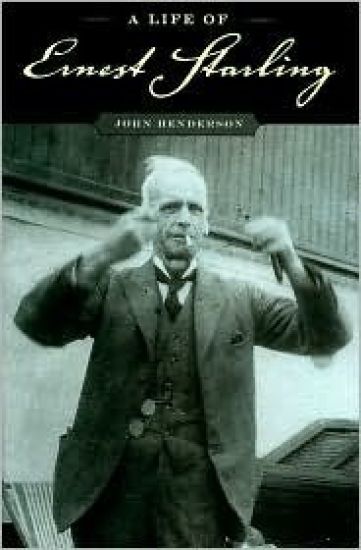
Ernest Starling (1866-1927) was pre-eminent in the golden age of British Physiology. His name is usually associated with his “Law of the Heart,? but his discovery of secretin (the first hormone whose mode of action was explained) and his work on capillaries were more important contributions. He coined the word 'hormone' one hundred years ago. His analysis of capillary function demonstrated that equal and opposite forces move across the capillary wall--an outward (hydrostatic) force and an inward (osmotic) force derived from plasma proteins. Starling’s contributions include:*Developing the "Frank-Starling Law of the Heart," presented in 1915 and modified in 1919.*The Starling equation, describing fluid shifts in the body (1896) *The discovery of secretin, the first hormone, with Bayliss (1902) and the introduction of the concept of hormones (1905).
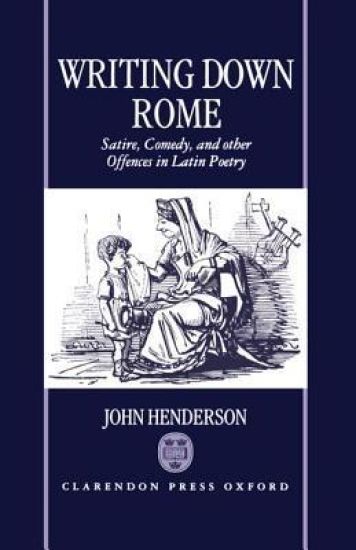
In a series of controversial essays, this book examines the Roman penchant for denigration, and in particular self-denigration, at the expense of Roman culture. Comedy in Republican Rome radically transformed both itself and the culture from which it sprang: in Poenulus, Plautus laughed at Roman depreciation of Carthage; in Adelphoe, Terence turned on his audience in provocation. The comic Roman poets played with self-mockery: in Eclogue III, Virgil tests his audience's security in judging peasant unpleasantness; in Odes III.22, Horace sends up his own pious rusticity down on the farm. In the second half of the book, Roman verse satire is the subject: the genre of male bragging mocks its own masculine aggression. The great Latin satirists make fun of making fun: Horace, Satires I.9, shows up the politics of humour, unmanned by his own good manners; Persius nails his own weaknesses in fortifying himself against the world; Juvenal, Satire 1, loathes the literary scene he bids to dominate. The book shows a vital ingredient of Roman poetry to be an energetic surge of urbane banter directed towards Roman culure.

This book examines the relationship between the secular and sacred in late medieval Florence through the vehicle of the religious confraternity, one of the most ubiquitous and popular forms of lay association throughout Europe. Based on a wealth of new documentation Dr Henderson provides a fascinating account of the development of the major fraternities of the city in relation to other types of communal ecclesiastical institutions. The first part discusses in detail their devotional activities for living members, including the singing of lauds, self-flagellation, processions and dramatic presentations, as well as funerals and commemorative services for the dead. Secondly, this is one of the most detailed analyses of relief to the poor and sick in medieval Europe. He examines the complementary welfare roles of fraternities and hospitals, during both non-crisis years and the emergencies caused by plague and famine, all within the wider context of communal policy towards the poor. Taken together the two themes of this book, piety and charity, provide new evidence concerning the complex relationship between religion and society in both private and public life.