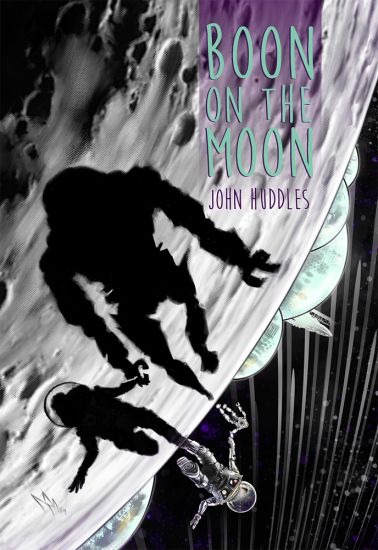
When ten-year-old Byron "Boon" Barnett boards a rocket-ship for a move to the Moon with his family (and his irritating robot, Jose Ignacio), he's expecting the time of his life in the lunar colony of Cosmopolis. What he's not expecting is a stellar disaster that'll demolish Cosmopolis before lunch. Boon insists he knows how to survive it, but people tend not to believe him about stuff. His parents have been lecturing him on the dividing line between using his imagination for fun and using it as an excuse for bad behavior. Suddenly it's the dividing line between life and death.
In a city levitating among the clouds, a translator of ancient languages casts his mind down to the surface of a long uninhabited earth and six thousand years into the past to tell the tale of Asha, a possibly mythical, possibly factual princess, or Raajakumaaree in the language of her era. Asha's life of beauty and privilege, the compensation for marriage to an abusive merchant prince, ultimately sets her on an epic yaatra, a trek of body and mind, to seek self-knowledge. Along the way she must imagine a path beyond the totality of her past mistakes--before hope itself comes to an end. A novel of fantasy, spiritual exploration, and adventure, Asha Of The Air interweaves European chivalric tradition with the mysticism of South Asia's sacred texts to craft an immersive world where legend and science, history and myth come together in a tale of intense emotionality. Asha's story is that of a young woman trying to conceive a new female archetype for herself, one that transcends the norms of gender and wedlock while still embracing all the rightful powers of femininity. It is strikingly relevant to the way that today we are renegotiating the balance of power between the sexes and learning how to reconcile the urge to dominate with the need to love.
A photographic odyssey through the modern-day landscape of the Civil War pairs historical images of the conflict from sixty-two battle sites with the author's own photographs of the same locations today, many of which depict such unexpected scenes as department stores and fast-food restaurants.
This book provides a methodology for analysing team tasks to identify the critical aspects of team performance that need to be trained and to determine appropriate training solutions to enable teams to operate efficiently, effectively and safely.
The 18th century was a wealth of knowledge, exploration and rapidly growing technology and expanding record-keeping made possible by advances in the printing press. In its determination to preserve the century of revolution, Gale initiated a revolution of its own: digitization of epic proportions to preserve these invaluable works in the largest archive of its kind. Now for the first time these high-quality digital copies of original 18th century manuscripts are available in print, making them highly accessible to libraries, undergraduate students, and independent scholars.Western literary study flows out of eighteenth-century works by Alexander Pope, Daniel Defoe, Henry Fielding, Frances Burney, Denis Diderot, Johann Gottfried Herder, Johann Wolfgang von Goethe, and others. Experience the birth of the modern novel, or compare the development of language using dictionaries and grammar discourses. ++++The below data was compiled from various identification fields in the bibliographic record of this title. This data is provided as an additional tool in helping to insure edition identification: ++++British LibraryT163907Anonymous. By John Huddlestone Wynne. With a half-title.London: printed by J. Chapman, for E. Newbery, 1788. xxiv,192p.: ill; 12
The 18th century was a wealth of knowledge, exploration and rapidly growing technology and expanding record-keeping made possible by advances in the printing press. In its determination to preserve the century of revolution, Gale initiated a revolution of its own: digitization of epic proportions to preserve these invaluable works in the largest archive of its kind. Now for the first time these high-quality digital copies of original 18th century manuscripts are available in print, making them highly accessible to libraries, undergraduate students, and independent scholars.Western literary study flows out of eighteenth-century works by Alexander Pope, Daniel Defoe, Henry Fielding, Frances Burney, Denis Diderot, Johann Gottfried Herder, Johann Wolfgang von Goethe, and others. Experience the birth of the modern novel, or compare the development of language using dictionaries and grammar discourses. ++++The below data was compiled from various identification fields in the bibliographic record of this title. This data is provided as an additional tool in helping to insure edition identification: ++++British LibraryT078523The author of 'Choice emblems' = John H. Wynne.London: printed for E. Newbery; and G. Riley, 1781. viii, iv, 1],4-162p., plates; 18
The 18th century was a wealth of knowledge, exploration and rapidly growing technology and expanding record-keeping made possible by advances in the printing press. In its determination to preserve the century of revolution, Gale initiated a revolution of its own: digitization of epic proportions to preserve these invaluable works in the largest archive of its kind. Now for the first time these high-quality digital copies of original 18th century manuscripts are available in print, making them highly accessible to libraries, undergraduate students, and independent scholars.Western literary study flows out of eighteenth-century works by Alexander Pope, Daniel Defoe, Henry Fielding, Frances Burney, Denis Diderot, Johann Gottfried Herder, Johann Wolfgang von Goethe, and others. Experience the birth of the modern novel, or compare the development of language using dictionaries and grammar discourses. ++++The below data was compiled from various identification fields in the bibliographic record of this title. This data is provided as an additional tool in helping to insure edition identification: ++++British LibraryT003347Preface signed: J. H. W., i.e. John Huddlestone Wynne. Sig. A4v mispaginated x. With a final advertisement leaf. Later editions published as 'Amusing and instructive tales for youth'.London: printed by J. Crowder, for E. Newbery, 1794. vi, 2],158, 2]p., plate; 12
The 18th century was a wealth of knowledge, exploration and rapidly growing technology and expanding record-keeping made possible by advances in the printing press. In its determination to preserve the century of revolution, Gale initiated a revolution of its own: digitization of epic proportions to preserve these invaluable works in the largest archive of its kind. Now for the first time these high-quality digital copies of original 18th century manuscripts are available in print, making them highly accessible to libraries, undergraduate students, and independent scholars.Rich in titles on English life and social history, this collection spans the world as it was known to eighteenth-century historians and explorers. Titles include a wealth of travel accounts and diaries, histories of nations from throughout the world, and maps and charts of a world that was still being discovered. Students of the War of American Independence will find fascinating accounts from the British side of conflict. ++++The below data was compiled from various identification fields in the bibliographic record of this title. This data is provided as an additional tool in helping to insure edition identification: ++++Bodleian Library (Oxford)N018778London: printed for T. Evans, 1773. 2v., plate: map; 8
Military capability is delivered operationally at a team and collective level, be it a unit as small as a squad or section, or as large as a maritime task group. Modern military forces are required to deal with a potentially wide range of missions frequently involving multiple alliance partners, within a geopolitical environment which can seem to change rapidly. Individual performance, while being important, is not the primary determinant of mission success - force integration, interoperability, adaptability and teamwork are key factors. Team and collective training which fully addresses these factors is fundamental to the development and delivery of military capability. As a consequence, the requirement to determine training requirements and specify effective systems for the delivery of team and collective training is critical to operational success. Training Needs Analysis (also known as Front End Analysis), is a well-established methodology for analysing training requirements and specifying training solutions used extensively by the UK and its NATO partners. However, the analytical techniques employed are optimised for individual training, with little guidance being offered on its application in the team and collective context. Team and Collective Training Needs Analysis (TCTNA) has been developed to close this methodological gap. It addresses the issues of the relationship of individual and team tasks, teamwork, command and control, task and training environments, scenario definition, instructional strategy, team training approaches, instructional functions, and wide-ranging organisational and procurement considerations. Part One of the book develops an integrated set of models which underpin the analytical approach presented in Part Two. Worked examples and case studies illustrate the application of the approach. Between 2005 and 2015 the authors worked on numerous training-related research projects at Cranfield University and Coventry University for the Human Factors Integration Defence Technology Centre and the Defence Human Capability Science and Technology Centre on behalf of the Defence Science and Technology Laboratory, UK Ministry of Defence.