
Kirjahaku
Etsi kirjoja tekijän nimen, kirjan nimen tai ISBN:n perusteella.
1000 tulosta hakusanalla John Hunt
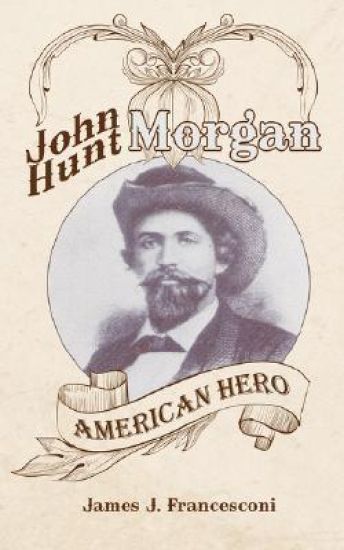

John Hunt Morgan and His Great Raid
William W. Slider
Createspace Independent Publishing Platform
2012
nidottu

This work has been selected by scholars as being culturally important and is part of the knowledge base of civilization as we know it.This work is in the public domain in the United States of America, and possibly other nations. Within the United States, you may freely copy and distribute this work, as no entity (individual or corporate) has a copyright on the body of the work.Scholars believe, and we concur, that this work is important enough to be preserved, reproduced, and made generally available to the public. To ensure a quality reading experience, this work has been proofread and republished using a format that seamlessly blends the original graphical elements with text in an easy-to-read typeface.We appreciate your support of the preservation process, and thank you for being an important part of keeping this knowledge alive and relevant.


The surgeon and anatomist John Hunter (1728–93) left a famous legacy in the Hunterian Museum of medical specimens now in the Royal College of Surgeons, and in this collection of his writings, edited by James Palmer, with a biography by Drewry Ottley, published between 1835 and 1837. The first four volumes are of text, and the larger Volume 5 contains plates. Hunter had begun his career as a demonstrator in the anatomy classes of his brother William, before qualifying as a surgeon. He regarded surgery as evidence of failure - the mutilation of a patient who could not be cured by other means - and his studies of anatomy and natural history were driven by his belief that it was necessary to understand the normal physiological processes before attempting to cure the abnormal ones. Volume 1 contains Ottley's biography, a list of Hunter's published works, and his lectures on surgery.
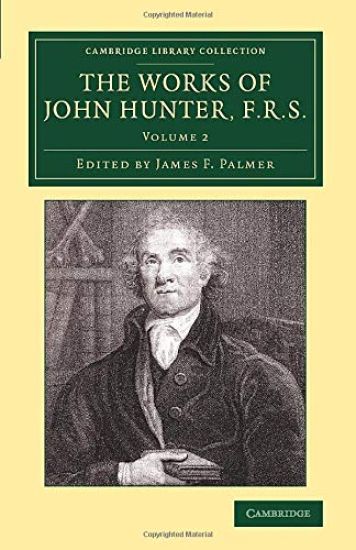
The surgeon and anatomist John Hunter (1728–93) left a famous legacy in the Hunterian Museum of medical specimens now in the Royal College of Surgeons, and in this collection of his writings, edited by James Palmer, with a biography by Drewry Ottley, published between 1835 and 1837. The first four volumes are of text, and the larger Volume 5 contains plates. Hunter had begun his career as a demonstrator in the anatomy classes of his brother William, before qualifying as a surgeon. He regarded surgery as evidence of failure - the mutilation of a patient who could not be cured by other means - and his studies of anatomy and natural history were driven by his belief that it was necessary to understand the normal physiological processes before attempting to cure the abnormal ones. Volume 2 discusses diseases of the jaw, teeth and gums, at a time when dental surgery was rudimentary.
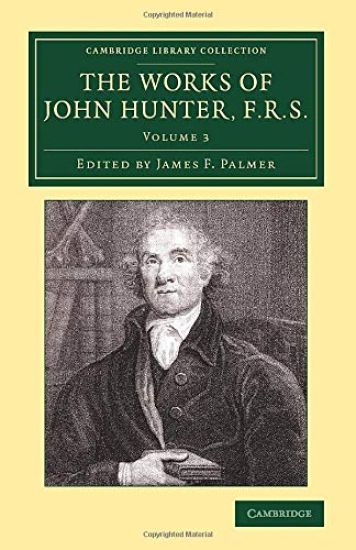
The surgeon and anatomist John Hunter (1728–93) left a famous legacy in the Hunterian Museum of medical specimens now in the Royal College of Surgeons, and in this collection of his writings, edited by James Palmer, with a biography by Drewry Ottley, published between 1835 and 1837. The first four volumes are of text, and the larger Volume 5 contains plates. Hunter had begun his career as a demonstrator in the anatomy classes of his brother William, before qualifying as a surgeon. He regarded surgery as evidence of failure - the mutilation of a patient who could not be cured by other means - and his studies of anatomy and natural history were driven by his belief that it was necessary to understand the normal physiological processes before attempting to cure the abnormal ones. Volume 3 discusses blood and the vascular system, wounds (especially those suffered in war), and infection.
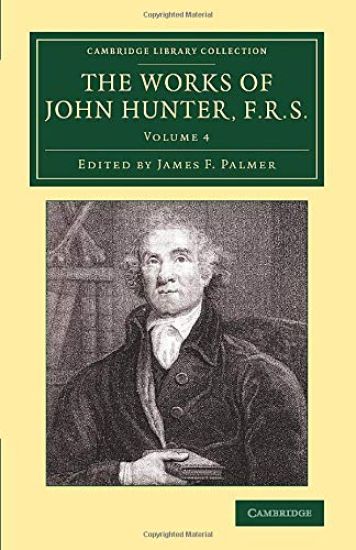
The surgeon and anatomist John Hunter (1728–93) left a famous legacy in the Hunterian Museum of medical specimens now in the Royal College of Surgeons, and in this collection of his writings, edited by James Palmer, with a biography by Drewry Ottley, published between 1835 and 1837. The first four volumes are of text, and the larger Volume 5 contains plates. Hunter had begun his career as a demonstrator in the anatomy classes of his brother William, before qualifying as a surgeon. He regarded surgery as evidence of failure - the mutilation of a patient who could not be cured by other means - and his studies of anatomy and natural history were driven by his belief that it was necessary to understand the normal physiological processes before attempting to cure the abnormal ones. Volume 4 contains Hunter's works on animal physiology, with notes by the distinguished palaeontologist Richard Owen.
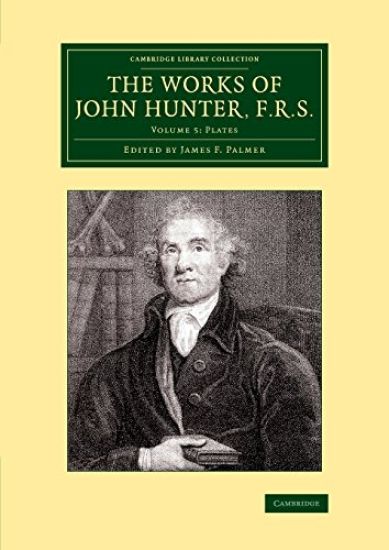
The Works of John Hunter, F.R.S.: Volume 5, Plates
John Hunter
Cambridge University Press
2015
pokkari
The surgeon and anatomist John Hunter (1728–93) left a famous legacy in the Hunterian Museum of medical specimens now in the Royal College of Surgeons, and in this collection of his writings, edited by James Palmer, with a biography by Drewry Ottley, published between 1835 and 1837. The first four volumes are of text, and the larger Volume 5 contains plates. Hunter had begun his career as a demonstrator in the anatomy classes of his brother William, before qualifying as a surgeon. He regarded surgery as evidence of failure - the mutilation of a patient who could not be cured by other means - and his studies of anatomy and natural history were driven by his belief that it was necessary to understand the normal physiological processes before attempting to cure the abnormal ones. Volume 5 contains the plates which accompany the works in the other volumes, along with notes.

Hunter, J: John Hunter's Abhandlung Uber Blut, Entzundung Un
John Hunter
KESSINGER PUBLISHING, LLC
2010
nidottu

Hunter, J: John Hunter's Abhandlung Uber Blut, Entzundung Un
John Hunter
KESSINGER PUBLISHING, LLC
2010
nidottu
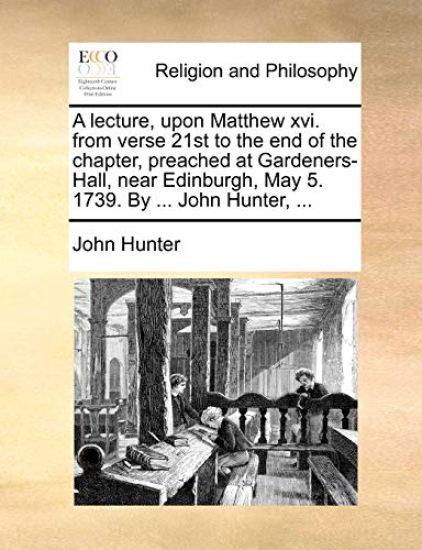
A Lecture, Upon Matthew XVI. from Verse 21st to the End of the Chapter, Preached at Gardeners-Hall, Near Edinburgh, May 5. 1739. by ... John Hunter, ...
John Hunter
Gale Ecco, Print Editions
2010
pokkari
A Practical Treatise on the Diseases of the Teeth; Intended as a Supplement to the Natural History of Those Parts. by John Hunter, ...
John Hunter
Gale Ecco, Print Editions
2010
pokkari