Kirjojen hintavertailu. Mukana 11 244 527 kirjaa ja 12 kauppaa.

Kirjahaku

Etsi kirjoja tekijän nimen, kirjan nimen tai ISBN:n perusteella.

1000 tulosta hakusanalla John J. McGavin; Greg Walker

Imagining Spectatorship

Imagining Spectatorship

John J. McGavin; Greg Walker

Oxford University Press
2016
sidottu
Oxford Textual Perspectives is a new series of informative and provocative studies focused upon literary texts (conceived of in the broadest sense of that term) and the technologies, cultures and communities that produce, inform, and receive them. It provides fresh interpretations of fundamental works and of the vital and challenging issues emerging in English literary studies. By engaging with the materiality of the literary text, its production, and reception history, and frequently testing and exploring the boundaries of the notion of text itself, the volumes in the series question familiar frameworks and provide innovative interpretations of both canonical and less well-known works. Imagining Spectatorship offers a new discussion of how spectators witnessed early drama in the various spaces and places in which those works were performed. It combines broad historical and theoretical reflection with closely analysed case studies to produce a comprehensive account of the ways in which individuals encountered early drama, how they were cued to respond to it, and how we might think about those issues today. It addresses the practical matters that conditioned spectatorship, principally those concerned with the location and configuration of the spaces in which a performance occurred, but also suggests how these factors intersected with social status, gender, religious commitment and affiliation, degrees of real or felt personal agency, and the operation of the cognitive processes themselves. It considers both real witnesses and those 'imagined' spectators which are seemingly figured by both dramatic and quasi-dramatic works, and whose assumed attitudes play-makers sought to second-guess. It also looks at the spectatorial experience itself as a subject of representation in a number of early texts. Finally, it examines the complex contract entered into by audiences and players for the duration of a performance, looking at how texts cued spectators to respond to specific dramaturgical tropes and gambits and how audience response was itself a cause of potential anxiety for writers. The book resists the conventional divide between 'medieval' and 'early-modern' drama, using its focus on the spectators' experience to point connections and continuities across a diverse range of genres, such as processions and tourneys as well as scripted plays, pageants, and interludes; a variety of different venues, such as city streets, great halls, and playhouses, and a period of about 150 years to the Shakespearean stage of the 1590s and 1600s. It seeks to offer routes by which inferences about early spectatorship can be made despite the relative absence of personal testimony from the period.
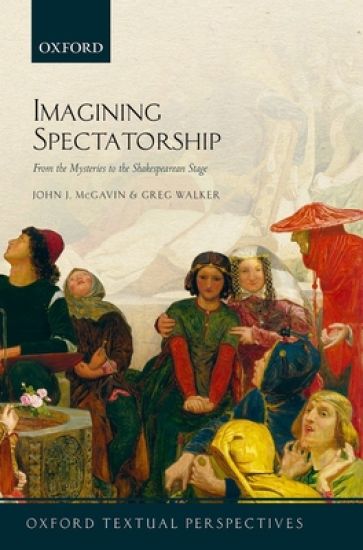
Imagining Spectatorship

Imagining Spectatorship

John J. McGavin; Greg Walker

Oxford University Press
2016
nidottu
Oxford Textual Perspectives is a new series of informative and provocative studies focused upon literary texts (conceived of in the broadest sense of that term) and the technologies, cultures and communities that produce, inform, and receive them. It provides fresh interpretations of fundamental works and of the vital and challenging issues emerging in English literary studies. By engaging with the materiality of the literary text, its production, and reception history, and frequently testing and exploring the boundaries of the notion of text itself, the volumes in the series question familiar frameworks and provide innovative interpretations of both canonical and less well-known works. Imagining Spectatorship offers a new discussion of how spectators witnessed early drama in the various spaces and places in which those works were performed. It combines broad historical and theoretical reflection with closely analysed case studies to produce a comprehensive account of the ways in which individuals encountered early drama, how they were cued to respond to it, and how we might think about those issues today. It addresses the practical matters that conditioned spectatorship, principally those concerned with the location and configuration of the spaces in which a performance occurred, but also suggests how these factors intersected with social status, gender, religious commitment and affiliation, degrees of real or felt personal agency, and the operation of the cognitive processes themselves. It considers both real witnesses and those 'imagined' spectators which are seemingly figured by both dramatic and quasi-dramatic works, and whose assumed attitudes play-makers sought to second-guess. It also looks at the spectatorial experience itself as a subject of representation in a number of early texts. Finally, it examines the complex contract entered into by audiences and players for the duration of a performance, looking at how texts cued spectators to respond to specific dramaturgical tropes and gambits and how audience response was itself a cause of potential anxiety for writers. The book resists the conventional divide between 'medieval' and 'early-modern' drama, using its focus on the spectators' experience to point connections and continuities across a diverse range of genres, such as processions and tourneys as well as scripted plays, pageants, and interludes; a variety of different venues, such as city streets, great halls, and playhouses, and a period of about 150 years to the Shakespearean stage of the 1590s and 1600s. It seeks to offer routes by which inferences about early spectatorship can be made despite the relative absence of personal testimony from the period.

John J. Pershing and the American Expeditionary Forces in World War I, 1917-1919
General of the Armies John J. Pershing (1860-1948) had a long and distinguished military career, but he is most famous for leading the American Expeditionary Forces in World War I. He published a memoir, My Experiences in the World War, and has been the subject of numerous biographies, but the literature regarding this towering figure and his enormous role in the First World War deserves to be expanded to include a collection of his wartime correspondence. Meticulously edited by John T. Greenwood, volume 2 of John J. Pershing and the American Expeditionary Forces in World War I, 1917-1919 covers the period of October 1 through December 31, 1917. During this time, Pershing focused his efforts on working with the French Ministry of War, the General Staff, and the field Army on training and equipping the AEF's few available combat divisions for frontline service. Russia's defection from the coalition and the surprising Italian defeat at Caporetto in October rocked the Allied ranks, and this volume addresses the creation of the Supreme War Council and the House's American War Mission - bodies that reexamined the Entente's military and diplomatic strategy and ultimately cemented the alliance. The correspondence also reveals how the House Mission revived the divisive issue of amalgamating arriving American troops into existing British and French combat divisions - something that Pershing utterly opposed and saw as a threat to the AEF. The dispute never resolved and irritated British prime minister Lloyd George and French premier Georges Clemenceau so much that both would try to engineer Pershing's removal in the following year. Extracts from the large volume of rarely referenced cablegrams represent an important contribution to Pershing's wartime story.
John J. Pershing and the American Expeditionary Forces in World War I, 1917-1919
General of the Armies John J. Pershing (1860–1948) had a long and decorated military career but is most famous for leading the American Expeditionary Forces in World War I. He published a memoir, My Experiences in the World War, and has been the subject of numerous biographies, but the literature regarding this towering figure and his enormous role in the First World War deserves to be expanded to include a collection of his wartime correspondence. Carefully edited by John T. Greenwood, volume 3 of John J. Pershing and the American Expeditionary Forces in World War I, 1917–1919 covers the period of January 1 through March 20, 1918, as General Pershing encounters logistical and organizational challenges that originated in the last months of 1917\. With the collapse of the Eastern Front and Allied defeats in Italy, British and French commanders were preparing for a renewed German offensive and proposed that American troops be put under their control for training and frontline combat in order to replenish losses. Pershing's diary entries indicate that he rejected these proposals and yet offered four segregated African American regiments to be placed under French control. The conclusion of the AEF autonomy debate allowed Pershing to focus on reorganizing the General Headquarters of the AEF, establishing effective communication lines, and contracting Allied European governments to produce armaments for the AEF with American raw materials. In March 1918, Maj. Gen. Peyton C. March replaced Gen. Tasker H. Bliss as chief of staff. The sources included in this edition show the origin of Pershing and March's personal feud, which persisted well after the war. Pershing's letters during this time period convey a long and arduous struggle to build an American army at the front. Together, these volumes of wartime correspondence provide new insight into the work of a legendary soldier and the historic events in which he participated.
John J. Ford, Jr. Correspondence, 1956

John J. Ford, Jr. Correspondence, 1956

Eric P Newman; Jr. John J. Ford

Hassell Street Press
2021
nidottu
This work has been selected by scholars as being culturally important and is part of the knowledge base of civilization as we know it.This work is in the public domain in the United States of America, and possibly other nations. Within the United States, you may freely copy and distribute this work, as no entity (individual or corporate) has a copyright on the body of the work.Scholars believe, and we concur, that this work is important enough to be preserved, reproduced, and made generally available to the public. To ensure a quality reading experience, this work has been proofread and republished using a format that seamlessly blends the original graphical elements with text in an easy-to-read typeface.We appreciate your support of the preservation process, and thank you for being an important part of keeping this knowledge alive and relevant.
John J. Ford, Jr. Correspondence, 1958

John J. Ford, Jr. Correspondence, 1958

Eric P Newman; Jr. John J. Ford

Hassell Street Press
2021
nidottu
This work has been selected by scholars as being culturally important and is part of the knowledge base of civilization as we know it.This work is in the public domain in the United States of America, and possibly other nations. Within the United States, you may freely copy and distribute this work, as no entity (individual or corporate) has a copyright on the body of the work.Scholars believe, and we concur, that this work is important enough to be preserved, reproduced, and made generally available to the public. To ensure a quality reading experience, this work has been proofread and republished using a format that seamlessly blends the original graphical elements with text in an easy-to-read typeface.We appreciate your support of the preservation process, and thank you for being an important part of keeping this knowledge alive and relevant.
John J. Ford, Jr. Correspondence, 1955

John J. Ford, Jr. Correspondence, 1955

Eric P Newman; Jr. John J. Ford

Hassell Street Press
2021
nidottu
This work has been selected by scholars as being culturally important and is part of the knowledge base of civilization as we know it.This work is in the public domain in the United States of America, and possibly other nations. Within the United States, you may freely copy and distribute this work, as no entity (individual or corporate) has a copyright on the body of the work.Scholars believe, and we concur, that this work is important enough to be preserved, reproduced, and made generally available to the public. To ensure a quality reading experience, this work has been proofread and republished using a format that seamlessly blends the original graphical elements with text in an easy-to-read typeface.We appreciate your support of the preservation process, and thank you for being an important part of keeping this knowledge alive and relevant.
John J. Plenty and Fiddler Dan: a New Fable of the Grasshopper and the Ant
This work has been selected by scholars as being culturally important and is part of the knowledge base of civilization as we know it.This work is in the public domain in the United States of America, and possibly other nations. Within the United States, you may freely copy and distribute this work, as no entity (individual or corporate) has a copyright on the body of the work.Scholars believe, and we concur, that this work is important enough to be preserved, reproduced, and made generally available to the public. To ensure a quality reading experience, this work has been proofread and republished using a format that seamlessly blends the original graphical elements with text in an easy-to-read typeface.We appreciate your support of the preservation process, and thank you for being an important part of keeping this knowledge alive and relevant.
John J. Ford, Jr. Correspondence, 1954

John J. Ford, Jr. Correspondence, 1954

Eric P Newman; Jr. John J. Ford

Hassell Street Press
2021
nidottu
This work has been selected by scholars as being culturally important and is part of the knowledge base of civilization as we know it.This work is in the public domain in the United States of America, and possibly other nations. Within the United States, you may freely copy and distribute this work, as no entity (individual or corporate) has a copyright on the body of the work.Scholars believe, and we concur, that this work is important enough to be preserved, reproduced, and made generally available to the public. To ensure a quality reading experience, this work has been proofread and republished using a format that seamlessly blends the original graphical elements with text in an easy-to-read typeface.We appreciate your support of the preservation process, and thank you for being an important part of keeping this knowledge alive and relevant.
John J. Ford, Jr. Correspondence, 1959

John J. Ford, Jr. Correspondence, 1959

Eric P Newman; Jr. John J. Ford

Hassell Street Press
2021
nidottu
This work has been selected by scholars as being culturally important and is part of the knowledge base of civilization as we know it.This work is in the public domain in the United States of America, and possibly other nations. Within the United States, you may freely copy and distribute this work, as no entity (individual or corporate) has a copyright on the body of the work.Scholars believe, and we concur, that this work is important enough to be preserved, reproduced, and made generally available to the public. To ensure a quality reading experience, this work has been proofread and republished using a format that seamlessly blends the original graphical elements with text in an easy-to-read typeface.We appreciate your support of the preservation process, and thank you for being an important part of keeping this knowledge alive and relevant.
The Donnelly Family / John J. Stephens.

The Donnelly Family / John J. Stephens.

John J. Stephens

Hassell Street Press
2021
nidottu
This work has been selected by scholars as being culturally important and is part of the knowledge base of civilization as we know it.This work is in the public domain in the United States of America, and possibly other nations. Within the United States, you may freely copy and distribute this work, as no entity (individual or corporate) has a copyright on the body of the work.Scholars believe, and we concur, that this work is important enough to be preserved, reproduced, and made generally available to the public. To ensure a quality reading experience, this work has been proofread and republished using a format that seamlessly blends the original graphical elements with text in an easy-to-read typeface.We appreciate your support of the preservation process, and thank you for being an important part of keeping this knowledge alive and relevant.
John J. Ford, Jr. Correspondence, 1952

John J. Ford, Jr. Correspondence, 1952

Eric P Newman; Jr. John J. Ford

Hassell Street Press
2021
nidottu
This work has been selected by scholars as being culturally important and is part of the knowledge base of civilization as we know it.This work is in the public domain in the United States of America, and possibly other nations. Within the United States, you may freely copy and distribute this work, as no entity (individual or corporate) has a copyright on the body of the work.Scholars believe, and we concur, that this work is important enough to be preserved, reproduced, and made generally available to the public. To ensure a quality reading experience, this work has been proofread and republished using a format that seamlessly blends the original graphical elements with text in an easy-to-read typeface.We appreciate your support of the preservation process, and thank you for being an important part of keeping this knowledge alive and relevant.