Kirjojen hintavertailu. Mukana 11 627 616 kirjaa ja 12 kauppaa.

Kirjahaku

Etsi kirjoja tekijän nimen, kirjan nimen tai ISBN:n perusteella.

1000 tulosta hakusanalla John Kaye; George Bruce Malleson

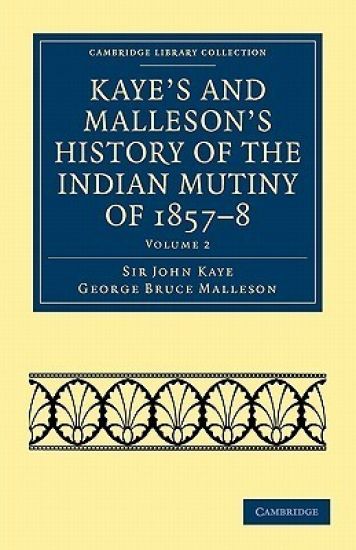
Kaye's and Malleson's History of the Indian Mutiny of 1857–8

Kaye's and Malleson's History of the Indian Mutiny of 1857–8

John Kaye; George Bruce Malleson

Cambridge University Press
2010
pokkari
This six-volume History of the Indian Mutiny was first produced in 1890 by Colonel George Malleson (1825–1898), who combined Sir John Kaye's History of the Sepoy War in India with his own later work. Kaye (1814–1876) was a prolific writer of biography and history who started the Calcutta Review in 1844. His use of first-hand evidence, collected from personal and professional contacts, supports (perhaps predictably) his assertion that the rebellion is a story of British 'national character', and the narrative is illustrated with biographical and personal anecdotes. Malleson's contributions however are derived from his controversial 'Red Pamphlet' (1857) and other writings, in which he is unafraid to criticise or praise British troops and administration as the occasion demands. Volume 2 covers Delhi history and the spread of the revolt from Meerut to Allahabad and Cawnpore, concluding with the battle of Najafgahr and the siege of Delhi.
Kaye's and Malleson's History of the Indian Mutiny of 1857–8

Kaye's and Malleson's History of the Indian Mutiny of 1857–8

John Kaye; George Bruce Malleson

Cambridge University Press
2010
pokkari
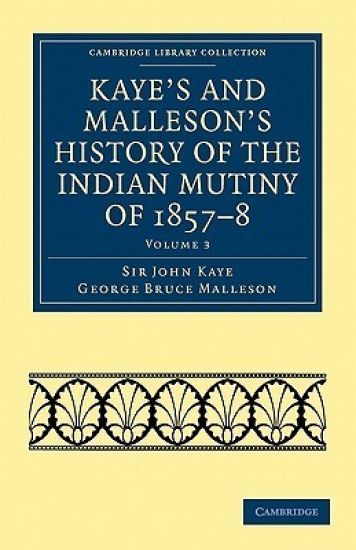
This six-volume History of the Indian Mutiny was first produced in 1890 by Colonel George Malleson (1825–1898), who combined Sir John Kaye's History of the Sepoy War in India with his own later work. Kaye (1814–1876) was a prolific writer of biography and history who started the Calcutta Review in 1844. His use of first-hand evidence, collected from personal and professional contacts, supports (perhaps predictably) his assertion that the rebellion is a story of British 'national character', and the narrative is illustrated with biographical and personal anecdotes. Malleson's contributions however are derived from his controversial 'Red Pamphlet' (1857) and other writings, in which he is unafraid to criticise or praise British troops and administration as the occasion demands. Volume 3 covers areas including Bengal and Bihar, Agra, the central and north-west, Oudh and Lucknow, and includes character assessments and discussions of conditions and causes.
Kaye's and Malleson's History of the Indian Mutiny of 1857–8

Kaye's and Malleson's History of the Indian Mutiny of 1857–8

John Kaye; George Bruce Malleson

Cambridge University Press
2010
pokkari
This six-volume History of the Indian Mutiny was first produced in 1890 by Colonel George Malleson (1825–1898), who combined Sir John Kaye's History of the Sepoy War in India with his own later work. Kaye (1814–1876) was a prolific writer of biography and history who started the Calcutta Review in 1844. His use of first-hand evidence, collected from personal and professional contacts, supports (perhaps predictably) his assertion that the rebellion is a story of British 'national character', and the narrative is illustrated with biographical and personal anecdotes. Malleson's contributions however are derived from his controversial 'Red Pamphlet' (1857) and other writings, in which he is unafraid to criticise or praise British troops and administration as the occasion demands. Volume 5 narrates the ending of the Mutiny, concluding, as Kaye had initially proposed, that the events of the period illustrate British strength of character and fortitude.
Kaye's and Malleson's History of the Indian Mutiny of 1857–8

Kaye's and Malleson's History of the Indian Mutiny of 1857–8

John Kaye; George Bruce Malleson

Cambridge University Press
2010
pokkari
This six-volume History of the Indian Mutiny was first produced in 1890 by Colonel George Malleson (1825–1898), who combined Sir John Kaye's History of the Sepoy War in India with his own later work. Kaye (1814–1876) was a prolific writer of biography and history who started the Calcutta Review in 1844. His use of evidence collected from personal and professional contacts supports (perhaps predictably) his assertion that the rebellion is a story of British 'national character', and the narrative is illustrated with biographical and personal anecdotes. Malleson's contributions however are derived from his controversial 'Red Pamphlet' (1857) and other writings, in which he is unafraid to criticise or praise British troops and administration as the occasion demands. Volume 6 examines the non-military aspects of the Mutiny, and the response of Anglo-Indian civilians to the revolt and to its aftermath. It also contains a comprehensive index.
Kaye's and Malleson's History of the Indian Mutiny of 1857–8

Kaye's and Malleson's History of the Indian Mutiny of 1857–8

Kaye John; Malleson George Bruce

Cambridge University Press
2010
pokkari
This six-volume History of the Indian Mutiny was first produced in 1890 by Colonel George Malleson (1825–1898), who combined Sir John Kaye's History of the Sepoy War in India with his own later work. Kaye (1814–1876) was a prolific writer of biography and history who started the Calcutta Review in 1844. His use of first-hand evidence, collected from personal and professional contacts, supports (perhaps predictably) his assertion that the rebellion is a story of British 'national character', and the narrative is illustrated with biographical and personal anecdotes. Malleson's contributions however are derived from his controversial 'Red Pamphlet' (1857) and other writings, in which he is unafraid to criticise or praise British troops and administration as the occasion demands. Volume 1 contains the first three books, covering introductory remarks on political, military and religious history; a description of the Sepoy army; and the outbreak of the Mutiny.
Kaye's and Malleson's History of the Indian Mutiny of 1857–8

Kaye's and Malleson's History of the Indian Mutiny of 1857–8

Kaye John; Malleson George Bruce

Cambridge University Press
2010
pokkari
This six-volume History of the Indian Mutiny was first produced in 1890 by Colonel George Malleson (1825–1898), who combined Sir John Kaye's History of the Sepoy War in India with his own later work. Kaye (1814–1876) was a prolific writer of biography and history who started the Calcutta Review in 1844. His use of evidence collected from personal and professional contacts supports (perhaps predictably) his assertion that the rebellion is a story of British 'national character', and the narrative is illustrated with biographical and personal anecdotes. Malleson's contributions however are derived from his controversial 'Red Pamphlet' (1857) and other writings, in which he is unafraid to criticise or praise British troops and administration as the occasion demands. Volume 4 covers the storming of Delhi and continues to follow the events in Agra, Cawnpore, Lucknow, Oudh, and Bihar with detailed narratives of the actions of key figures.
Lincolnshire Parish Correspondence of John Kaye, Bishop of Lincoln 1827-53
The 532 letters that are published in this volume come from the extensive correspondence that was received from people in Lincolnshire parishes by John Kaye, Bishop of Lincoln between 1827 and 1853. They are important because theyexpress the opinions and reflect the attitudes of lay people as well as clergymen: Kaye's correspondents ranged from members of the landed gentry to people who would usually have little direct contact with the bishop. They included a 'troublesome', 'deceptious' and 'pugnacious' village carrier disputing the fees charged for burial in his local churchyard, as well as the farmer who complained of the 'hill usige' that he had 'ricivid from the viker' of hisparish. The correspondence reflects Kaye's work as a Church reformer, but it is also important for the way that it demonstrates the changing significance of the Church in the lives of local communities. The extent to which the Church and its affairs were the means through which the social relations of parishes were articulated and sustained was a measure of the continuing importance of the establishment. ROD AMBLER is Senior Lecturerin History at the University of Hull.
History of the Indian mutiny, 1857-1858. Commencing from the close of the second volume of Sir John Kaye's History of the Sepoy war (Volume II)
This book has been considered by academicians and scholars of great significance and value to literature. This forms a part of the knowledge base for future generations. We have represented this book in the same form as it was first published. Hence any marks seen are left intentionally to preserve its true nature.