Kirjojen hintavertailu. Mukana 11 244 527 kirjaa ja 12 kauppaa.

Kirjahaku

Etsi kirjoja tekijän nimen, kirjan nimen tai ISBN:n perusteella.

1000 tulosta hakusanalla John L. Ingraham

Kin

Kin

John L. Ingraham

Harvard University Press
2017
sidottu
Since Darwin, people have speculated about the evolutionary relationships among dissimilar species, including our connections to the diverse life forms known as microbes. In the 1970s biologists discovered a way to establish these kinships. This new era of exploration began with Linus Pauling’s finding that every protein in every cell contains a huge reservoir of evolutionary history. His discovery opened a research path that has changed the way biologists and others think about the living world. In Kin John L. Ingraham tells the story of these remarkable breakthroughs. His original, accessible history explains how we came to understand our microbe inheritance and the relatedness of all organisms on Earth.Among the most revolutionary scientific achievements was Carl Woese’s discovery that a large group of organisms previously lumped together with bacteria were in fact a totally distinct form of life, now called the archaea. But the crowning accomplishment has been to construct the Tree of Life—an evolutionary project Darwin dreamed about over a century ago. Today, we know that the Tree’s three main stems are dominated by microbes. The nonmicrobes—plants and animals, including humans—constitute only a small upper branch in one stem.Knowing the Tree’s structure has given biologists the ability to characterize the complex array of microbial populations that live in us and on us, and investigate how they contribute to health and disease. This knowledge also moves us closer to answering the tantalizing question of how the Tree of Life began, over 3.5 billion years ago.
March of the Microbes

March of the Microbes

John L. Ingraham; Roberto Kolter

The Belknap Press
2012
nidottu
Though nothing in the natural world would be quite the same without them, microbes go mostly unnoticed. They are the tiny, mighty force behind the pop in Champagne and the holes in Swiss cheese, the granite walls of Yosemite and the white cliffs of Dover, the workings of snowmaking machines, Botox, and gunpowder; and yet we tend to regard them as peripheral, disease-causing, food-spoiling troublemakers. In this book renowned microbiologist John Ingraham rescues these supremely important and ubiquitous microorganisms from their unwonted obscurity by showing us how we can, in fact, see them—and appreciate their vast and varied role in nature and our lives.Though we might not be able to see microbes firsthand, the consequences of their activities are readily apparent to our unaided senses. March of the Microbes shows us how to examine, study, and appreciate microbes in the manner of a birdwatcher, by making sightings of microbial activities and thereby identifying particular microbes as well as understanding what they do and how they do it. The sightings are as different as a smelly rock cod, a bottle of Chateau d’Yquem, a moment in the Salem witch trials, and white clouds over the ocean. Together they summarize the impact of microbes on our planet, its atmosphere, geology, weather, and other organisms including ourselves, to whom they dole out fatal illnesses and vital nutrients alike.In the end, Ingraham leaves us marveling at the power and persistence of microbes on our planet and gives credence to Louis Pasteur’s famous assertion that “microbes will have the last word.”
John L. Lewis

John L. Lewis

Melvyn Dubofsky; Warren Van Van Tine

University of Illinois Press
1986
nidottu
John L. Lewis (1880-1969), who ruled the United Mine Workers for four decades beginning in 1919, defied presidents, challenged Congress, and kept American political life in an uproar. Drawing upon previously untapped resources in the UMW archives and upon oral histories by major figures of the 1930s and 1940s, the authors have created a remarkable portrait of this 'self-made man' and his times.
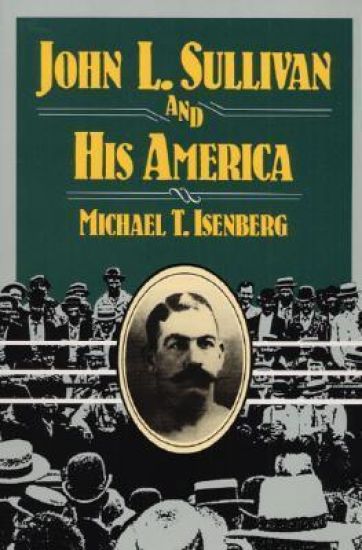
John L. Sullivan and His America

John L. Sullivan and His America

Michael T. Isenberg

University of Illinois Press
1994
nidottu
The "Great John L." reigned supreme as world heavyweight champion from his victory over Paddy Ryan in 1882 until James J. Corbett knocked him out in 1892. A drunkard, a wastrel, an adulterer, a wife beater, and a bully, Sullivan still became American's first national sports hero and represented the hopes and aspirations of millions of people. Michael Isenberg traces Sullivan's eventful life from his humble beginnings in Boston to the height of his immense popularity. The boxer moved as easily in the world of reputable workingmen as he did in the shadowlands on the margins of the sport while his success played a major role in transforming boxing into a profitable and ultimately legitimate business. Tapping previously unexplored archival material--including the notorious National Police Gazette and the other sporting papers of the day--Isenberg tells us why presidents, princes, and turn-of-the-century Americans accepted Sullivan as a hero, even as others vilified him for his drunken and belligerent behavior.
John L. Sullivan

John L. Sullivan

Adam J. Pollack

McFarland Co Inc
2006
pokkari
""Detailed"--Press-Citizen (Iowa City). From his first match in the late 1870s through his final fight in 1905, this biography contains a thoroughly researched, detailed accounting of John L. Sullivan's boxing career. With special attention to the 1880s it follows Sullivan's skill development and discusses his opponents in detail, providing various viewpoints of a single event"--Provided by publisher.
John L.O'Sullivan and His Times

John L.O'Sullivan and His Times

Kent State University Press
2003
sidottu
Brings to life one of the most enigmatic, romantic, and ultimately tragic characters in American history. The life of nineteenth-century journalist, diplomat, adventurer, and enthusiast for lost causes John Louis O'Sullivan is usually glimpsed only in brief episodes, perhaps because the components of his life are sometimes contradictory. An exponent of romantic democracy, O'Sullivan became a defender of slavery. A champion of reforms for women, labor, criminals, and public schools, he ended his life promoting spiritualism. This first full-length biography reveals a man possessed of the idealism and promise, as well as the prejudices and follies, of his age, a man who sensed the revolutionary and liberating potential of radical democracy but was unable to acknowledge the racial barriers it had to cross to fulfill its promise.