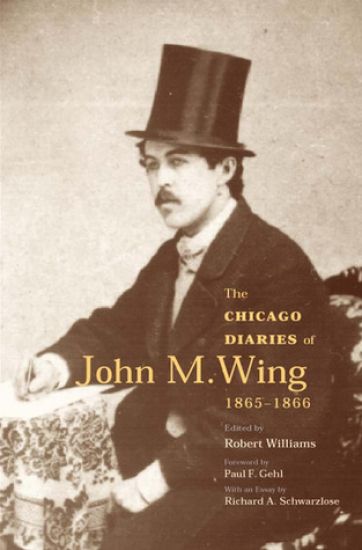
The personal - and often intimate - diaries of fledgling journalist and entrepreneur John Mansir Wing create a unique portrait of a rough-and-tumble Chicago in the first few years following the Civil War. Wing writes of a city filled with new immigrants, exsoldiers, and the thriving merchant class making its fortune from both before the great fire of 1871 left much of the city in ashes. Transcribed and edited by noted Chicago bibliophile and historian Robert Williams, and published in cooperation with the Caxton Club, this volume also details the early adventures of a rural Eastern who came to the ""Metropolis of the West"" in his early twenties and worked for some of the most influential journalists of his day. Wing shared cigars and conversation with notable politicians, businessmen, and war heroes including Sherman and Grant, all the while conducting an active romantic life with members of his own sex in boarding houses and barrooms. Wing's greatest passion was for book collecting. Following a successful career in trade journal publishing, he provided an endowment to create the John M. Wing Foundation at Chicago's famed Newberry Library. The Wing Foundation became the first American public collection devoted to the history of printing; it remains today among the nation's best resources for the study of the bibliographic arts. Despite his lasting importance in publishing and philanthropy, and the fact that no serious history of Chicago can be written without reference to many of his publications, John M. Wing has been largely absent from most histories of the city's movers and shakers. Complete with historical annotations and a bibliography of Wing's writings for the press, this fascinating personal account reclaims his deserved place in Chicago life and lore.
While You're Up, Jack Camp's engaging memoir, covers many topics: The wood products industry, Camp Manufacturing; Union Camp; particle board production; paper mills; paper production; Tidewater Virginia; Franklin, Virginia; Wallace, NC; St. Stephen, SC; farm life: dairy cows; sheep; hog killings; Virginia Military Institute; Babson College; flight school, World War II, the China-Burma-India Theater; General George Marshall; Karachi; Taj Mahal; Ceylon (Sri Lanka); flying The Hump; Rancheros; romance; raising children; deer hunting; the Baptist Church; church missionaries; blacks in the South; quail hunting; coon hunting; fishing; Virginia Beach; the Dismal Swamp; riding; travel; dogs; furniture making; rose gardening; charitable foundations; Figure Eight Island, NC; family reunions, vintage airplanes, and numerous other topics. This charming memoir includes many excerpted letters written by Jack Camp while in India during World War II.
In the first full biography of Lieutenant General John McAllister Schofield (1831-1906), Donald B. Connelly examines the career of one of the leading commanders in the western theater during the Civil War. In doing so, Connelly illuminates the role of politics in the formulation of military policy, during both war and peace, in the latter half of the nineteenth century.Connelly relates how Schofield, as a department commander during the war, had to cope with contending political factions that sought to shape military and civil policies. Following the war, Schofield occupied every senior position in the army--including secretary of war and commanding general of the army--and became a leading champion of army reform and professionalism. He was the first senior officer to recognize that professionalism would come not from the separation of politics and the military but from the army's accommodation of politics and the often contentious American constitutional system. Seen through the lens of Schofield's extensive military career, the history of American civil-military relations has seldom involved conflict between the military and civil authority, Connelly argues. The central question has never been whether to have civilian control but rather which civilians have a say in the formulation and execution of policy.
Deirdre of the Sorrows is a three-act play written by Irish playwright John Millington Synge, first performed at the Abbey Theatre by the Irish National Theatre Society in 1910. The play is based on Irish mythology, in particular the myths concerning Deirdre and Conchobar. The work was unfinished at the author's death in 1909, but was completed by William Butler Yeats and Synge's fianc e, Molly Allgood. Plot synopsis edit] Act I: Lavarcham's house on Slieve Fuadh. Conchubor, the aging High King of Ulster, has charged Lavarcham to raise the child Deirdre to be his queen when she comes of age. Lavarcham finds that the now-beautiful Deirdre is a willful young woman, without interest in marrying an old man. Conchubor comes to Slieve Fuadh to bring Deirdre to his palace, Emain Macha, ignoring her pleas to remain in the countryside for another year. After he leaves, Naoise, son of Usna, and his brothers come to the cottage seeking Deirdre, and she tells them of her summons. Deirdre is aware of a prophecy that she will be the doom of the sons of Usna; nonetheless she asks Naoise to take her away from Ulster. He agrees, and Ainnle weds them in an impromptu ceremony. Act II: Alban. Deirdre and the sons of Usna have lived happily on a remote island for seven years. Fergus arrives bearing an offer of peace from Conchubor, and asks Deirdre and Naoise to return with him to Emain Macha. Lavarcham warns Deirdre not to accept, and Owen, a spy in the service of Conchubor, intimidates Deirdre with suggestions that death awaits Naoise in Ulster. Naoise tells Fergus that he plans to live the rest of his life with Deirdre in Alban, but Deirdre convinces him to accept Conchubor's offer, reasoning that it is better to die young, at the peak of their love, than to grow old and live in the shadow of their past happiness. Act III: A tent near Emain. Lavarcham arrives at Conchubor's tent and tries to convince him to give up his pursuit of Deirdre, claiming that she has grown old and lost her beauty. His soldiers arrive and contradict her claims, and he leaves just before Deirdre and Naoise enter. They discuss the possibility of their impending deaths until Conchubor returns. Deirdre nearly convinces him to put aside past grievances and let them live in peace when the sound of a battle between Conchubor's men and Naoise's brothers reaches them. Conchubor and Naoise go to join the fray and Naoise is killed. Fergus and his men arrive, enraged by the king's treachery, and set Emain Macha ablaze. Lavarcham tries to convince Deirdre to flee Ulster, and Conchubor tries to take her to a different castle, but she stays and mourns her dead lover and his brothers. In the end, Deirdre takes Naoise's dagger, stabs herself, and falls into his open grave, leaving Conchubor with nothing.... Edmund John Millington Synge (16 April 1871 - 24 March 1909) was an Irish playwright, poet, prose writer, travel writer and collector of folklore. He was a key figure in the Irish Literary Revival and was one of the co-founders of the Abbey Theatre. He is best known for his play The Playboy of the Western World, which caused riots in Dublin during its opening run at the Abbey Theatre. Although he came from a privileged Anglo-Irish background, Synge's writings are mainly concerned with the world of the Roman Catholic peasants of rural Ireland and with what he saw as the essential paganism of their world view. Synge developed Hodgkin's disease, a metastatic cancer that was then untreatable. He died several weeks short of his 38th birthday as he was trying to complete his last play, Deirdre of the Sorrows.