Oliver Wendell Holmes, Jr. has been, and continues to be, praised as America’s greatest judge and he is widely considered to have done more than anyone else to breathe life into the Constitution’s right of free speech, probably the most crucial right for democracy. One indeed finds among professors of constitutional law and federal judges the widespread belief that the scope of the First Amendment owes much of its incredible expansion over the last sixty years to Holmes’s judicial dissents in Abrams and Gitlow. In this book, John M. Kang offers the novel thesis that Holmes’s dissenting opinions in Abrams and Gitlow drew in part from a normative worldview structured by an idiosyncratic manliness, a manliness which was itself rooted in physical courage. In making this argument, Kang seeks to show how Holmes’s justification for the right of speech was a bid to proffer a philosophical commentary about the demands of democracy.
Oliver Wendell Holmes, Jr. has been, and continues to be, praised as America’s greatest judge and he is widely considered to have done more than anyone else to breathe life into the Constitution’s right of free speech, probably the most crucial right for democracy. One indeed finds among professors of constitutional law and federal judges the widespread belief that the scope of the First Amendment owes much of its incredible expansion over the last sixty years to Holmes’s judicial dissents in Abrams and Gitlow. In this book, John M. Kang offers the novel thesis that Holmes’s dissenting opinions in Abrams and Gitlow drew in part from a normative worldview structured by an idiosyncratic manliness, a manliness which was itself rooted in physical courage. In making this argument, Kang seeks to show how Holmes’s justification for the right of speech was a bid to proffer a philosophical commentary about the demands of democracy.
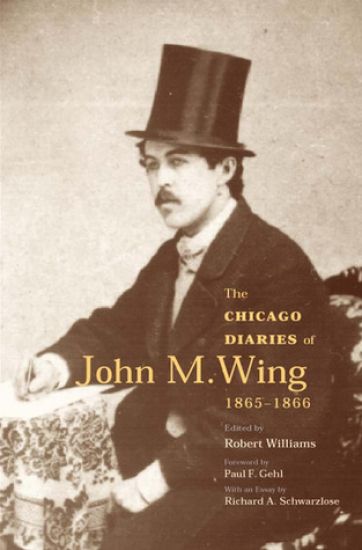
The personal - and often intimate - diaries of fledgling journalist and entrepreneur John Mansir Wing create a unique portrait of a rough-and-tumble Chicago in the first few years following the Civil War. Wing writes of a city filled with new immigrants, exsoldiers, and the thriving merchant class making its fortune from both before the great fire of 1871 left much of the city in ashes. Transcribed and edited by noted Chicago bibliophile and historian Robert Williams, and published in cooperation with the Caxton Club, this volume also details the early adventures of a rural Eastern who came to the ""Metropolis of the West"" in his early twenties and worked for some of the most influential journalists of his day. Wing shared cigars and conversation with notable politicians, businessmen, and war heroes including Sherman and Grant, all the while conducting an active romantic life with members of his own sex in boarding houses and barrooms. Wing's greatest passion was for book collecting. Following a successful career in trade journal publishing, he provided an endowment to create the John M. Wing Foundation at Chicago's famed Newberry Library. The Wing Foundation became the first American public collection devoted to the history of printing; it remains today among the nation's best resources for the study of the bibliographic arts. Despite his lasting importance in publishing and philanthropy, and the fact that no serious history of Chicago can be written without reference to many of his publications, John M. Wing has been largely absent from most histories of the city's movers and shakers. Complete with historical annotations and a bibliography of Wing's writings for the press, this fascinating personal account reclaims his deserved place in Chicago life and lore.
While You're Up, Jack Camp's engaging memoir, covers many topics: The wood products industry, Camp Manufacturing; Union Camp; particle board production; paper mills; paper production; Tidewater Virginia; Franklin, Virginia; Wallace, NC; St. Stephen, SC; farm life: dairy cows; sheep; hog killings; Virginia Military Institute; Babson College; flight school, World War II, the China-Burma-India Theater; General George Marshall; Karachi; Taj Mahal; Ceylon (Sri Lanka); flying The Hump; Rancheros; romance; raising children; deer hunting; the Baptist Church; church missionaries; blacks in the South; quail hunting; coon hunting; fishing; Virginia Beach; the Dismal Swamp; riding; travel; dogs; furniture making; rose gardening; charitable foundations; Figure Eight Island, NC; family reunions, vintage airplanes, and numerous other topics. This charming memoir includes many excerpted letters written by Jack Camp while in India during World War II.
In the first full biography of Lieutenant General John McAllister Schofield (1831-1906), Donald B. Connelly examines the career of one of the leading commanders in the western theater during the Civil War. In doing so, Connelly illuminates the role of politics in the formulation of military policy, during both war and peace, in the latter half of the nineteenth century.Connelly relates how Schofield, as a department commander during the war, had to cope with contending political factions that sought to shape military and civil policies. Following the war, Schofield occupied every senior position in the army--including secretary of war and commanding general of the army--and became a leading champion of army reform and professionalism. He was the first senior officer to recognize that professionalism would come not from the separation of politics and the military but from the army's accommodation of politics and the often contentious American constitutional system. Seen through the lens of Schofield's extensive military career, the history of American civil-military relations has seldom involved conflict between the military and civil authority, Connelly argues. The central question has never been whether to have civilian control but rather which civilians have a say in the formulation and execution of policy.