
Kirjahaku
Etsi kirjoja tekijän nimen, kirjan nimen tai ISBN:n perusteella.
1000 tulosta hakusanalla John Macfarlane
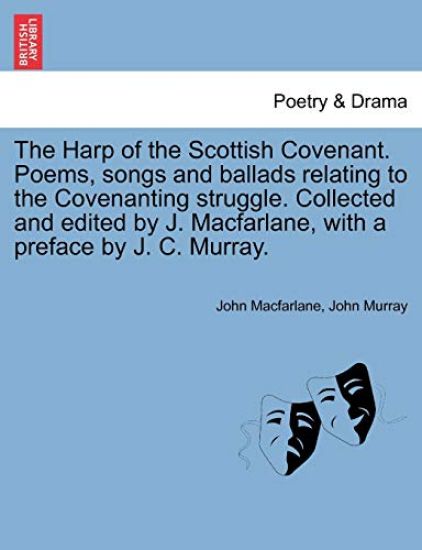
The Harp of the Scottish Covenant. Poems, Songs and Ballads Relating to the Covenanting Struggle. Collected and Edited by J. MacFarlane, with a Preface by J. C. Murray.
John MacFarlane; John Murray
British Library, Historical Print Editions
2011
pokkari

John MacFarlane debates how we might make sense of the idea that truth is relative, and how we might use this idea to give satisfying accounts of parts of our thought and talk that have resisted traditional methods of analysis. Although there is a substantial philosophical literature on relativism about truth, going back to Plato's Theaetetus, this literature (both pro and con) has tended to focus on refutations of the doctrine, or refutations of these refutations, at the expense of saying clearly what the doctrine is. In contrast, Assessment Sensitivity begins with a clear account of what it is to be a relativist about truth, and uses this view to give satisfying accounts of what we mean when we talk about what is tasty, what we know, what will happen, what might be the case, and what we ought to do. The book seeks to provide a richer framework for the description of linguistic practices than standard truth-conditional semantics affords: one that allows not just standard contextual sensitivity (sensitivity to features of the context in which an expression is used), but assessment sensitivity (sensitivity to features of the context from which a use of an expression is assessed). The Context and Content series is a forum for outstanding original research at the intersection of philosophy, linguistics, and cognitive science. The general editor is François Recanati (Institut Jean-Nicod, Paris).

John MacFarlane debates how we might make sense of the idea that truth is relative, and how we might use this idea to give satisfying accounts of parts of our thought and talk that have resisted traditional methods of analysis. Although there is a substantial philosophical literature on relativism about truth, going back to Plato's Theaetetus, this literature (both pro and con) has tended to focus on refutations of the doctrine, or refutations of these refutations, at the expense of saying clearly what the doctrine is. In contrast, Assessment Sensitivity begins with a clear account of what it is to be a relativist about truth, and uses this view to give satisfying accounts of what we mean when we talk about what is tasty, what we know, what will happen, what might be the case, and what we ought to do. The book seeks to provide a richer framework for the description of linguistic practices than standard truth-conditional semantics affords: one that allows not just standard contextual sensitivity (sensitivity to features of the context in which an expression is used), but assessment sensitivity (sensitivity to features of the context from which a use of an expression is assessed). The Context and Content series is a forum for outstanding original research at the intersection of philosophy, linguistics, and cognitive science. The general editor is François Recanati (Institut Jean-Nicod, Paris).
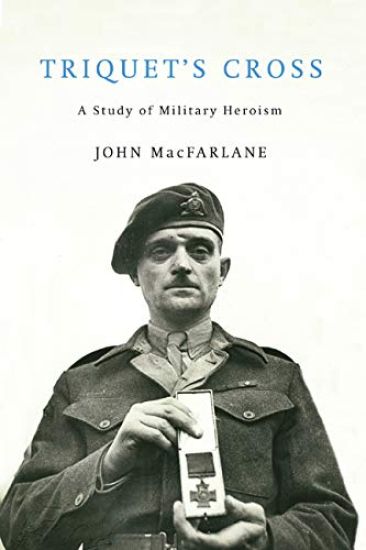
In Triquet's Cross John MacFarlane tells the story of Paul Triquet, a French-Canadian soldier who was awarded the Victoria Cross for bravery in the battle for Casa Berardi during the Second World War.One of only thirteen members of the Canadian Armed Forces to be awarded the highest military honour during the war, Triquet was later pressured to resign from the force due to the overwhelming public and political expectations that the award entailed. The role of hero did not suit Triquet and weighed heavily on him and his family. MacFarlane shows how Triquet's story was changed by those who wished to make his hero status the cornerstone in a political debate between francophones and anglophones, particularly with regard to his representing the Commonwealth despite his French-Canadian heritage.Military heroism has changed in the postwar period, and heroes are no longer expected to be perfect models. But in 1944 Paul Triquet - perhaps the most popular Canadian hero of the war - was asked to conform to political, social, and military agendas. His story reveals much about Canadian and Québécois society at the time and the history of French-Canadians in the Second World War.


The personal, political, and public burden created by Paul Triquet's heroism in the Second World War
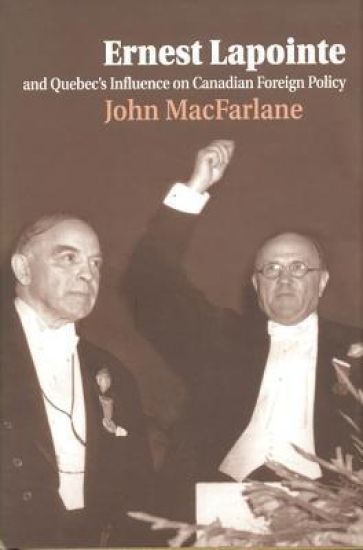
Ernest Lapointe and Quebec's Influence on Canada's Foreign Policy
John MacFarlane
University of Toronto Press
1999
sidottu
Currently the stakes are higher than ever for anglophone Canada to recognize and understand the extent and nature of Quebec's role in the shaping of the nation. John MacFarlane's revision of anglophone history is a compelling step in that process. Historians often emphasize how, during both the difficult inter-war years and the Second World War, the Liberal government of Mackenzie King successfully reconciled the needs of majority rule with the recognition of minority voice, particularly in foreign affairs. How did a consummate anti-Catholic, who did not even speak French, manage to acknowledge and accommodate the vastly different demands of the French-speaking population? Issues such as conscription, relations with Great Britain, and Canadian policy at the League of Nations threatened to divide Canada when the instability of the international scene urgently required a unified voice. Ernest Lapointe, officially the minister of justice (1924-5, 1926-30, 1935-41) and minister of fisheries (1921-4), represented francophone Quebeckers in the federal cabinet. His ability to influence and reflect the views of the Quebec population, his loyalty to Mackenzie King, and in some cases, his threats of resignation, awarded him considerable weight in many external affairs questions. Yet his influence, as a major figure of twentieth century Canadian political history, is one of the least understood. Analysing seventeen foreign policy decisions, the author uncovers Ernest Lapointe's relationship with King, and the voice of Quebec represented by his skilful interceptions.


Introductory logic is generally taught as a straightforward technical discipline. In this book, John MacFarlane helps the reader think about the limitations of, presuppositions of, and alternatives to classical first-order predicate logic, making this an ideal introduction to philosophical logic for any student who already has completed an introductory logic course.The book explores the following questions. Are there quantificational idioms that cannot be expressed with the familiar universal and existential quantifiers? How can logic be extended to capture modal notions like necessity and obligation? Does the material conditional adequately capture the meaning of 'if'—and if not, what are the alternatives? Should logical consequence be understood in terms of models or in terms of proofs? Can one intelligibly question the validity of basic logical principles like Modus Ponens or Double Negation Elimination? Is the fact that classical logic validates the inference from a contradiction to anything a flaw, and if so, how can logic be modified to repair it? How, exactly, is logic related to reasoning? Must classical logic be revised in order to be applied to vague language, and if so how? Each chapter is organized around suggested readings and includes exercises designed to deepen the reader's understanding.Key Features:An integrated treatment of the technical and philosophical issues comprising philosophical logicDesigned to serve students taking only one course in logic beyond the introductory levelProvides tools and concepts necessary to understand work in many areas of analytic philosophyIncludes exercises, suggested readings, and suggestions for further exploration in each chapter
Introductory logic is generally taught as a straightforward technical discipline. In this book, John MacFarlane helps the reader think about the limitations of, presuppositions of, and alternatives to classical first-order predicate logic, making this an ideal introduction to philosophical logic for any student who already has completed an introductory logic course.The book explores the following questions. Are there quantificational idioms that cannot be expressed with the familiar universal and existential quantifiers? How can logic be extended to capture modal notions like necessity and obligation? Does the material conditional adequately capture the meaning of 'if'—and if not, what are the alternatives? Should logical consequence be understood in terms of models or in terms of proofs? Can one intelligibly question the validity of basic logical principles like Modus Ponens or Double Negation Elimination? Is the fact that classical logic validates the inference from a contradiction to anything a flaw, and if so, how can logic be modified to repair it? How, exactly, is logic related to reasoning? Must classical logic be revised in order to be applied to vague language, and if so how? Each chapter is organized around suggested readings and includes exercises designed to deepen the reader's understanding.Key Features:An integrated treatment of the technical and philosophical issues comprising philosophical logicDesigned to serve students taking only one course in logic beyond the introductory levelProvides tools and concepts necessary to understand work in many areas of analytic philosophyIncludes exercises, suggested readings, and suggestions for further exploration in each chapter

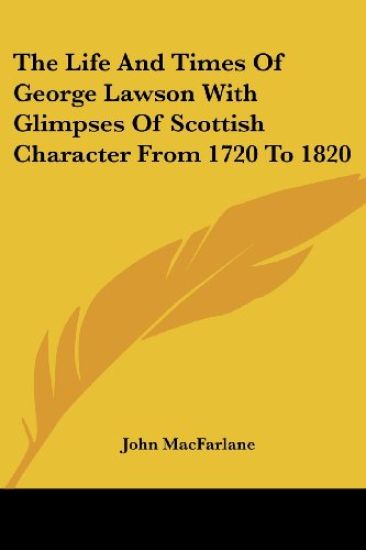
The Life and Times of George Lawson With Glimpses of Scottish Character from 1720 to 1820
John MacFarlane
Kessinger Pub
2005
pokkari