
Kirjahaku
Etsi kirjoja tekijän nimen, kirjan nimen tai ISBN:n perusteella.
1000 tulosta hakusanalla John Marshall Lang

The Last Supper of our Lord and his Words of Consolation to the Desciples
John Marshall Lang
Hutson Street Press
2025
sidottu

The Last Supper of our Lord and his Words of Consolation to the Desciples
John Marshall Lang
Hutson Street Press
2025
pokkari




The Last Supper of Our Lord and His Words of Consolation to the Disciples
John Marshall Lang
Kessinger Pub
2009
pokkari


Glasgow and the Barony Thereof. a Review of Three Hundred Years and More.
John Marshall Lang
British Library, Historical Print Editions
2011
pokkari




The Last Supper of Our Lord. And His Words of Consolation to the Disciples
John Marshall Lang
Outlook Verlag
2024
nidottu

The Stomach in Its Morbid States
John Marshall; Langston Parker; John Burne
Antigonos Verlag
2025
nidottu

The Representation of Language in the Brain: In Honour of John C. Marshall
Psychology Press Ltd
2015
nidottu
John C Marshall is one of the most influential neuropsychologists of his generation. His impact on the development of cognitive neuropsychology has been pivotal, particularly in the neuropsychology of language. This Festschrift in his honour brings together contributions from his colleagues and friends to celebrate this contribution and presents a comprehensive survey of contemporary and historical issues concerned with The Representation of Language in the Brain. There are contributions on reading, naming, syntax, comprehension, foreign accent syndrome, progressive aphasia, the history of aphasia, treatment, the evolution of language, calculation and embodied cognition. The content reflects John’s own interests in language and aphasia, and it is therefore no wonder that it also reflects current and central issues in the neuropsychology of language.
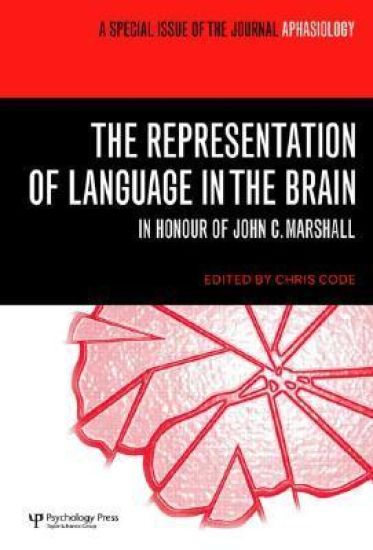
The Representation of Language in the Brain: In Honour of John C. Marshall
Psychology Press Ltd
2006
sidottu
John C Marshall is one of the most influential neuropsychologists of his generation. His impact on the development of cognitive neuropsychology has been pivotal, particularly in the neuropsychology of language. This Festschrift in his honour brings together contributions from his colleagues and friends to celebrate this contribution and presents a comprehensive survey of contemporary and historical issues concerned with The Representation of Language in the Brain. There are contributions on reading, naming, syntax, comprehension, foreign accent syndrome, progressive aphasia, the history of aphasia, treatment, the evolution of language, calculation and embodied cognition. The content reflects John’s own interests in language and aphasia, and it is therefore no wonder that it also reflects current and central issues in the neuropsychology of language.

The surprising life of Chief Justice John Marshall, who turned the Supreme Court into a bulwark against presidential and congressional tyranny and saved American democracyIn this startling biography, award-winning author Harlow Giles Unger reveals how Virginia-born John Marshall emerged from the Revolutionary War's bloodiest battlefields to become one of the nation's most important Founding Fathers: America's greatest Chief Justice. With nine decisions that shocked the nation, John Marshall and his court saved American liberty by protecting individual rights and the rights of private business against tyranny by federal, state, and local government.
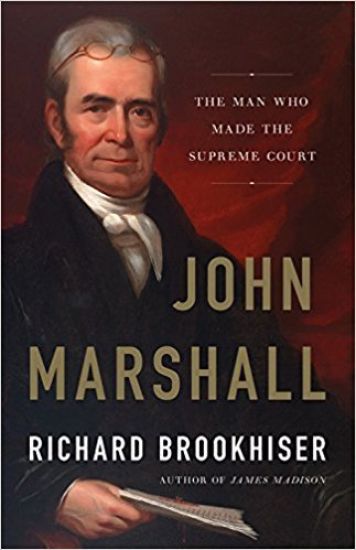
In 1801, a 45-year-old Revolutionary War veteran and politician, slovenly, genial, brilliant, and persuasive, became the fourth chief justice of the United States, a post he would hold for a record thirty-four years. Before John Marshall joined the Court, the judicial branch was viewed as the poor sister of the federal government, lacking in dignity and clout. After his passing, the Supreme Court of the United States would never be ignored again. John Marshall is award-winning and bestselling author Richard Brookhiser's definitive biography of America's longest-serving Chief Justice.Marshall (1755-1835) was born in Northern Virginia and served as a captain during the Revolutionary War and then as a delegate to the Virginia state convention. He was a friend and admirer of George Washington, and a cousin and enemy of Thomas Jefferson. His appointment to the Supreme Court came almost by chance-Adams saw him as the last viable option, after previous appointees declined the nomination. Yet he took to the court immediately, turning his sharp mind toward strengthening America's fragile legal order.Americans had inherited from their colonial past a deep distrust of judges as creatures of arbitrary royal power; in reaction, newly independent states made them pawns of legislative whim. The result was legal caprice, sometimes amounting to chaos. Marshall wanted a strong federal judiciary, led by the Supreme Court, to define laws, protect rights, and balance the power of the legislative and executive branches. However, America's legal system, he believed, was threatened by specific individuals-namely Thomas Jefferson and the early Republican Party-who were intent on undermining the Constitution and respect for law in order to empower themselves.As a Federalist and a follower of Washington and Hamilton, he also wanted a strong national government, favorable to business. In his three decades on the court, Marshall accomplished just that. As Brookhiser vividly relates, in a string of often-colorful cases involving businessmen, educators, inventors, scoundrels, Native Americans, and slaves, Marshall clipped the power of the states vis-à-vis the federal government, established the Supreme Court's power to correct or rebuke Congress or the president, and bolstered commerce and contracts. John Marshall's modus operandi was charm and wit, frequently uniting his fellow justices around unanimous decisions in even the most controversial cases. For better and for worse, he made the Supreme Court a central part of American life.John Marshall is the definitive biography of America's greatest judge and most important early Chief Justice.