Kirjojen hintavertailu. Mukana 11 244 527 kirjaa ja 12 kauppaa.

Kirjahaku

Etsi kirjoja tekijän nimen, kirjan nimen tai ISBN:n perusteella.

1000 tulosta hakusanalla John O'Neill

Official Report of Gen. John O'Neill, President of the Fenian Brotherhood
Official Report of Gen. John O'Neill, President of the Fenian Brotherhood - On the attempt to invade Canada, May 25th, 1870. The preparations therefor, and the cause of its failure, with a sketch of his connection with the organization is an unchanged, high-quality reprint of the original edition of 1870. Hansebooks is editor of the literature on different topic areas such as research and science, travel and expeditions, cooking and nutrition, medicine, and other genres. As a publisher we focus on the preservation of historical literature. Many works of historical writers and scientists are available today as antiques only. Hansebooks newly publishes these books and contributes to the preservation of literature which has become rare and historical knowledge for the future.
The Market

The Market

John O'Neill

Routledge
1998
sidottu
Following the failure of 'really existing socialism' in Eastern Europe and Asia, the market is now generally perceived, by Left and Right, to be supreme in any rational economic system. The current debate now focuses on the proper boundaries of markets rather than the system itself. This book examines the problems of defining these boundaries for the recent defences of the market, and shows that they highlight major weaknesses in the cases made by its proponents. The author draws on considerable research in this area to provide an overdue critical evaluation of the limits of the market, and future prospects for non-market socialism. The issues discussed cross a number of academic boundaries including economics, philosophy and politics.
The Poverty of Postmodernism

The Poverty of Postmodernism

John O'Neill

Routledge
1994
sidottu
The Poverty of Postmodernism rejects the current celebration of knowledge and value relativism. This is on the grounds that it renders critical reason and commonsense incapable of resisting the superifical ideologies of minoritarianism that leave the hard core of global capitalism unanalyzed. In this book John O'Neill examines the postmodern turn in the social sciences. From a phenomenological standpoint (Husserl, Merleau Ponty, Schutz, Winch), he challenges Lyotard's postrationalist reading of Wittgenstein and Habermas in order to defend commonsense reason and values that are constitutive of the everyday life-world. In addition he argues from the standpoint of Vico and Marx on the civil history of embodied mind that the post-rationalist celebration of the arts of superificiality undermines the recognition of the cultural debt each generation owes to past and post-generations. In a positive way O'Neill develops an account of the historical vocation of reason and of the charitable accountability of science to commonsense that is necessary to sustain the basic institutions of civic democracy.
The Poverty of Postmodernism

The Poverty of Postmodernism

John O'Neill

Routledge
1994
nidottu
The Poverty of Postmodernism rejects the current celebration of knowledge and value relativism. This is on the grounds that it renders critical reason and commonsense incapable of resisting the superifical ideologies of minoritarianism that leave the hard core of global capitalism unanalyzed. In this book John O'Neill examines the postmodern turn in the social sciences. From a phenomenological standpoint (Husserl, Merleau Ponty, Schutz, Winch), he challenges Lyotard's postrationalist reading of Wittgenstein and Habermas in order to defend commonsense reason and values that are constitutive of the everyday life-world. In addition he argues from the standpoint of Vico and Marx on the civil history of embodied mind that the post-rationalist celebration of the arts of superificiality undermines the recognition of the cultural debt each generation owes to past and post-generations. In a positive way O'Neill develops an account of the historical vocation of reason and of the charitable accountability of science to commonsense that is necessary to sustain the basic institutions of civic democracy.
The Market

The Market

John O'Neill

Routledge
1998
nidottu
Following the failure of 'really existing socialism' in Eastern Europe and Asia, the market is now generally perceived, by Left and Right, to be supreme in any rational economic system. The current debate now focuses on the proper boundaries of markets rather than the system itself. This book examines the problems of defining these boundaries for the recent defences of the market, and shows that they highlight major weaknesses in the cases made by its proponents. The author draws on considerable research in this area to provide an overdue critical evaluation of the limits of the market, and future prospects for non-market socialism. The issues discussed cross a number of academic boundaries including economics, philosophy and politics.
Markets, Deliberation and Environment
What is the source of our environmental problems? Why is there in modern societies a persistent tendency to environmental damage? From within neoclassical economic theory there is a straightforward answer to those questions: it is because environmental goods and harms are unpriced. They come free. This position runs up against a view which runs in entirely the opposite direction, that our environmental problems have their source not in a failure to apply market norms rigorously enough, but in the very spread of these market mechanisms and norms. The source of environmental problems lies in part in the spread of markets both in real geographical terms across the globe and through the introduction of markets mechanisms and norms into spheres of life that previously have been protected from markets. In this book, John O’Neill conducts a thorough examination of these two opposing viewpoints covering a discussion of the ethical boundaries of markets, the role of private property rights in environmental protection, the nature of sustainability and the valuation of goods over time.This book is essential reading for undergraduate and postgraduate students studying courses in ecological and environmental economics.
Markets, Deliberation and Environment
What is the source of our environmental problems? Why is there in modern societies a persistent tendency to environmental damage? From within neoclassical economic theory there is a straightforward answer to those questions: it is because environmental goods and harms are unpriced. They come free. This position runs up against a view which runs in entirely the opposite direction, that our environmental problems have their source not in a failure to apply market norms rigorously enough, but in the very spread of these market mechanisms and norms. The source of environmental problems lies in part in the spread of markets both in real geographical terms across the globe and through the introduction of markets mechanisms and norms into spheres of life that previously have been protected from markets. In this book, John O’Neill conducts a thorough examination of these two opposing viewpoints covering a discussion of the ethical boundaries of markets, the role of private property rights in environmental protection, the nature of sustainability and the valuation of goods over time.This book is essential reading for undergraduate and postgraduate students studying courses in ecological and environmental economics.
The 'bago Blues

The 'bago Blues

John O'Neill

John O'Neill Books
2018
nidottu
Val, Sophie, Goldie, Mo, and Lily don't have a lot in common. Mo is a pious Irish Catholic. Goldie is Jewish. Sophie is a brash irreverent New Yorker; Lily a straight-laced Georgia belle. Val is the meticulous, devious mother hen. Nevertheless, as the five widows have aged, they have become the closest of friends. They have supported each other through illness, trauma, and death. However, Val knows that nothing lasts forever. She learned that the hard way when the love of her life died and left her with nothing but memories. Soon, the same will happen with the others. Lily has been diagnosed with early Alzheimer's disease and is mentally deteriorating. Mo's body can't withstand her breast cancer treatments. The group will be broken up. Val is determined to have one last, unforgettable adventure before that happens. She has rented a Winnebago, and she can't wait to see where their journey takes them. In this bittersweet novel of growing old and growing up, the five learn that putting hundreds of miles of asphalt between themselves and their problems doesn't make them go away. Someone is hiding a secret from the others, and it has the potential to lead to a terrible tragedy.
Around Grangetown

Around Grangetown

John O'Neill

The History Press Ltd
2004
nidottu
This absorbing collection of old images traces some of the changes and developments that have taken place in Grangetown from the Victorian age through to the 1950s. Illustrated with over 200 postcards and photographs, many never before published, this volume features some of the important events that have occurred in this industrial town. It also describes the impact of the iron and steelworks, which brought housing and employment to the area, as well as the effect of war on the community.It considers aspects of everyday life, from schools and churches, public houses, shops and streets - such as a decorated Whitworth Road celebrating the coronation of King George V in 1911, and children playing in Holden Street in 1912, and nearby Eston Junction - to leisure pursuits and local townspeople.
Five Bodies

Five Bodies

John O'Neill†

SAGE Publications Inc
2004
sidottu
Five Bodies offers an introduction to some of the most urgent contemporary concerns within the sociology of the body. The book was first published in 1985 in the USA by Cornell University Press, and was nominated for the John Porter Award (sponsored by the Canadian Sociology and Anthropology Association). A path breaking book, it offered a framework for the growing field of the sociology of the body and opened up 'the body' for sociological research. This new edition (the previous edition was published by Cornell University Press (1985) has been substantially revised and updated to address today's issues of the body in modern life, community and politics. John O'Neill examines how embodied selves and relationships are being re-shaped and re-figured and how the embodied figures of the polity, economy and society represent the contested notions of identity, desire, wholeness and fragmentation. He focuses upon those cultural practices through which we map our macro-micro worlds: · articulating a cosmology · a body politic · a productivensumptive economy · a bio-technological frontier of human design and transplantation
Five Bodies

Five Bodies

John O'Neill†

SAGE Publications Inc
2004
nidottu
Five Bodies offers an introduction to some of the most urgent contemporary concerns within the sociology of the body. The book was first published in 1985 in the USA by Cornell University Press, and was nominated for the John Porter Award (sponsored by the Canadian Sociology and Anthropology Association). A path breaking book, it offered a framework for the growing field of the sociology of the body and opened up 'the body' for sociological research. This new edition (the previous edition was published by Cornell University Press (1985) has been substantially revised and updated to address today's issues of the body in modern life, community and politics. John O'Neill examines how embodied selves and relationships are being re-shaped and re-figured and how the embodied figures of the polity, economy and society represent the contested notions of identity, desire, wholeness and fragmentation. He focuses upon those cultural practices through which we map our macro-micro worlds: · articulating a cosmology · a body politic · a productivensumptive economy · a bio-technological frontier of human design and transplantation
Civic Capitalism

Civic Capitalism

John O'Neill

University of Toronto Press
2005
pokkari
Offering a positive formulation of the moral practices that are basic to the civic institution of childhood, citizenship, and social justice, Civic Capitalism expands the economist's concept of human capital to include health, education, and other social transfers that enrich civic capital formation. John O'Neill demonstrates how this development has become the political core of capitalist societies in North America and Europe whose welfare regimes are continuously contested yet intrinsic to ideals of citizenship and social justice. Civic Capitalism examines the current surrender to global capitalism and market elites that exploit rich national niches of civic society, education, health, the rule of law, and social security, and challenges it to re-focus on the needs of children and the poor. Elite ideologies of anti-governance and anti-taxation are indifferent to the needs of society's most vulnerable, and fail to realize that inequality, ignorance, and sickness are the most present impediments to economic growth and democracy. O'Neill gives moral voice to children and the state of childhood – the site where our notions of well-being (health, education, human capital) are tested. His research draws upon the classical tradition of critical political economy and social policy in Galbraith, Rawls, and Tawney, to name a few. Working within this tradition, he provides a grammar of civic childhood and the wealth of nations.
For Marx Against Althusser

For Marx Against Althusser

John O'Neill

University Press of America
1982
sidottu
Introducing a new cross-disciplinary genre co-published with The Center for Advanced Research in Phenomenology, this volume argues that any attempt to break into the intertextuality of Marx's philosophy, economics, history, and sociology, or to separate him from Hegel and the classical economists, merely results in crude reductions of Marx's achievement.
Essaying Montaigne

Essaying Montaigne

John O’Neill

Liverpool University Press
2001
sidottu
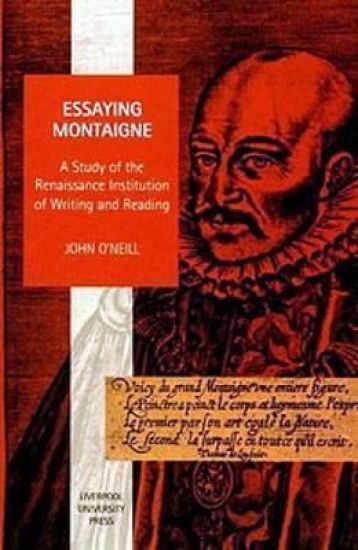
John O’Neill reads Montaigne’s Essays from their central principle of friendship as a communicative and pedagogical practice operative in society, literature and politics. The friendship between Montaigne and La Boétie was ruled neither by plenitude nor lack but by a capacity for recognition and transitivity. As an essayist Montaigne is an exemplary practitioner of a technique of difference and recognition that puts all certainties of history, philosophy and culture in the balance of weighted comparison. The essayist reveals how every absolute subjectivity or authority is shaken by its internal weakness once we move inside the contrastive structure of domination in politics, gender and race. O’Neill’s reading of the Essays strives to be faithful to the phenomenology of their embodied practices of reading-to-write-to re-read and re-write. From this standpoint he engages the principal critical readings of the Essays over the last century that have examined with great brilliance their history, structure and psychology. Whether the structure is evolutionary, structuralist, Marxist or psychoanalytical, O’Neill provides close readings of Montaigne’s literary critics. By bringing to bear the ethico-critical practice of ‘essaying’ to resist the subjection of the Essays to dominant criticism, O’Neill reminds readers that Montaigne’s appeal is in how he survived bloody cultural war with a balance of modesty and tolerance, invoking compromise where others practice violence.