Kirjojen hintavertailu. Mukana 11 244 527 kirjaa ja 12 kauppaa.

Kirjahaku

Etsi kirjoja tekijän nimen, kirjan nimen tai ISBN:n perusteella.

1000 tulosta hakusanalla John Raymaker; Pierre Whalon

Attentive, Intelligent, Rational, and Responsible

Attentive, Intelligent, Rational, and Responsible

John Raymaker; Pierre Whalon

Marquette University Press
2023
nidottu
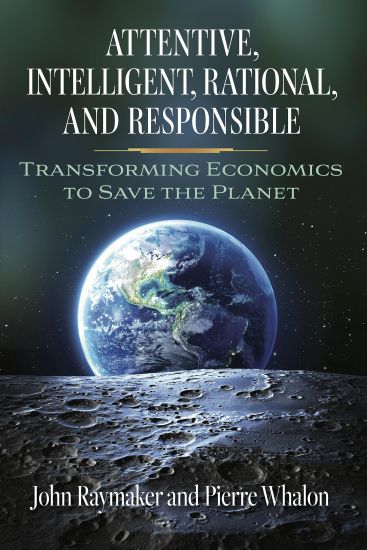
The philosophical theology and economic ideas of the Canadian Jesuit Bernard Lonergan (1904-84) form the superstructure of the book. Its genius lies in the authors' fusing the fruit of their scholarship with Lonergan's ideas without disturbing the flow of their argument. The two scholars detail carefully, but unapologetically, why they've had to draw from a theologian to correct the errors of economists. For, in Lonergan, they find a rich tapestry of economic ideas and "fresh original thinking" that can help resolve some contested issues in economics… The realities of contemporary global society cry for such a development and prompt us to ask: How does Lonergan's economics fit the new world global financial market? Does his economic theory adequately address how we can overcome the limitations of those social and economic engineers who are content with making the masses seem like raw materials of rich people's economic propaganda? "Attentive, Intelligent, Rational, and Responsible": Transforming Economics to Save the Planet answers these questions and many more.
Empowering the Lonely Crowd

Empowering the Lonely Crowd

John Raymaker

University Press of America
2003
nidottu
In Empowering the Lonely Crowd, John Raymaker simplifies and extends arguments made in his previous book, A Buddhist-Christian Logic of the Heart, in particular the notion of a spiritual genome. Raymaker explores and compares John Paul II and Lonergan's thought in relation to (Japanese) Buddhism, concluding that while all life has a coded genome, all humans have a free, uncoded spiritual genome that is a viable alternative to postmodern skepticism.
Empowering Philosophy and Science with the Art of Love

Empowering Philosophy and Science with the Art of Love

John Raymaker

University Press of America
2006
nidottu
Philosophy and Science are subject to conflicting interpretations, such as the rules of positivism and analytic thought. Bernard Lonergan and Gilles Deleuze have both assessed such issues in complementary fashion. This book examines their arguments through the application of mathematical theories and Buddhist-Christian ethics. Using a structured analogy based on a spiritual genome, Empowering Philosophy and Science with the Art of Love seeks to bridge the religious-secularist divide exacerbated by postmodernism. The goal is to empower the practitioners of philosophy and science by having them pay heed to the art of ethical virtue.
Empowering Bernard Lonergan's Legacy

Empowering Bernard Lonergan's Legacy

John Raymaker

University Press of America
2012
sidottu
Empowering Bernard Lonergan’s Legacy offers an interdisciplinary approach to Lonergan’s work. It presents a series of five “feedback matrices” to situate his work within a historical context. The matrices also serve to establish foundations for an interdisciplinary ethics and a method for interreligious dialogue. “Feedback” and “matrix” are key, but previously unstressed, notions in Lonergan’s work. The book’s final two collaborative feedback matrices could best be implemented in a proposed international Lonergan association. Raymaker argues that without such an association, Lonergan’s breakthrough method cannot reach its interdisciplinary and collaborative potential. One of Lonergan’s most important achievements was his development of foundations for the sciences, ethics, and interreligious dialogue. One can best empower Lonergan’s legacy through a correct understanding and implementation of how the data of human consciousness affects all human knowledge and activities.
Empowering Climate-Change Strategies with Bernard Lonergan's Method
This book addresses the climate change crisis through scientific, historical, and spiritual lenses. Using Bernard Lonergan’s functional specialization method, developed to facilitate collaboration among specialists, Raymaker and Durrani not only analyze data and rebut the claims of climate change deniers, but also look for inspiration to motivate and coordinate needed action by persons, groups, and nations. The book is wide-ranging in its historical examination of leaders who have shown us ways to work together constructively in finding solutions to problems. Lonergan’s method helps us study the past with a view to change the future. To do so, we must first reform ourselves.
Empowering Climate-Change Strategies with Bernard Lonergan's Method
This book addresses the climate change crisis through scientific, historical, and spiritual lenses. Using Bernard Lonergan’s functional specialization method, developed to facilitate collaboration among specialists, Raymaker and Durrani not only analyze data and rebut the claims of climate change deniers, but also look for inspiration to motivate and coordinate needed action by persons, groups, and nations. The book is wide-ranging in its historical examination of leaders who have shown us ways to work together constructively in finding solutions to problems. Lonergan’s method helps us study the past with a view to change the future. To do so, we must first reform ourselves.
Bernard Lonergan’s Third Way of the Heart and Mind
Today the world is confronted with many religious wars and the migrations of millions of persons due to these conflicts. There is a need for informed dialog as to the roots of the conflicts and ways of addressing these in ways that speak to peoples’ minds and hearts. This is what this book attempts to do from the viewpoint of major religious and ethical thinkers. The book relies on Bernard Lonergan’s foundational method to address problems systematically with a view to achieve breakthroughs in our openness to one another. The book appeals to the teachings of the Buddha, Jesus, and Mohammad, relying on the mystical and insights of these religious founders as well as those of dozens of their followers so as to find commonalities that can build bridges of mercy. A global secularity ethics plays a leading role in this book’s bridging efforts.
Bernard Lonergan’s Third Way of the Heart and Mind
Today the world is confronted with many religious wars and the migrations of millions of persons due to these conflicts. There is a need for informed dialog as to the roots of the conflicts and ways of addressing these in ways that speak to peoples’ minds and hearts. This is what this book attempts to do from the viewpoint of major religious and ethical thinkers. The book relies on Bernard Lonergan’s foundational method to address problems systematically with a view to achieve breakthroughs in our openness to one another. The book appeals to the teachings of the Buddha, Jesus, and Mohammad, relying on the mystical and insights of these religious founders as well as those of dozens of their followers so as to find commonalities that can build bridges of mercy. A global secularity ethics plays a leading role in this book’s bridging efforts.
Bernard Lonergan's Method and a Medical Doctor's Approach to Healthcare
Pat Daly, MD, has written a series of articles which uphold Bernard Lonergan's method explored in his famous book Insight as a model that could be followed or applied in practicing medicine or promoting healthcare. Daly calls his effort a GEM Model for medicine. Daly, however, has not explored in-depth Lonergan's second major work, Method in Theology, which develops an eight-step method that complements Insight. This book focuses on these eight steps, or Functional Specialties so as to better promote Lonergan's views on ""Healing and Creating in History.""
Bernard Lonergan's Method and a Medical Doctor's Approach to Healthcare
Pat Daly, MD, has written a series of articles which uphold Bernard Lonergan's method explored in his famous book Insight as a model that could be followed or applied in practicing medicine or promoting healthcare. Daly calls his effort a GEM Model for medicine. Daly, however, has not explored in-depth Lonergan's second major work, Method in Theology, which develops an eight-step method that complements Insight. This book focuses on these eight steps, or Functional Specialties so as to better promote Lonergan's views on ""Healing and Creating in History.""
Pope Francis, Conscience of the World

Pope Francis, Conscience of the World

John Raymaker; Gerald Grudzen

Hamilton Books
2019
nidottu
Why is it that Pope Francis is admired by so many? What gives him the uncanny ability to speak with young people in language familiar to them? In this book, John Raymaker and Gerry Gruzden explore the life and writings of Pope Francis which have a prophetic, visionary ability to speak to important issues of the day. The authors evaluate how Pope Francis’ encounters with religious leaders of other faiths have broken new ground to help unite mankind. They reach back into Christian history to explore the teachings of such Catholic mystics as Thomas Merton while also delving into the beliefs of Islamic and Buddhist mystics to demonstrate how well the pope is in touch with a spirituality that can speak to those seeking the truth. In its final chapters, the book examines how the pope endorses the work of Christians who live their faith in small Christian communities and reveals how such communities can strengthen parish life in various parts of the world. Like St. Francis, his namesake, and like Teilhard de Chardin before him, the pope has an appropriate vision to rebuild God’s Church in a transitional age. His writings have focused on caring for the earth and preaching the good news of the gospels in a way that and allows him to reach young people in need of joy as they face an uncertain future. He is the Conscience of the World.
Will Pope Francis or a Successor Call a Vatican III Council?

Will Pope Francis or a Successor Call a Vatican III Council?

John Raymaker; Gerald Grudzen

Hamilton Books
2020
nidottu
In 2008, the authors wrote Steps toward Vatican III which explored developments occurring in the Catholic Church including its teachings on social justice, interreligious dialogue, and Small Christian Communities. This update of Steps explores how Pope Francis has developed such themes in original ways in his encyclicals and in his use of synodal consultations. For example, in his Encyclical Laudato Si, the pope seeks to lead us into the mysteries of the universe, of creatures, and the harmony of creation. It helps us reflect on the universal communion of nature. Calling for a global ecological policy and a cooperative approach, the pope warns us that unless we respect nature, the entire planet and humanity will face drastic consequences. In his meetings with economists and entrepreneurs, the pope has proposed a pact for renewing the economy to counteract the asocial aspects of modern business practices. He has discussed some of the most complex problems in today's world--from safeguarding the environment to courageously committing oneself to rethink the economic paradigms of our time. Young people, in particular, have responded with enthusiasm to Pope Francis’ initiatives. The book notes how some "traditional" Catholics have opposed the pope, but it argues that, in fact, the pope is more traditional than his critics for he insists on going back to Jesus' own teachings. The new ongoing crises such as the breakdown and rise of new ideologies, terrorism, massive advances in the sciences and in technology, as well as fundamental shifts in gender relations are further factors considered in the book. Indeed, the world is now radically different from the world of the early 1960’s when Vatican II Council was held. Due to these many radical changes, the book suggests the need for a Vatican III which would consolidate the Church’s global outreach on every continent.
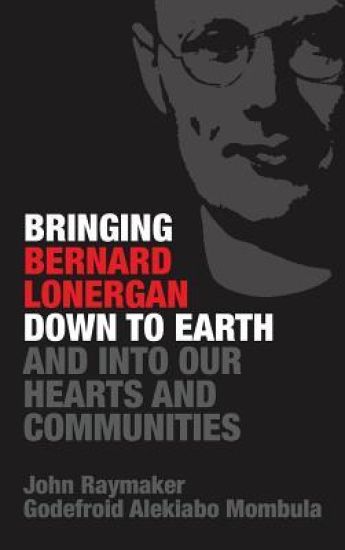
Bringing Bernard Lonergan Down to Earth and Into Our Hearts and Communities

Bringing Bernard Lonergan Down to Earth and Into Our Hearts and Communities

John Raymaker; Godefroid Alekiabo Mombula

Wipf Stock Publishers
2018
sidottu
Bernard Lonergan is a world-renowned philosopher, methodologist, and theologian. The complexity of his work has tended to limit his accessibility to average readers. Bringing Bernard Lonergan Down to Earth seeks to remedy this limitation by showing how Lonergan did address problems of community life. He also broadened his interest after writing Insight to include a reaching into our hearts as modeled, for example, by the genius Blaise Pascal. Lonergan also sought to bridge religious divides. Here the Christian theological virtues of faith, hope, and love are indispensable but that does not curtail from Lonergan's uncanny ability to reach out to secularists by focusing on ethics. The importance of Lonergan's interdisciplinary work is signaled in the book's twelve explorations (in the concluding Part IV) that detail for interested readers his extraordinary ability to solve major philosophical issues. ""Do not be deceived by Raymaker's and Mombula's title, as if they have arrived at a formula regarding 'bringing down to earth.' On the contrary, they identify splendidly a massive task for these next centuries. On their road to that identification there is quite an astonishing sweep through cultures and sciences, climbing to a dozen quite definite and powerful illustrations of 'the amplitude of Lonergan's pointers' in the final part of the book. This is not a book for light or commonsense reading: it is a door-opening to the real possibility of establishing a world community in the millennium ahead."" --Philip McShane, editor, Phenomenology and Logic John Raymaker has specialized in social ethics and in studying Buddhism during his twenty years in Japan where he taught cultural anthropology at Hosei University. He has authored and coauthored books on a possible Vatican III Council and on Bernard Lonergan. Godefroid Mombula, a native of the Congo, is a member of the Missionhurst missionary congregation. He spent several years as a missionary in the Philippines. After obtaining his PhD at the Gregorianum in Rome, he has returned to the Congo where he now directs several developmental projects.
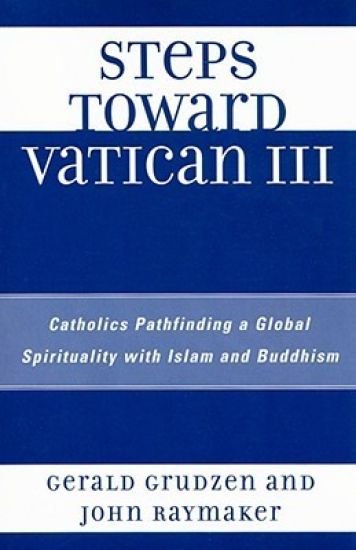
Steps Toward Vatican III

Steps Toward Vatican III

Gerald Grudzen; John Raymaker

University Press of America
2008
nidottu
The Catholic Church has a tradition of bridge-building, one founded on Christ and that began with the Apostle St. John and the convert St. Paul. It helped bridge the Hebrew, Greek, and Roman worlds. Later, it helped civilize the tribes that overran Europe. Limits appeared in the Church's bridge-building ability when Europe was confronted with Islam, and later with the secular mentality that arose in Western Europe, as well as in its encounters with China, India, and Africa. Steps Toward Vatican III examines the present dilemmas facing the Church and humanity in an age of globalization that daily brings people of various backgrounds into close proximity. It offers a "middle-way" to face such issues. It develops a global ethics and a global spirituality that can be incarnated within alert, loving, small Christian communities, as well as in the larger Church structures directed from the Vatican. It builds on Vatican II to find paths that may help bring peace and understanding in the world by a sympathetic evaluation of different world traditions. Such sympathy must be informed by the conversions that Jesus and the Church have demanded of their followers.
John

John

Ledio - Scuola Primaria L Santucci

Lulu.com
2017
pokkari
John un ragazzino con tanti sogni. Ma ha anche un'ideale: un mondo senza le bugie e le parolacce. Ce la far a realizzarlo? Leggete e lo scoprirete...
John

John

David Jeremiah

HarperChristian Resources
2019
nidottu
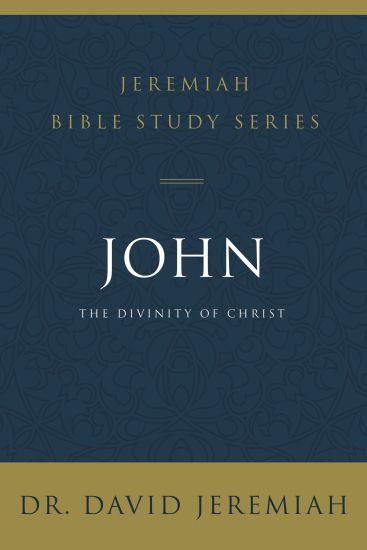
Jesus came to give us life.Jesus called twelve men to be His disciples, but three fishermen–Peter, James, and John–shared a special relationship with Him. They were given direct access to some of the more pivotal events in Jesus’ ministry, such as the transfiguration, His raising of Lazarus from the dead, and His agony in the Garden of Gethsemane. John’s account thus gives us a unique glimpse from one of Jesus’ closest disciples into the significance of the life, death, and resurrection of Christ. John reveals how Jesus came to provide “living water” to quench our deep spiritual thirst for the things of God. He shows how Jesus is the “bread of life” who satisfies our deep spiritual hunger. And he reveals how Jesus is the only way we can obtain that living water and bread of life, for “no one comes to the Father” except through Him.The Jeremiah Bible Study Series captures Dr. David Jeremiah’s forty-plus years of commitment to teaching the Word of God. In each study, he will help you understand what the Bible says, what it meant to the people at the time it was written, and what it means to you today. Along the way, you will gain insights into the text, identify key stories and themes, and be challenged to apply the truth you find in your life.
John

John

George R. Beasley-Murray

ZONDERVAN
2020
nidottu
A companion series to the acclaimed Word Biblical CommentaryFinding the great themes of the books of the Bible is essential to the study of God's Word and to the preaching and teaching of its truths. These themes and ideas are often like precious gems: they lie beneath the surface and can only be discovered with some difficulty. While commentaries are useful for helping readers understand the content of a verse or chapter, they are not usually designed to help the reader to trace important subjects systematically within a given book a Scripture.The Word Biblical Themes series helps readers discover the important themes of a book of the Bible. This series distills the theological essence of a given book of Scripture and serves it up in ways that enrich the preaching, teaching, worship, and discipleship of God's people. Volumes in this series:Are written by top biblical scholarsFeature authors who wrote on the same book of the Bible for the Word Biblical Commentary seriesDistill deep and focused study on a biblical book into the most important themes and practical applications of themGive readers an ability to see the "big picture" of a book of the Bible by understanding what topics and concerns were most important to the biblical writersHelp address pressing issues in the church today by showing readers see how the biblical writers approached similar issues in their dayAre ideal for sermon preparation and for other teaching in the church Word Biblical Themes are an ideal resource for any reader who has used and benefited from the Word Biblical Commentary series, and will help pastors, bible teachers, and students as they seek to understand and apply God’s word to their ministry and learning.
John

John

Scot McKnight

HarperChristian Resources
2023
nidottu
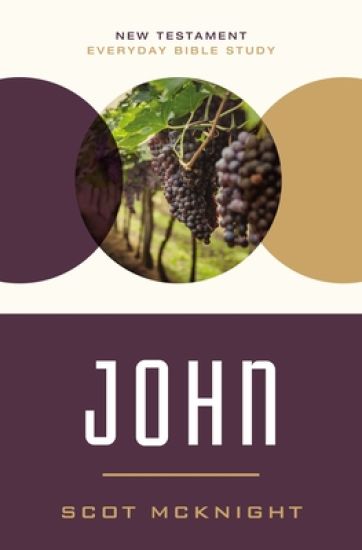
Become a daily Bible reader, attentive to the mind of God."Scot McKnight is one of my absolute favorite New Testament scholars and his Everyday Bible Study series is akin to Einstein creating a user-friendly version of the Theory of Relativity!"—Lisa Harper, award-winning author and Bible teacherIn the New Testament Everyday Bible Study Series, widely respected biblical scholar Scot McKnight reveals the newness and activeness of God's Word as it works in our everyday lives. His unique approach to Bible study combines sound theology with relevant pastoral wisdom. Each volume of this series provides:Original Meaning: Brief, precise expositions of the biblical text and offers a clear focus for the central message of each passage.Fresh Interpretation: Brings the passage alive with fresh images and what it means to follow King Jesus.Practical Application: Biblical connections and questions for reflection and application for each passage. Ideal for personal reflection or group study, John will help you see God in the biblical context so you can hear from God in your context. John's Gospel highlights how people responded to Jesus in the first century but also showcases responses for readers today: faith that abides in who he is, obeys what he calls us to do, and witnesses about Jesus to the world.Who Jesus is and who we understand him to be shape how we respond to Jesus and the kind of person we are created to become.Scot McKnight will walk you and your group through John with Scripture passages (sometimes translated from the original by McKnight himself), reflection questions, pastoral insights, and ideas for putting God's words into action.