Kirjojen hintavertailu. Mukana 12 390 323 kirjaa ja 12 kauppaa.

Kirjahaku

Etsi kirjoja tekijän nimen, kirjan nimen tai ISBN:n perusteella.

1000 tulosta hakusanalla John Sutherland; Jolyon Connell

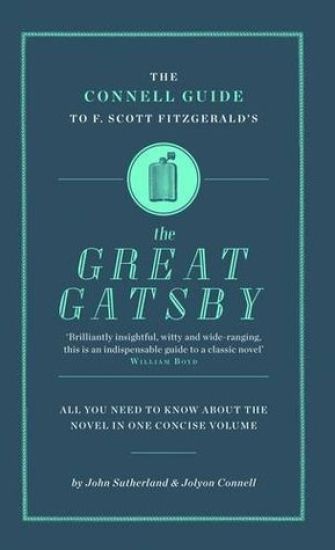
The Connell Guide To F. Scott Fitzgerald's The Great Gatsby

The Connell Guide To F. Scott Fitzgerald's The Great Gatsby

John Sutherland; Jolyon Connell

Connell Guides
2012
pokkari
When The Great Gatsby was first published, in 1925, reviews were mixed. H.L. Mencken called it "no more than a glorified anecdote". L.P. Hartley, author of The Go-Between, thought Fitzgerald deserved "a good shaking": "The Great Gatsby is evidently not a satire; but one would like to think that Mr Fitzgerald's heart is not in it, that it is a piece of mere naughtiness." Yet, gradually the book came to be seen as one of the greatest - if not the greatest - of American novels. Why? What is it that makes this story of a petty hoodlum so compelling? Why has a novel so intimately rooted in its own time "lasted" into ours? What is it that posterity, eight decades later, finds so fascinating in this chronicle of the long-gone "Jazz Age", flappers, speakeasies and wild parties? It is, after all, scarcely a novel at all, more a long short story. But it has a power out of all proportion to its length. It is beautifully written, making it feel even shorter than it is, and is full of haunting imagery. It is also, perhaps, the most vivid literary evocation of the "Great American Dream", about which it is profoundly sceptical, as it is about dreams generally. In the end, however, as D.H. Lawrence would put it, it is "on the side of life". Gatsby's dream may be impossible, so much so that the book can end in no other way than with his death, but up to a point he is redeemed by it and by the tenacity with which he clings to it. It is this that makes the novel so moving and so haunting.
The Connell Guide To Charles Dickens's Great Expectations

The Connell Guide To Charles Dickens's Great Expectations

John Sutherland; Jolyon Connell

Connell Guides
2012
pokkari
Great Expectations is one of the best-selling Victorian novels of our time. No Dickens work, with the exception of A Christmas Carol, has been adapted more for both film and television. It has been as popular with critics as it has with the public. In 1937, George Bernard Shaw called the novel Dickens's "most compactly perfect book". John Lucas describes it as "the most perfect and the most beautiful of all Dickens's novels", Angus Wilson as "the most completely unified work of art that Dickens ever produced". Great Expectations has been so successful partly because it's an exciting story. Dickens always had a keen eye on the market and subscribed to Wilkie Collins's advice: "make 'em laugh, make 'em cry, above all make 'em wait." From the violent opening scene on the marshes to the climax of Magwitch's attempted escape on the Thames, the story is full of suspense, mystery and drama. But while these elements of Great Expectations have ensured its popularity, it is also a novel which, as this guide will seek to show, raises profound questions not just about the nature of Victorian society but about the way human relationships work and the extent to which people are shaped by their childhoods and the circumstances in which they grow up.
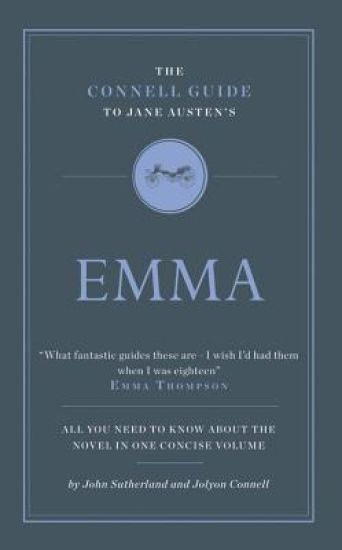
The Connell Guide To Jane Austen's Emma

The Connell Guide To Jane Austen's Emma

John Sutherland; Jolyon Connell

Connell Guides
2012
pokkari
"A heroine whom no-one but myself will much like," the author famously proclaimed. In fact, in any league of likeability Miss Woodhouse is streets ahead of Miss Fanny - the ostentatiously "meek" heroine of Mansfield Park. Meek Emma is not. Indeed it is her sense of absolute sovereignty over her little world of Highbury - her right, as she presumes, to dispose of the marriage choices of those in her circle - which brings her to grief. And that grief, by the familiar course of the heroine's moral education in Austen's fiction, makes her, through remorse and repentance, a mature woman capable of forming correct judgements. Not least about whom Miss Woodhouse herself will marry. Emma, of all the six great novels, is the one which conforms most closely to Austen's famous formula that "three or four families in a country village is the very thing to work on". Emma is, by general agreement, the "quietest" of the novels. Some have complained that there is not enough of a story in it, but others, as this guide shows, have found the plot in Emma the most successful Austen achieved. It is, for example, unusual among the sextet in playing a cunning trick on the reader who - unless they are sharp (sharper certainly than Miss Woodhouse) - may well be deluded as to which eligible young (or less than young) man the heroine will end up spending the rest of her life with. Or whether, given her frequently uttered distaste for marriage, she will end up the only unwed of the six heroines at the end of it all.
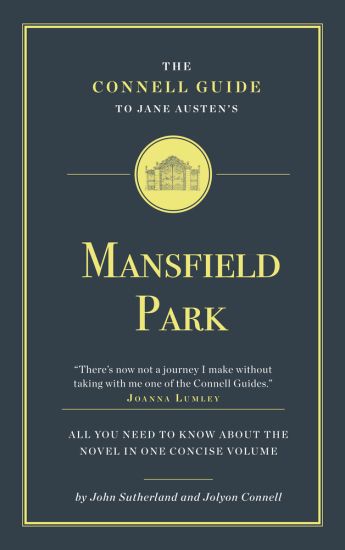
The Connell Guide to Jane Austen's Mansfield Park

The Connell Guide to Jane Austen's Mansfield Park

John Sutherland; Jolyon Connell

Connell Guides
2018
pokkari
Few novels have divided critics more than Mansfield Park. It has been fiercely argued over for more than 200 years, and with good reason: it is open to radically different interpretations. At its broadest, it is a novel about the condition of England, setting up an opposition, as the Austen biographer Claire Tomalin has put it, between someone with strongly held religious and moral principles who will not consider a marriage that is not based on true feeling, and is revolted by sexual immorality, and "a group of worldly, highly cultivated, entertaining and well-to-do young people who pursue pleasure without regard for religious or moral principles". Many have dismissed the heroine, Fanny Price, as a mere picture of goodness, but the author of this guide, John Wiltshire, one of the most respected and original of modern Austen critics, dismisses this argument. "The still, principled fulcrum of moral right, celebrated and excoriated by earlier critics," he says, is now "understood to be a trembling, unstable entity", an "erotically driven and conflicted figure". Indeed, in part at least, this is a novel about female desire - the plot revolves around the passionate feelings of two young women, Fanny and Maria. The argument that it is a straightforward defence of the conservative way of life is hard to sustain; it is more plausibly seen as questioning the whole patriarchal basis of society, and in particular the extent to which women were trapped by a system over which they had no control. Far from being devoid of irony, it is now frequently, and perhaps rightly, thought of as the most ironic of all Austen's novels.
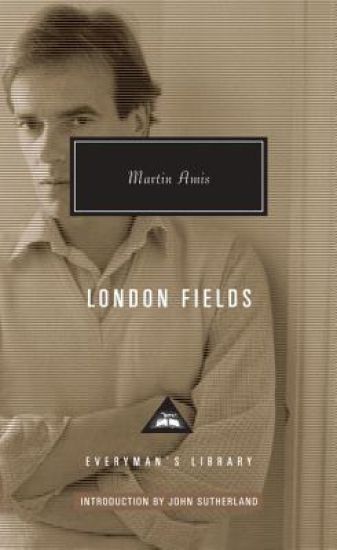
London Fields: Introduction by John Sutherland
Martin Amis's acclaimed novel--now in a twenty-fifth-anniversary hardcover edition--is a blackly comic murder mystery about a murder that has not yet happened. First published in 1989, LONDON FIELDS is set ten years into a dark future, against a backdrop of environmental and social decay and the looming threat of global cataclysm. As the dreaded millennium approaches, Nicola Six, a "black hole" of sex and self-loathing, attempts to orchestrate her own extinction, choosing her thirty-fifth birthday, November 5, 1999, as the date of her murder. Whom to manipulate into killing her is the question; her choice wavers between violent lowlife Keith Talent, who is obsessed with winning a darts tournament, and a dimly romantic banker named Guy Clinch. When Samson Young--a writer suffering from a long bout of writer's block--stumbles upon these three, he believes he has found a story that will write itself. A highly unusual mystery with an unexpected twist at the end, LONDON FIELDS is also a corrosively funny narrative of pyrotechnic complexity and scalding moral vision.
Unto the Right Honourable the Lords of Council and Session, the Petition of John Sutherland of Wester, Provost of the Burgh of Wick, and Other Magistrates and Counsellors of That Burgh,
The 18th century was a wealth of knowledge, exploration and rapidly growing technology and expanding record-keeping made possible by advances in the printing press. In its determination to preserve the century of revolution, Gale initiated a revolution of its own: digitization of epic proportions to preserve these invaluable works in the largest archive of its kind. Now for the first time these high-quality digital copies of original 18th century manuscripts are available in print, making them highly accessible to libraries, undergraduate students, and independent scholars.This collection reveals the history of English common law and Empire law in a vastly changing world of British expansion. Dominating the legal field is the Commentaries of the Law of England by Sir William Blackstone, which first appeared in 1765. Reference works such as almanacs and catalogues continue to educate us by revealing the day-to-day workings of society.++++The below data was compiled from various identification fields in the bibliographic record of this title. This data is provided as an additional tool in helping to insure edition identification: ++++Bodleian Library (Oxford)T213408Dated at head of the drop-head title: February 24. 1773. Edinburgh, 1773]. 17, 1]p.; 4
Original Matter Contained in Lieut.-Colonel Sutherland's Memoir On the Kaffers, Hottentots, and Bosjemans, of South Africa, Heads 1St and 2Nd
"Original Matter Contained in Lieut.-Colonel Sutherland's Memoir On the Kaffers, Hottentots, and Bosjemans, of South Africa, Heads 1St and 2Nd" is a historical account by John Sutherland, offering insights into the indigenous peoples of South Africa during the 19th century. This work provides a detailed look at the cultures, customs, and social structures of the Kaffirs, Hottentots, and Bosjemans (Bushmen) as observed and documented by a colonial officer. Sutherland's memoir is a valuable resource for understanding the complex interactions and historical dynamics of the region during this period. This book is essential for researchers and anyone interested in the history of South Africa, anthropology, and the study of indigenous cultures. It offers a firsthand perspective on the encounters between European colonizers and the native populations, providing context for understanding the lasting impact of colonialism on the region. This work has been selected by scholars as being culturally important, and is part of the knowledge base of civilization as we know it. This work was reproduced from the original artifact, and remains as true to the original work as possible. Therefore, you will see the original copyright references, library stamps (as most of these works have been housed in our most important libraries around the world), and other notations in the work. This work is in the public domain in the United States of America, and possibly other nations. Within the United States, you may freely copy and distribute this work, as no entity (individual or corporate) has a copyright on the body of the work. As a reproduction of a historical artifact, this work may contain missing or blurred pages, poor pictures, errant marks, etc. Scholars believe, and we concur, that this work is important enough to be preserved, reproduced, and made generally available to the public. We appreciate your support of the preservation process, and thank you for being an important part of keeping this knowledge alive and relevant.
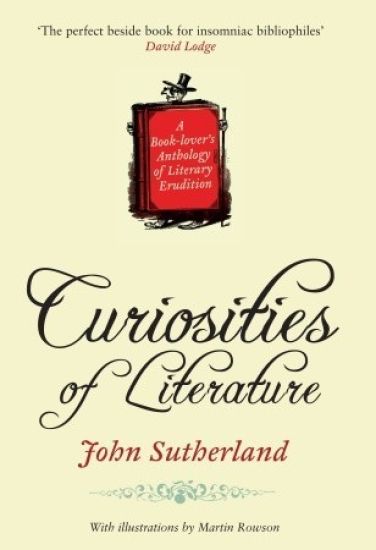
Curiosities of Literature

Curiosities of Literature

John Sutherland

Arrow Books Ltd
2009
pokkari
How much heavier was Thackeray's brain than Walt Whitman's? Which novels do American soldiers read? When did cigarettes start making an appearance in English literature? And is there any link between asthma and literary genius? This title contemplates the import of questions such as these, and attempts a few answers in a series of essays.
Stephen Spender: A Literary Life

Stephen Spender: A Literary Life

John Sutherland

Oxford University Press
2005
sidottu
The literary, political, and artistic interests of poet and cultural icon Stephen Spender are illuminated in this narrative based on his private papers, tracing his rise to success as a poet in the 1930s through his later years as cultural statesman of the twentieth century, and examining his relationships with such luminaries as Dylan Thomas, Sylvia Plath, T. S. Eliot, and Virgina Woolf.
Mrs Humphry Ward

Mrs Humphry Ward

John Sutherland

Clarendon Press
1990
sidottu
Mary Ward (1851-1920) had a furiously active public career, her literary and philanthropic activities transforming her from an eminent Victorian into a pre-eminent Edwardian. The granddaughter of Thomas Arnold, she found herself at the centre of an intellectual and cultural coterie comprising the Arnold, Huxley, and Trevelyan families. Her novel, Robert Elsmere (1888), the first of a series of bestsellers, earned her both unprecedented sums of money and the critical respect of writers such as Henry James. She helped found Somerville College, Oxford, the University's first institution for the higher education of women, and inaugurated a number of play centres for the children of London's working women, despite being a fierce opponent of women's suffrage. As the first female reporter to visit the trenches in 1916, she was instrumental in bringing America into the war. Yet for all her achievements, her private life was overshadowed - often tragically so - by misfortune. Her parents's marriage was seriously affected by her father's religious doubts; she eclipsed her husband, a Times journalist and art critic, while her indolent son frittered away her financial and emotional resources. John Sutherland's fascinating study of the private suffering of this predominantly public person also provides useful insights into the restrictions placed upon women in the late-Victorian-Edwardian era. This title also appears in the Oxford General Books catalogue for Autumn 1990.
Bestsellers

Bestsellers

John Sutherland

Oxford University Press
2007
nidottu
'I rejoice', said Doctor Johnson, 'to concur with the Common Reader.' For the last century, the tastes and preferences of the common reader have been reflected in the American and British bestseller lists, and this Very Short Introduction takes an engaging look through the lists to reveal what we have been reading - and why. John Sutherland shows that bestseller lists monitor one of the strongest pulses in modern literature and are therefore worthy of serious study. Along the way, he lifts the lid on the bestseller industry, examines what makes a book into a bestseller, and asks what separates bestsellers from canonical fiction. Exploring the relationship between bestsellers and the fashions, ideologies, and cultural concerns of the day, the book includes short case-studies and lively summaries of bestsellers through the years: from In His Steps - now almost totally forgotten, but the biggest all-time bestseller between 1895 and 1945, to Gone with the Wind and The Andromeda Strain, and The Da Vinci Code. ABOUT THE SERIES: The Very Short Introductions series from Oxford University Press contains hundreds of titles in almost every subject area. These pocket-sized books are the perfect way to get ahead in a new subject quickly. Our expert authors combine facts, analysis, perspective, new ideas, and enthusiasm to make interesting and challenging topics highly readable.
How Literature Works: 50 Key Concepts

How Literature Works: 50 Key Concepts

John Sutherland

Oxford University Press
2011
nidottu
How Literature Works is an indispensable book for any reader seeking a greater appreciation of their favorite novel, poem, or play. It offers a lively and straightforward guide to literary thinking. With a series of compact essays, the renowned literary critic John Sutherland--widely admired for his wit and clear reasoning--strips away the obscurity and pretension of literary study. His book offers concise definitions and clear examples of the fifty concepts that all book lovers should know. It includes basic descriptive terms (ambiguity, epic), the core vocabulary of literary culture (genre, style), and devices employed by authors (irony, defamiliarization). More broadly, How Literature Works explores the animating concepts behind literary theory (textuality, sexual politics), traces the forces that impact literature's role in the real world (obscenity, plagiarism), and grapples with the future of reading (fanfic, e-book). For any reader who wants to get the most out of the literature they read, Sutherland's short sharp book will both inform and delight.
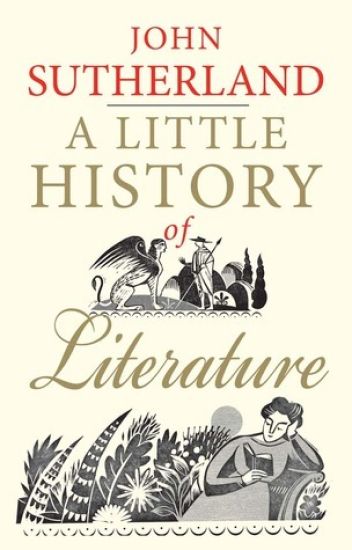
A Little History of Literature

A Little History of Literature

John Sutherland

Yale University Press
2014
pokkari
“An enjoyable account of a lifelong involvement with literature.”—John Vukmirovich, Times Literary Supplement This “little history” takes on a very big subject: the glorious span of literature from Greek myth to graphic novels, from The Epic of Gilgamesh to Harry Potter. Beloved author, John Sutherland, who has researched, taught, and written on virtually every area of literature, guides both young readers and the adults in their lives on an entertaining journey “through the wardrobe” to show how literature from across the world can transport us and help us to make sense of what it means to be human. Along the way he introduces us to a wide range of works, enlivening his offerings with humor as well as learning—from Beowulf and Shakespeare to T. S. Eliot and George Orwell, and from the rude jests of Anglo-Saxon runes to The Da Vinci Code. For younger readers, Sutherland offers a proper introduction to literature, promising to interest as much as instruct. For more experienced readers, he promises just the same.
A Little History of Literature

A Little History of Literature

John Sutherland

YALE UNIVERSITY PRESS
2025
pokkari
A vibrant guide to the world of literature, from dramatic plays to engrossing novels Literature has inspired every civilisation, from Greek myth to today’s graphic novels. John Sutherland, who has researched, taught and written on the entire glorious span of human literary activity, here guides readers on a journey ‘through the looking glass’ to show how literature from across the world can transport us, transfix us, and teach us about ourselves. He introduces key works, from the Epic of Gilgamesh and Shakespeare to T.S. Eliot, George Orwell and Margaret Atwood, and looks afresh at literature’s links to power, identity and taste. From the rude jokes within Anglo-Saxon riddles to the guilty pleasures of potboilers and fan fiction, this celebratory guide offers wit, humour and deep learning to all who enjoy literature, and who want to understand it anew. Little Histories – Inspiring Guides for Curious Minds
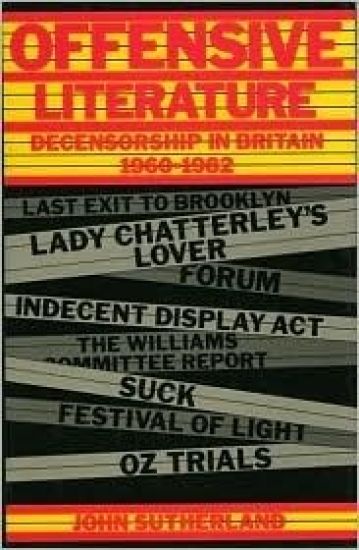
Offensive Literature

Offensive Literature

John Sutherland

Barnes Noble Books-Imports, Div of Rowman Littlefield Pubs., Inc
1983
sidottu
This provocative book takes decensorship from the 1960 Lady Chatterley trial through the long-term drive against pornography which continues into the 1980s.
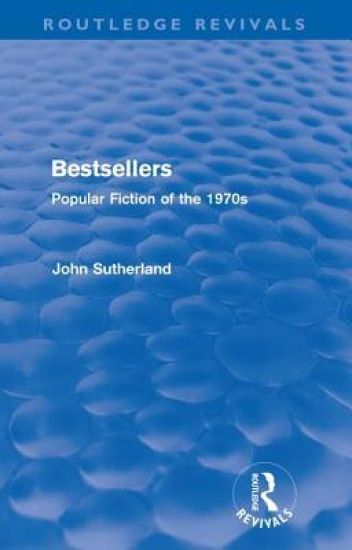
Bestsellers (Routledge Revivals)

Bestsellers (Routledge Revivals)

John Sutherland

Routledge
2010
sidottu
First published in 1981, this book offers a study of British and American popular fiction in the 1970s, a decade in which the quest for the superseller came to dominate the lives of publishers on both sides of the Atlantic. Illustrated by examples of the lurid incidents that catapult so many books into the bestseller charts, this comprehensive study covers the work of Robbins, Hailey and Maclean, the 'bodice rippers', the disaster craze, horror, war stories and media tie-ins such as The Godfather, Jaws and Star Wars.
Bestsellers (Routledge Revivals)

Bestsellers (Routledge Revivals)

John Sutherland

Routledge
2011
nidottu
First published in 1981, this book offers a study of British and American popular fiction in the 1970s, a decade in which the quest for the superseller came to dominate the lives of publishers on both sides of the Atlantic. Illustrated by examples of the lurid incidents that catapult so many books into the bestseller charts, this comprehensive study covers the work of Robbins, Hailey and Maclean, the 'bodice rippers', the disaster craze, horror, war stories and media tie-ins such as The Godfather, Jaws and Star Wars.