Kirjojen hintavertailu. Mukana 11 244 527 kirjaa ja 12 kauppaa.

Kirjahaku

Etsi kirjoja tekijän nimen, kirjan nimen tai ISBN:n perusteella.

1000 tulosta hakusanalla John T. Irwin

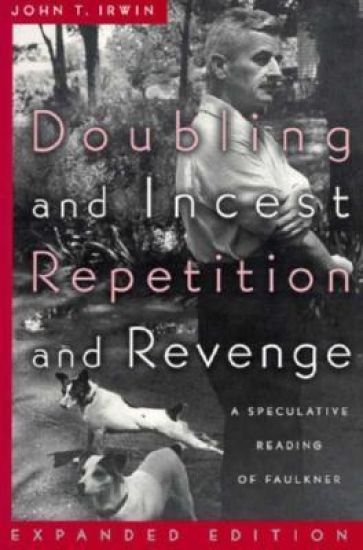
Doubling and Incest / Repetition and Revenge

Doubling and Incest / Repetition and Revenge

John T. Irwin

Johns Hopkins University Press
1996
pokkari
When it was first published, Doubling and Incest/Repetition and Revenge proved to be a seminal work in the psychoanalytic study of Faulkner's fiction, especially of The Sound and the Fury and Absalom, Absalom! This softcover reissue of John Irwin's masterful exposition unwinds the mystery of unconscious desire and doubling that inform the novels.
The Mystery to a Solution

The Mystery to a Solution

John T. Irwin

Johns Hopkins University Press
1994
pokkari
In The Mystery to a Solution, John Irwin brilliantly examines the deeper significance of the analytical detective genre which Poe created and the meaning of Borges' efforts to "double" the genre's origins one hundred years later. Combining history, literary history, and practical and speculative criticism, Irwin pursues the issues underlying the detective story into areas as various as the history of mathematics, classical mythology, the double-mirror structure of self-consciousness, the anthropology of Evans and Frazer, the structure of chess, the mind-body problem, the etymology of the word labyrinth, and dozens of other topics. Irwin mirrors the aesthetic impact of the genre by creating in his study the dynamics of a detective story-the uncovering of mysteries, the accumulation of evidence, the tracing of clues, and the final solution that ties it all together.
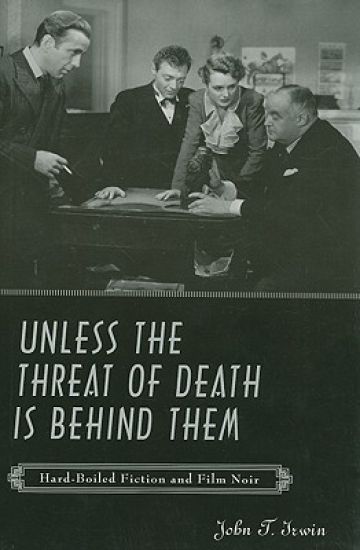
Unless the Threat of Death Is Behind Them

Unless the Threat of Death Is Behind Them

John T. Irwin

Johns Hopkins University Press
2008
pokkari
Early in the twentieth century a new character type emerged in the crime novels of American writers such as Dashiell Hammett and Raymond Chandler: the "hard-boiled" detective, most famously exemplified by Sam Spade in The Maltese Falcon. Unlike the analytical detectives of nineteenth-century fiction, such as Edgar Allan Poe's Inspector Dupin, the new detectives encountered cases not as intricate logical puzzles but as stark challenges of manhood. In the stories of these characters and their criminal opposites, John T. Irwin explores the tension within ideas of American masculinity between subordination and independence and, for the man who becomes "his own boss," the conflict between professional codes and personal desires. He shows how, within different works of hard-boiled fiction, the professional either overcomes the personal or is overcome by it, ending in ruinous relationships or in solitary integrity, and how within the genre all notions of manly independence are ultimately revealed to be illusions subordinate to fate itself. Tracing the stylistic development of the genre, Irwin demonstrates the particular influence of the novel of manners, especially the writing of F. Scott Fitzgerald. He goes on to argue that, from the time of World War II, when hard-boiled fiction began to appear on the screen in film noir just as women entered the workforce in large numbers, many of its themes came to extend to female empowerment. Finally, he discusses how these themes persist in contemporary dramatic series on television, representing the conflicted lives of Americans into the twenty-first century.
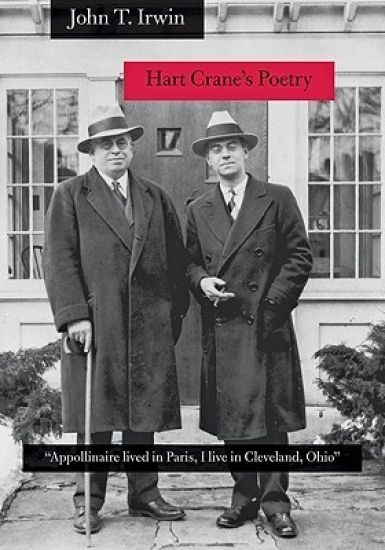
Hart Crane's Poetry

Hart Crane's Poetry

John T. Irwin

Johns Hopkins University Press
2011
sidottu
In one of his letters Hart Crane wrote, "Appollinaire lived in Paris, I live in Cleveland, Ohio," comparing-misspelling and all-the great French poet's cosmopolitan roots to his own more modest ones in the midwestern United States. Rebelling against the notion that his work should relate to some European school of thought, Crane defiantly asserts his freedom to be himself, a true American writer. John T. Irwin, long a passionate and brilliant critic of Crane, gives readers the first major interpretation of the poet's work in decades. Irwin aims to show that Hart Crane's epic The Bridge is the best twentieth-century long poem in English. Irwin convincingly argues that, compared to other long poems of the century, The Bridge is the richest and most wide-ranging in its mythic and historical resonances, the most inventive in its combination of literary and visual structures, the most subtle and compelling in its psychological underpinnings. Irwin brings a wealth of new and varied scholarship to bear on his critical reading of the work-from art history to biography to classical literature to philosophy-revealing The Bridge to be the near-perfect synthesis of American myth and history that Crane intended. Irwin contends that the most successful entryway to Crane's notoriously difficult shorter poems is through a close reading of The Bridge. Having admirably accomplished this, Irwin analyzes Crane's poems in White Buildings and his last poem, "The Broken Tower," through the larger context of his epic, showing how Crane, in the best of these, worked out the structures and images that were fully developed in The Bridge. Thoughtful, deliberate, and extraordinarily learned, this is the most complete and careful reading of Crane's poetry available. Hart Crane may have lived in Cleveland, Ohio, but, as Irwin masterfully shows, his poems stand among the greatest written in the English language.
F. Scott Fitzgerald’s Fiction

F. Scott Fitzgerald’s Fiction

John T. Irwin

Johns Hopkins University Press
2014
sidottu
"Fitzgerald's work has always deeply moved me," writes John T. Irwin. "And this is as true now as it was fifty years ago when I first picked up The Great Gatsby. I can still remember the occasions when I first read each of his novels; remember the time, place, and mood of those early readings, as well as the way each work seemed to speak to something going on in my life at that moment. Because the things that interested Fitzgerald were the things that interested me and because there seemed to be so many similarities in our backgrounds, his work always possessed for me a special, personal authority; it became a form of wisdom, a way of knowing the world, its types, its classes, its individuals." In his personal tribute to Fitzgerald's novels and short stories, Irwin offers an intricate vision of one of the most important writers in the American canon. The third in Irwin's trilogy of works on American writers, F. Scott Fitzgerald's Fiction resonates back through all of his previous writings, both scholarly and poetic, returning to Fitzgerald's ongoing theme of the twentieth-century American protagonist's conflict between his work and his personal life. This conflict is played out against the typically American imaginative activity of self-creation, an activity that involves a degree of theatrical ability on the protagonist's part as he must first enact the role imagined for himself, which is to say, the self he means to invent. The work is suffused with elements of both Fitzgerald's and Irwin's biographies, and Irwin's immense erudition is on display throughout. Irwin seamlessly ties together details from Fitzgerald's life with elements from his entire body of work and considers central themes connected to wealth, class, work, love, jazz, acceptance, family, disillusionment, and life as theatrical performance.
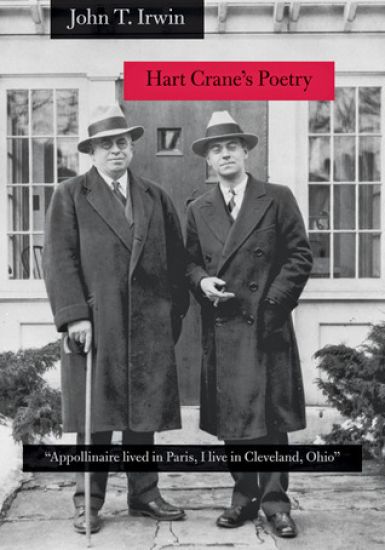
Hart Crane's Poetry

Hart Crane's Poetry

John T. Irwin

Johns Hopkins University Press
2014
pokkari
In one of his letters Hart Crane wrote, "Appollinaire lived in Paris, I live in Cleveland, Ohio," comparing - misspelling and all - the great French poet's cosmopolitan roots to his own more modest ones in the midwestern United States. Rebelling against the notion that his work should relate to some European school of thought, Crane defiantly asserted his freedom to be himself, a true American writer. John T. Irwin, long a passionate and brilliant critic of Crane, gives readers the first major interpretation of the poet's work in decades. Irwin aims to show that Hart Crane's epic The Bridge is the best twentieth-century long poem in English. Irwin convincingly argues that, compared to other long poems of the century, The Bridge is the richest and most wide-ranging in its mythic and historical resonances, the most inventive in its combination of literary and visual structures, the most subtle and compelling in its psychological underpinnings. Irwin brings a wealth of new and varied scholarship to bear on his critical reading of the work - from art history to biography to classical literature to philosophy - revealing The Bridge to be the near-perfect synthesis of American myth and history that Crane intended. Irwin contends that the most successful entryway to Crane's notoriously difficult shorter poems is through a close reading of The Bridge. Having admirably accomplished this, Irwin analyzes Crane's poems in White Buildings and his last poem, "The Broken Tower," through the larger context of his epic, showing how Crane, in the best of these, worked out the structures and images that were fully developed in The Bridge. Thoughtful, deliberate, and extraordinarily learned, this is the most complete and careful reading of Crane's poetry available. Hart Crane may have lived in Cleveland, Ohio, but, as Irwin masterfully shows, his poems stand among the greatest written in the English language.
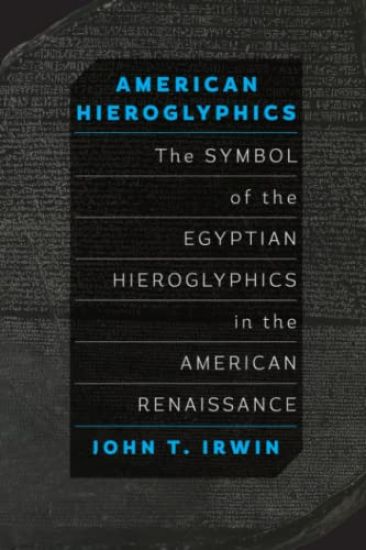
American Hieroglyphics

American Hieroglyphics

John T. Irwin

Johns Hopkins University Press
2016
pokkari
The discovery of the Rosetta Stone and the subsequent decipherment of Egyptian hieroglyphics captured the imaginations of nineteenth-century American writers and provided a focal point for their speculations on the relationships between sign, symbol, language, and meaning. Through fresh readings of classic works by Emerson, Thoreau, Whitman, Poe, Hawthorne, and Melville, John T. Irwin's American Hieroglyphics examines the symbolic mode associated with the pictographs. Irwin demonstrates how American Symbolist literature of the period was motivated by what he calls "hieroglyphic doubling," the use of pictographic expression as a medium of both expression and interpretation. Along the way, he touches upon a wide range of topics that fascinated people of the day, including the journey to the source of the Nile and ideas about the origin of language.
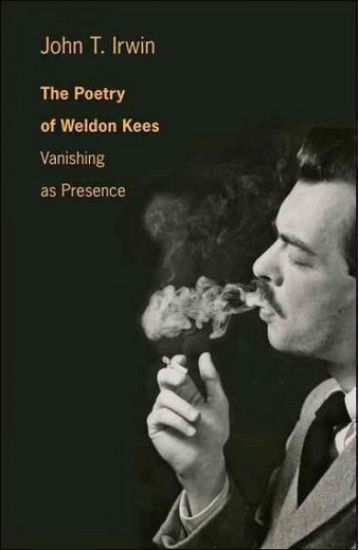
The Poetry of Weldon Kees

The Poetry of Weldon Kees

John T. Irwin

Johns Hopkins University Press
2017
sidottu
Weldon Kees is one of those fascinating people of whom you've likely never heard. Most intriguingly, he disappeared without a trace on July 18, 1955. Police found his 1954 Plymouth Savoy abandoned on the north side of the Golden Gate Bridge one day later. The keys were still in the ignition. Though Kees had alluded days prior to picking up and moving to Mexico, none of his poetry, art, or criticism has since surfaced either north or south of the Rio Grande. Kees's vanishing has led critics to compare him to another American modernist poet who met a similar end two decades prior-Hart Crane. In comparison to Crane, Kees is certainly now a more obscure figure. John T. Irwin, however, is not content to allow Kees to fall out of the twentieth-century literary canon. In The Poetry of Weldon Kees, Irwin ties together elements of biography and literary criticism, spurring renewed interest in Kees as both an individual and as a poet. Irwin acts the part of literary detective, following clues left behind by the poet to make sense of Kees's fascination with death, disappearance, and the lasting interpretation of an artist's work. Arguing that Kees's apparent suicide was a carefully plotted final aesthetic act, Irwin uses the poet's disappearance as a lens through which to detect and interpret the structures, motifs, and images throughout his poems-as the author intended. The first rigorous literary engagement with Weldon Kees's poetry, this book is an astonishing reassessment of one of the twentieth century's most gifted writers.
Australia's Naval Shipbuilding Enterprise

Australia's Naval Shipbuilding Enterprise

John Birkler; John F. Schank; Mark V. Arena; Edward G. Keating; Joel B. Predd; James Black; Irina Danescu; Dan Jenkins; James G. Kallimani; Gordon T. Lee; Roger Lough; Robert Murphy; David Nicholls; Deborah Peetz; Brian Perkinson; Jerry M. Sollinger; Shane Tierney; Obaid Younossi

RAND
2015
pokkari
To prepare for its next Defence White Paper, Australia is examining an enterprise-level naval shipbuilding plan. To support this effort, RAND researchers explore the feasibility of Australia sustaining a domestic naval shipbuilding industry compared with buying ships from foreign shipbuilders. The authors outline the complex consequences and trade-offs of both options.
Auditory System

Auditory System

Moshe Abeles; Göran Bredberg; Robert A. Butler; John H. Casseday; John E. Desmedt; Irving T. Diamond; Solomon D. Erulkar; E. F. Evans; Jay M. Goldberg; Moise H. Goldstein; David M. Green; Ivan M. Hunter-Duvar; Lloyd A. Jeffress; William D. Neff; William A. Yost; E. Zwicker

Springer-Verlag Berlin and Heidelberg GmbH Co. K
2011
nidottu
nerve; subsequently, however, they concluded that the recordings had been from aberrant cells of the cochlear nucleus lying central to the glial margin of the VIII nerve (GALAMBOS and DAVIS, 1948). The first successful recordmgs from fibres of the cochlear nerve were made by TASAKI (1954) in the guinea pig. These classical but necessarily limited results were greatly extended by ROSE, GALAMBOS, and HUGHES (1959) in the cat cochlear nucleus and by KATSUKI and co-workers (KATSUKI et at. , 1958, 1961, 1962) in the cat and monkey cochlear nerve. Perhaps the most significant developments have been the introduction of techniques for precise control of the acoustic stimulus and the quantitative analysis of neuronal response patterns, notably by the laboratories of KIANG (e. g. GERSTEIN and KIANG, 1960; KIANG et at. , 1962b, 1965a, 1967) and ROSE (e. g. ROSE et at. , 1967; HIND et at. , 1967). These developments have made possible a large number of quanti­ tative investigations of the behaviour of representative numbers of neurons at these levels of the peripheral auditory system under a wide variety of stimulus conditions. Most of the findings discussed herein have been obtained on anaesthetized cats. Where comparative data are available, substantially similar results have been obtained in other mammalian species (e. g. guinea pig, monkey, rat). Certain significant differences have been noted in lizards, frogs and fish as would be expect­ ed from the different morphologies of their organs of hearing (e. g.