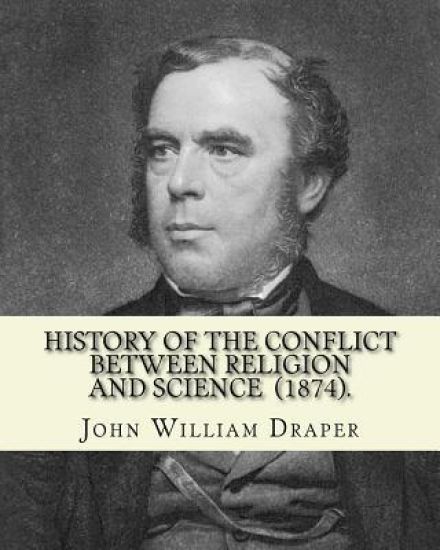
John William Draper (May 5, 1811 - January 4, 1882) was an English-born American scientist, philosopher, physician, chemist, historian and photographer. He is credited with producing the first clear photograph of a female face (1839-40) and the first detailed photograph of the moon in 1840. He was also the first president of the American Chemical Society (1876-77) and a founder of the New York University School of Medicine. One of Draper's books, the History of the Conflict between Religion and Science, popularised the conflict thesis proposing intrinsic hostility in the relationship between religion and science. It was widely read and was translated into several languages. His son, Henry Draper, and his granddaughter, Antonia Maury, were astronomers, her younger sister, Carlotta Maury, was a paleontologist, and his eldest son, John Christopher Draper, was a chemist. Early life: John William Draper was born May 5, 1811, in St. Helens, Lancashire, England, to John Christopher Draper, a Wesleyan clergyman and Sarah (Ripley) Draper. He also had three sisters, Dorothy Catherine (August 6, 1807 - December 10, 1901), Elizabeth Johnson, and Sarah Ripley. On June 23, he was baptized by the Wesleyan minister Jabez Bunting. His father often needed to move the family due to serving various congregations throughout England. John Wm. Draper was home tutored until 1822, when he entered Woodhouse Grove School. He returned to home instruction (1826) prior to entering University College London in 1829. While at University College London, Draper studied chemistry under the direction of Edward Turner (chemist). On September 13, 1831, John William Draper married Antonia Coetana de Paiva Pereira Gardner (c. 1814-1870), the daughter of Daniel Gardner, a court physician to John VI of Portugal and Charlotte of Spain. Antonia was born in Brazil after the royal family fled Portugal with Napoleon's invasion. There is dispute as to the identity of Antonia's mother. Around 1830, Antonia was sent with her brother Daniel to live with their aunt in London...
A whole chapter of nineteenth-century history is condensed in the phrase "the conflict between religion and science," with our Mother Eve and the proto-Ape jostling for places at the head of the family tree. An outstanding figure in the center of this intellectual conflict was John William Draper, author of History of the Intellectual Development of Modern Europe and The Conflict Between Religion and Science, which played an important part in intellectual debates for many years. Draper helped break new ground for an age of science, and brought to the level of laymen some of the issues with which they must grapple in the future. However, he had the gift of the great popularizer for seeming to leaven the loaf of tradition, instead of throwing it away, and succeeded in lending to new ideas the appearance of old ones. His work is an excellent case history of the way in which innovations are knit up into continuity with tradition and revolutions in thought are made palatable.