Terran man befriends 2 people from another world and is invited to visit them on their world. While there, he develops a close relationship with a juvenile member of an ancient alien race who is not even remotely human, physically, but has a very human personality. Together, the two of them provide a valuable service to their hosts that ends with the Terran being hired to work as an Explorer for the other world. That job leads to an unending series of adventures and priceless friendships.
Girl born on Terra grows up on another world and becomes the top expert in communication with other humans, strange aliens and intelligent animals. In a symbiotic relationship with an equally young alien composed of nothing but energy, she must avoid assassins and deadly creatures in order to do her job.
A wise old man with a much older friend takes over a captured alien spaceship and they set out on a mission to find new worlds and restore peace on worlds that were victims of the ship's former owners. In the process, they must battle more of the enemy aliens as well as make friends with the previous victims. Some of those victims have long memories and are as much or more dangerous than the original enemies at first contact. The mission requires the friends to recruit highly talented people to help them operate their ship.
Readers will find this book an invaluable reference on the design of experiments. It contains hard-to-find information on topics such as change-over designs with residual effects and early treatment of analysis of covariance. Other topics include linear models and quadratic forms, experiments with one or more factors, Latin square designs, and fractions of 2n factorial designs. There is also extensive coverage of the analysis of incomplete block designs and of the existence and construction of balanced and partially balanced designs. A new preface (to the Classics edition) describes the changes made in experimental design since the book was first published in 1971. It discusses the use of personal computers to analyze data and details the emergence of industrial statistics.
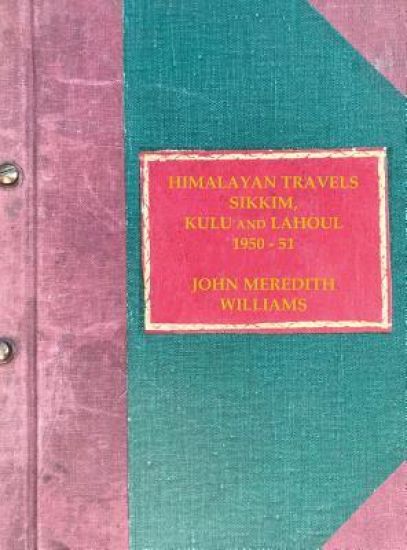
These journals record the travels of John Meredith Williams in the Himalayas in 1950-51. As a young man he worked in Calcutta and took two excursions, one to Sikkim, one to Kulu and Lahoul, to explore the mountains he loved, the culture and the people. They reflect the period in which they were written, shortly after Indian Independence, and record his delight in the natural surroundings, the trials and joys of the expeditions, and his energetic and at times irascible nature. After being educated at Sherborne School, Dorset and Trinity Hall, Cambridge, Johnny served in the Royal Signals and then worked for Shaw Wallace and Company Ltd., based in Calcutta. On returning to Calcutta from his travels, he typed and illustrated the journals with photographs and sent them to his parents, Gwynne and Cicely Williams. They have been edited by his grandson, Tobias Lescht, and daughter, Cecily Hennessy.Johnny always loved the mountains but as he said himself, 'I have come to the conclusion that I will never make anything of a Himalyan climber as I am always far too keen on seeing round the corner--and there is always a corner round which has not been inspected before'.
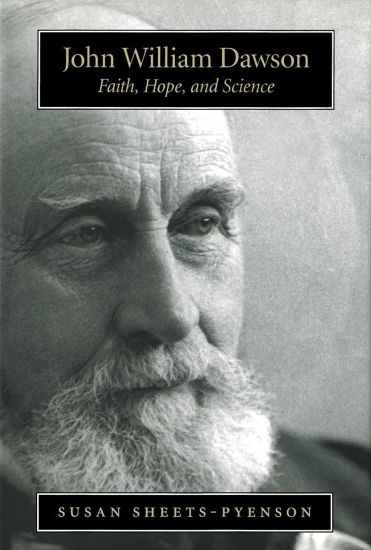
Dawson was born and raised in Pictou, Nova Scotia, where the many sandstone and coal formations provided fertile ground for his first scientific explorations, which culminated in the publication of Acadian Geology. He became principal of McGill University in 1855 and over the next forty years worked unceasingly to transform McGill from a "tiny, poverty-stricken provincial school" into a scientific institution of the highest rank. He was the only person to hold the presidency of both the American Association for the Advancement of Science and its British equivalent. Dawson's energetic promotion of scientific institutions in Canada remains one of his most enduring legacies, particularly his role in creating the Royal Society of Canada. Drawing on Dawson's correspondence and personal papers, Sheets-Pyenson paints an intimate portrait of a pivotal figure in Canada's scientific heritage and a proper Victorian gentleman whose pious Presbyterianism, missionary zeal, and unwavering belief in the light of knowledge drove him on a quest to conquer ignorance, eradicate prejudice, and vanquish bigotry.
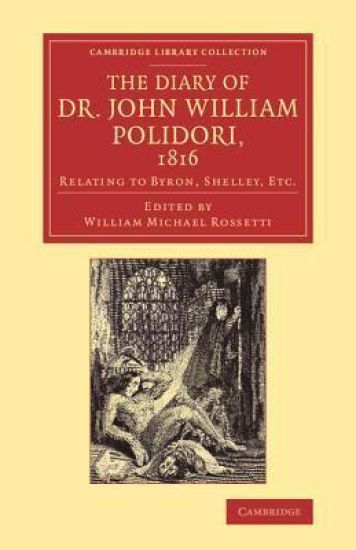
John William Polidori (1795–1821) was, for a brief period, the personal physician to Lord Byron. Half Italian, he was the uncle of the Rossetti siblings, and it was William Michael Rossetti, in his role as family recorder, who published Polidori's manuscript diary after nearly a century, in 1911. This account of his time with Byron (which ended two months later when they quarrelled and parted company) is the only contemporary account of the few weeks, crucial to the development of the Romantic movement, during which Mary Shelley's Frankenstein arose from a storytelling competition at the Villa Diodati. Polidori's later career as a physician and writer was hampered by a severe accident in 1817 which left him with brain damage. His most famous work, The Vampyre, was published in 1819, but attributed to Byron, leading both men to threaten the publisher with lawsuits. Polidori died (probably a suicide) two years later.







![Poems and Fragments. [By Sir John William Kaye.]](/covers/9781241013387.jpg)