Kirjojen hintavertailu. Mukana 11 244 527 kirjaa ja 12 kauppaa.

Kirjahaku

Etsi kirjoja tekijän nimen, kirjan nimen tai ISBN:n perusteella.

1000 tulosta hakusanalla Jon Barwise; Lawrence Moss

Vicious Circles

Vicious Circles

Jon Barwise; Lawrence Moss

Centre for the Study of Language Information
1996
pokkari
Circular analyses of philosophical, linguistic, or computational phenomena have been attacked on the assumption that they conflict with mathematical rigour. Barwise and Moss have undertaken to prove this assumption false. This volume is concerned with extending the modelling capabilities of set theory to provide a uniform treatment of circular phenomena. As a means of guiding the reader through the concrete examples of the theory, the authors have included many exercises and solutions: these exercises range in difficulty and ultimately stimulate the reader to come up with new results. Vicious Circles is intended for use by researchers who want to use hypersets; although some experience in mathematics is necessary, the book is accessible to people with widely differing backgrounds and interests.

Vicious Circles

Vicious Circles

Jon Barwise; Lawrence Moss

Centre for the Study of Language Information
1996
sidottu
Circular analyses of philosophical, linguistic, or computational phenomena have been attacked on the assumption that they conflict with mathematical rigour. Barwise and Moss have undertaken to prove this assumption false. This volume is concerned with extending the modelling capabilities of set theory to provide a uniform treatment of circular phenomena. As a means of guiding the reader through the concrete examples of the theory, the authors have included many exercises and solutions: these exercises range in difficulty and ultimately stimulate the reader to come up with new results. Vicious Circles is intended for use by researchers who want to use hypersets; although some experience in mathematics is necessary, the book is accessible to people with widely differing backgrounds and interests.
Papers in Honor of Jon Barwise

Papers in Honor of Jon Barwise

Centre for the Study of Language Information
2022
sidottu
Jon Barwise (1942-2000) was a noted scholar of mathematical logic and philosophy who served on the faculties of Yale University, the University of Wisconsin, Stanford University (where he was cofounder and the first director of the Center for the Study of Language and Information), and Indiana University. This collection honors Barwise's legacy to the academy with current contributions inspired by his diverse fields of interest, from infinitiary logic to natural language, situation semantics, circular claims, and non-well-founded set theory.
The Situation in Logic

The Situation in Logic

Jon Barwise

Centre for the Study of Language Information
1989
pokkari
Situation Theory and situation semantics are recent approaches to language and information, approaches first formulated by Jon Barwise and John Perry in Situations and Attitudes (1983). The present volume collects some of Barwise's papers written since then, those directly concerned with relations among logic, situation theory, and situation semantics. Several papers appear here for the first time.
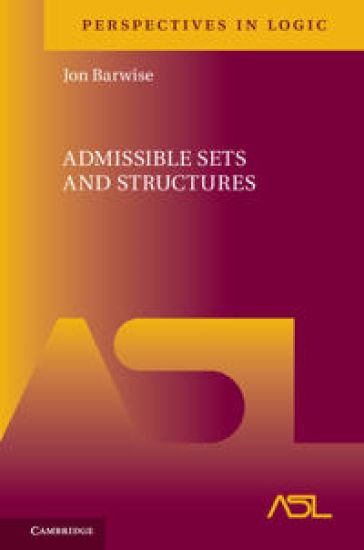
Admissible Sets and Structures

Admissible Sets and Structures

Jon Barwise

Cambridge University Press
2017
sidottu
Since their inception, the Perspectives in Logic and Lecture Notes in Logic series have published seminal works by leading logicians. Many of the original books in the series have been unavailable for years, but they are now in print once again. Admissible set theory is a major source of interaction between model theory, recursion theory and set theory, and plays an important role in definability theory. In this volume, the seventh publication in the Perspectives in Logic series, Jon Barwise presents the basic facts about admissible sets and admissible ordinals in a way that makes them accessible to logic students and specialists alike. It fills the artificial gap between model theory and recursion theory and covers everything the logician should know about admissible sets.
The Liar

The Liar

Jon Barwise; John Etchemendy

Oxford University Press Inc
1989
nidottu
This monograph purports to provide a solution to semantical paradoxes like the Liar. The authors base this solution on J. L. Austin's idea of truth, which is fundamental to situation semantics. They compare two models of language, propositions and truth, one based on Russell and the other on Austin, as they bear on the Liar Paradox. In Russell's view, a sentence expresses a proposition, which is true or not. According to Austin, however, there is always a contextual parameter - the situation the sentence is about - that comes between the sentence and proposition. The Austinian perspective proves to have fruitful applications to the analysis of semantic paradox. The authors show that, on this account, the liar is a genuine diagonal argument. This argument can be shown to have profound consequences for our understanding of some of the most basic semantical mechanisms at work in our language. Jon Barwise is, with John Perry, a co-founder of the Centre for the Study of Language and Information at Stanford.
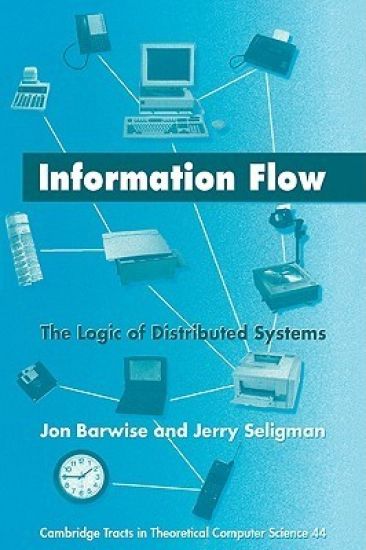
Information Flow

Information Flow

Jon Barwise; Seligman Jerry

Cambridge University Press
2008
pokkari
Information is a central topic in computer science, cognitive science and philosophy. In spite of its importance in the 'information age', there is no consensus on what information is, what makes it possible, and what it means for one medium to carry information about another. Drawing on ideas from mathematics, computer science and philosophy, this book addresses the definition and place of information in society. The authors, observing that information flow is possible only within a connected distribution system, provide a mathematically rigorous, philosophically sound foundation for a science of information. They illustrate their theory by applying it to a wide range of phenomena, from file transfer to DNA, from quantum mechanics to speech act theory.
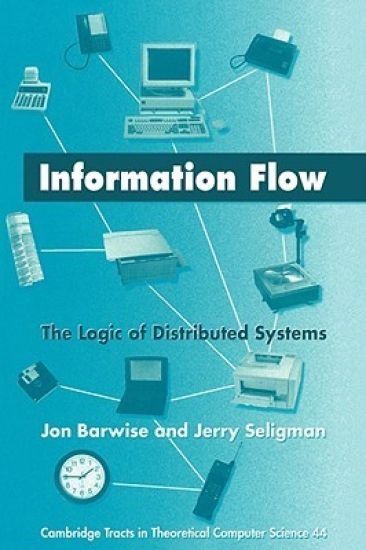
Information Flow

Information Flow

Jon Barwise; Jerry Seligman

Cambridge University Press
1997
sidottu
Information is a central topic in computer science, cognitive science, and philosophy. In spite of its importance in the ‘information age,’ there is no consensus on what information is, what makes it possible, and what it means for one medium to carry information about another. Drawing on ideas from mathematics, computer science, and philosophy, this book addresses the definition and place of information in society. The authors, observing that information flow is possible only within a connected distribution system, provide a mathematically rigorous, philosophically sound foundation for a science of information. They illustrate their theory by applying it to a wide range of phenomena, from file transfer to DNA, from quantum mechanics to speech act theory.
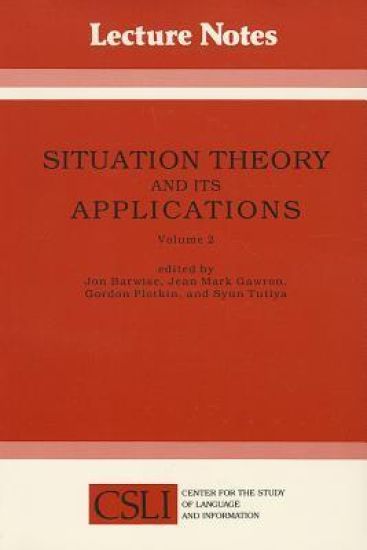
Situation Theory and Its Applications

Situation Theory and Its Applications

Jon Barwise; Jen Mark Gawron; Gordon Plotkin

Centre for the Study of Language Information
1992
pokkari
Situation theory is the result of an interdisciplinary effort to create a full-fledged theory of information. Created by scholars and scientists from cognitive science, computer science, AI, linguistics, logic, philosophy, and mathematics, the theory is forging a common set of tools for the analysis of phenomena from all these fields. This volume presents work that evolved out of the Second Conference on Situation Theory and its Applications. Twenty-six essays exhibit the wide range of the theory, covering such topics as natural language semantics, philosophical issues about information, mathematical applications, and the visual representation of information in computer systems.Jon Barwise is a professor of philosophy, mathematics, and logic at Indiana University in Bloomington. Jean Mark Gawron is a researcher at SRI International and a consultant at Hewlett-Packard Laboratories. Gordon Plotkin is a professor of theoretical computer science at the University of Edinburgh. Syun Tutiya is in the philosophy department at Chiba University in Japan.
Situations and Attitudes

Situations and Attitudes

Jon Barwise; John Perry

Center for the Study of Language and Informat
1999
nidottu
In this provocative book, Barwise and Perry tackle the slippery subject of 'meaning', a subject that has long vexed linguists, language philosophers, and logicians. Meaning does not exist solely within words and sentences but resides largely in the situation and the attitudes brought to it by those involved. The authors present an unusually lucid treatment of important innovations in the field of natural semantics, contending that the standard view of logic (as derived from Frege, Russell, and work in mathematics and logic) is inappropriate for many of the uses to which it has been put by scholars. In Situations and Attitudes Barwise and Perry provide the basics of a realistic model-theoretic semantics of natural language, explain the main ideas of the theory, and contrast them with those of competing theories.
Tarski's World: Revised and Expanded

Tarski's World: Revised and Expanded

Jon Barwise; John Etchemendy; David Barker-Plummer

Centre for the Study of Language Information
2007
nidottu
"Tarski's World" is an innovative and exciting method of introducing students to the language of first-order logic. Using the courseware package, students quickly master the meanings of connectives and qualifiers and soon become fluent in the symbolic language at the core of modern logic. The accompanying CD-ROM, compatible with both Macintosh and PC formats, includes a unique and effective corrective tool in the form of a game that methodically leads students back through any errors in sentences they have constructed, as well as a program for submitting homework to an automated grader. Intended as a supplement to a standard logic text, "Tarski's World" is an essential resource for helping students learn the language of logic.
Hyperproof

Hyperproof

Jon Barwise; John Etchemendy

Centre for the Study of Language Information
1994
pokkari
Hyperproof is a system for learning the principles of analytical reasoning and proof construction, consisting of a text and a Macintosh software program. Unlike traditional treatments of first-order logic, Hyperproof combines graphical and sentential information, presenting a set of logical rules for integrating these different forms of information. This strategy allows students to focus on the information content of proofs, rather than the syntactic structure of sentences. Using Hyperproof the student learns to construct proofs of both consequence and nonconsequence using an intuitive proof system that extends the standard set of sentential rules to incorporate information represented graphically. Hyperproof is compatible with various natural-deduction-style proof systems, including the system used in the authors' Language of First-Order Logic.
Logical Reasoning with Diagrams

Logical Reasoning with Diagrams

Gerard Allwein; Jon Barwise

Oxford University Press Inc
1996
sidottu
One effect of information technology is the increasing need to present information visually. The trend raises intriguing questions. What is the logical status of reasoning that employs visualization? What are the cognitive advantages and pitfalls of this reasoning? What kinds of tools can be developed to aid in the use of visual representation? This newest volume on the Studies in Logic and Computation series addresses the logical aspects of the visualization of information. The authors of these specially commissioned papers explore the properties of diagrams, charts, and maps, and their use in problem solving and teaching basic reasoning skills. As computers make visual representations more commonplace, it is important for professionals, researchers and students in computer science, philosophy, and logic to develop an understanding of these tools; this book can clarify the relationship between visuals and information.
Language, Proof, and Logic

Language, Proof, and Logic

David Barker-Plummer; Jon Barwise; John Etchemendy

Centre for the Study of Language Information
2011
nidottu
This textbook/software package covers first-order language in a method appropriate for a wide range of courses, from first logic courses for undergraduates (philosophy, mathematics, and computer science) to a first graduate logic course. The accompanying online grading service instantly grades solutions to hundreds of computer exercises. The second edition of "Language, Proof and Logic" represents a major expansion and revision of the original package and includes applications for mobile devices, additional exercises, a dedicated website, and increased software compatibility and support.
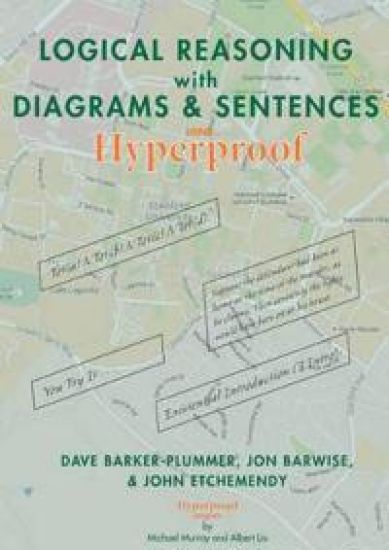
Logical Reasoning with Diagrams and Sentences

Logical Reasoning with Diagrams and Sentences

David Barker-Plummer; Jon Barwise; John Etchemendy

Centre for the Study of Language Information
2017
nidottu
The Logical Reasoning with Diagrams and Sentences courseware package teaches the principles of analytical reasoning and proof construction using a carefully crafted combination of textbook, desktop, and online materials. This package is sure to be an essential resource in a range of courses incorporating logical reasoning, including formal linguistics, philosophy, mathematics, and computer science. Unlike traditional formal treatments of reasoning, this package uses both graphical and sentential representations to reflect common situations in everyday reasoning where information is expressed in many forms, such as finding your way to a location using a map and an address. It also teaches students how to construct and check the logical validity of a variety of proofs of consequence and non-consequence, consistency and inconsistency, and independence using an intuitive proof system which extends standard proof treatments with sentential, graphical, and heterogeneous inference rules, allowing students to focus on proof content rather than syntactic structure. Building upon the widely used Tarski's World and Language, Proof and Logic courseware packages, Logical Reasoning with Diagrams and Sentences contains more than three hundred exercises, most of which can be assessed by the Grade Grinder online assessment service; is supported by an extensive website through which students and instructors can access online video lectures by the authors; and allows instructors to create their own exercises and assess their students' work.Logical Reasoning with Diagrams and Sentences is an expanded revision of the Hyperproof courseware package.
Jon

Jon

Jacqueline Fredrickson

Mereo Books
2015
nidottu
Jon Fredrickson was 16 when he started to complain of headaches and sickness. An eyesight test revealed the shocking news that he had developed a brain tumour. Over the months and years that followed Jon and his devoted family endured a roller-coaster ride of treatment and therapy, diagnosis and disappointment, until finally no more could be done for Jon, and he died at the age of only 26 with his devoted parents at his bedside. Jon's illness did not prevent this brave young man from setting up home on his own, travelling around the country independently and embarking on a successful career. His mother Jacky kept a diary of her years of trial, and she has now developed it into this moving and inspiring book.