Kirjojen hintavertailu. Mukana 11 241 056 kirjaa ja 12 kauppaa.

Kirjahaku

Etsi kirjoja tekijän nimen, kirjan nimen tai ISBN:n perusteella.

1000 tulosta hakusanalla Jon Elster

Jon Elsters Theorie rationaler Bindungen
Jon Elster (geb. 1940 in Oslo) gehört zu den international prominentesten Vertretern der Theorie rationalen Handelns in den Sozialwissenschaften. Er verfasste vor allem wichtige Beiträge zum Problem rationaler Bindungen. Durch institutionelle Vorkehrungen vermag man nicht nur andere, sondern auch sich selbst zu binden: Selbstbindungen individueller oder kollektiver Art können von rationalen Akteuren (auf freiwilliger Basis) eingesetzt werden, um voraussehbare unerwünschte Folgen des eigenen Handelns gezielt zu verhindern.Jon Elsters Publikationen decken thematisch ein breites Spektrum ab, angefangen von Fragen lokaler Gerechtigkeit bis zu den Verfassungsprozessen in den USA oder aktuell in Osteuropa. Im Zentrum aber stehen Studien über Rationalität, vor allem über den rationalen Umgang mit Irrationalität durch Bindungen. Hierbei bilden methodologische Auseinandersetzungen stets den roten Faden. Elster warnt die Sozialwissenschaften vor funktionalistischen Fehlschlüssen und einem allzu naiven Umgang mit dem Rational-Choice-Ansatz.Die Autoren des vorliegenden Bandes stellen zentrale Arbeiten aus Jon Elsters Gesamtwerk vor und vermitteln so einen Überblick über die Stoßrichtung, Anwendungsbreite und Wirkungsgeschichte seiner Publikationen. Insbesondere Probleme lokaler Gerechtigkeit, zeitinkonsistenten Verhaltens, der Integration der Gefühle in die Theorie rationalen Handelns, des Zusammenhalts von Gesellschaften und der Verfassungsgestaltung werden kritisch diskutiert. Damit werden all diejenigen angesprochen, die an den theoretischen Grundlagen demokratischer Wirtschafts- und Gesellschaftspolitik interessiert sind.
Explaining Technical Change

Explaining Technical Change

Jon Elster

Cambridge University Press
1983
pokkari
Technical change, defined as the manufacture and modification of tools, is generally thought to have played an important role in the evolution of intelligent life on earth, comparable to that of language. In this volume, first published in 1983, Jon Elster approaches the study of technical change from an epistemological perspective. He first sets out the main methods of scientific explanation and then applies those methods to some of the central theories of technical change. In particular, Elster considers neoclassical, evolutionary, and Marxist theories, whilst also devoting a chapter to Joseph Schumpeter's influential theory.
Nuts and Bolts for the Social Sciences

Nuts and Bolts for the Social Sciences

Jon Elster

Cambridge University Press
1989
pokkari
This book is intended as an introductory survey of the philosophy of the social sciences. It is essentially a work of exposition which offers a tool-box of mechanisms - nuts and bolts, cogs and wheels - that can be used to explain complex social phenomena. Within a brief compass, Jon Elster covers a vast range of topics. His point of departure is the conflict we all face between our desires and our opportunities. How can rational choice theory help us understand our motivation and behaviour? More significantly, what happens when the theory breaks down but we still cleave to a belief in the power of the rational? Elster describes the fascinating range of forms of irrationality - wishful thinking, the phenomenon of sour grapes, discounting the future in non-cooperative behaviour. He shows how these issues bear very directly upon our lives in such concrete situations as wage bargaining, economic cartels, political strikes, voting in elections, and court decisions involving child custody. This is a remarkably lucid and comprehensive introduction to the social sciences for students of political science, philosophy, sociology and economics. It will also prove fascinating to any non-academic readers who want to understand a little better the forces governing human behaviour in its social context.
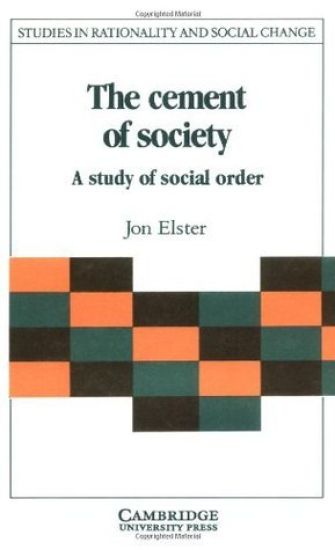
The Cement of Society

The Cement of Society

Jon Elster

Cambridge University Press
1989
pokkari
The question Jon Elster addresses in this challenging new book is what binds societies together and prevents them from disintegrating into chaos and war. He analyses two concepts of social order: stable, predictable patterns of behaviour, and co-operative behaviour. The book examines various aspects of collective action and bargaining from the perspective of rational-choice theory and the theory of social norms. It is a fundamental assumption of the book that social norms provide an important kind of motivation for action that is irreducible to rationality. The book represents a major new statement by Elster which will be of particular interest to political scientists, political philosophers, sociologists, and economists.
Solomonic Judgements

Solomonic Judgements

Jon Elster

Cambridge University Press
1989
pokkari
This volume of essays is very much a sequel to the two earlier collections by Jon Elster, Ulysses and the Sirens and Sour Grapes. His topic is rationality - its scope, its limitations, and its failures. Elster considers rational responses to the insufficiency of reason itself, and to the ‘indeterminacies’ in deploying rational-choice theory and discusses the irrationality of not seeing when, where, and what these are. A key essay which gives the collection its title examines disputes in cases of child custody, which are paradigmatically indeterminate. Leaving aside cases where one parent is patently unfit and assuming that protracted dispute is against the immediate interests of the child, Elster argues that three options present themselves: a strong presumption in favour of the mother, a strong presumption in favour of the primary caretaker (also likely to be the mother), and tossing a coin. Though the first two options may be preferable in the short/medium term, Elster argues that there is a case for randomisation in the long term. The book will be read with interest by anyone concerned with political and social science.
Political Psychology

Political Psychology

Jon Elster

Cambridge University Press
1993
sidottu
This provocative new textbook takes up and develops the themes of rationality and irrationality in Jon Elster's earlier work. Its purposes are threefold. First, Elster shows how belief and preference formation in the realm of politics are shaped by social and political institutions. Second, he argues for an important distinction in the social sciences between mechanisms and theories. Third, he illustrates those general principles of political psychology through readings of three outstanding political psychologists: the French classical historian, Paul Veyne; the Soviet dissident writer, Alexander Zinoviev; the great French political theorist, Alexis de Tocqueville.
Political Psychology

Political Psychology

Jon Elster

Cambridge University Press
1993
pokkari
This provocative new textbook takes up and develops the themes of rationality and irrationality in Jon Elster’s earlier work. Its purposes are threefold. First, Elster shows how belief and preference formation in the realm of politics are shaped by social and political institutions. Second, he argues for an important distinction in the social sciences between mechanisms and theories. Third, he illustrates those general principles of political psychology through readings of three outstanding political psychologists: the French classical historian, Paul Veyne; the Soviet dissident writer, Alexander Zinoviev; the great French political theorist, Alexis de Tocqueville.
Alexis de Tocqueville, the First Social Scientist

Alexis de Tocqueville, the First Social Scientist

Jon Elster

Cambridge University Press
2009
sidottu
The book proposes a new interpretation of Alexis de Tocqueville that views him first and foremost as a social scientist rather than as a political theorist. Drawing on his earlier work on the explanation of social behavior, Elster argues that Tocqueville's main claim to our attention today rests on the large number of exportable causal mechanisms to be found in his work, many of which are still worthy of further exploration. Elster proposes a novel reading of Democracy in America in which the key explanatory variable is the rapid economic and political turnover rather than equality of wealth at any given point in time. He also offers a reading of The Ancien Régime and the Revolution as grounded in the psychological relations among the peasantry, the bourgeoisie, and the nobility. Consistently going beyond exegetical commentary, he argues that Tocqueville is eminently worth reading today for his substantive and methodological insights.
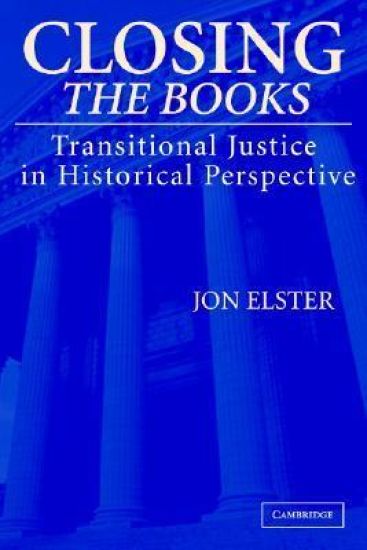
Closing the Books

Closing the Books

Jon Elster

Cambridge University Press
2004
pokkari
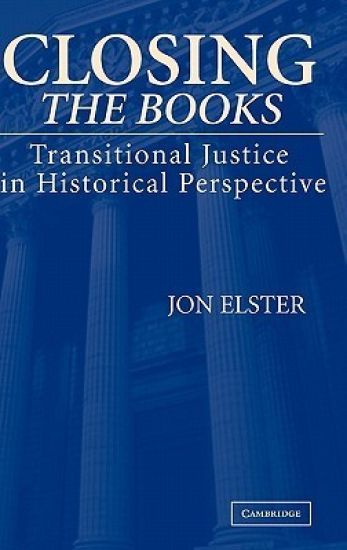
An analysis of transitional justice - retribution and reparation after a change of political regime - from Athens in the fifth century BC to the present. Part I, ‘The Universe of Transitional Justice’, describes more than thirty transitions, some of them in considerable detail, others more succinctly. Part II, ‘The Analytics of Transitional Justice’, proposes a framework for explaining the variations among the cases - why after some transitions wrongdoers from the previous regime are punished severely and in other cases mildly or not at all, and victims sometimes compensated generously and sometimes poorly or not at all. After surveying a broad range of justifications and excuses for wrongdoings and criteria for selecting and indemnifying victims, the book concludes with a discussion of three general explanatory factors: economic and political constraints, the retributive emotions, and the play of party politics.
Alchemies of the Mind

Alchemies of the Mind

Jon Elster

Cambridge University Press
1999
sidottu
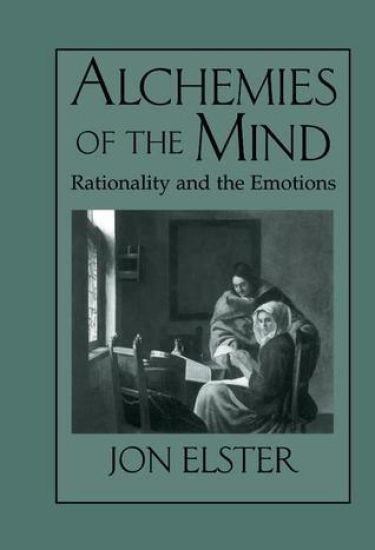
Jon Elster has written a comprehensive, wide-ranging book on the emotions in which he considers the full range of theoretical approaches. Drawing on history, literature, philosophy and psychology, Elster presents a complete account of the role of the emotions in human behaviour. While acknowledging the importance of neurophysiology and laboratory experiment for the study of emotions, Elster argues that the serious student of the emotions can learn more from the great thinkers and writers of the past, from Aristotle to Jane Austen. He attaches particular importance to the work of the French moralists, notably La Rochefoucauld, who demonstrated the way esteem and self-esteem shape human motivation. The book also maintains a running dialogue with economists and rational-choice theorists. Combining methodological and theoretical arguments with empirical case-studies and written with Elster's customary verve and economy, this book has great cross-disciplinary appeal.
Alchemies of the Mind

Alchemies of the Mind

Jon Elster

Cambridge University Press
1998
pokkari
Jon Elster has written a comprehensive, wide-ranging book on the emotions in which he considers the full range of theoretical approaches. Drawing on history, literature, philosophy and psychology, Elster presents a complete account of the role of the emotions in human behaviour. While acknowledging the importance of neurophysiology and laboratory experiment for the study of emotions, Elster argues that the serious student of the emotions can learn more from the great thinkers and writers of the past, from Aristotle to Jane Austen. He attaches particular importance to the work of the French moralists, notably La Rochefoucauld, who demonstrated the way esteem and self-esteem shape human motivation. The book also maintains a running dialogue with economists and rational-choice theorists. Combining methodological and theoretical arguments with empirical case-studies and written with Elster’s customary verve and economy, this book has great cross-disciplinary appeal.
Ulysses Unbound

Ulysses Unbound

Jon Elster

Cambridge University Press
2000
sidottu
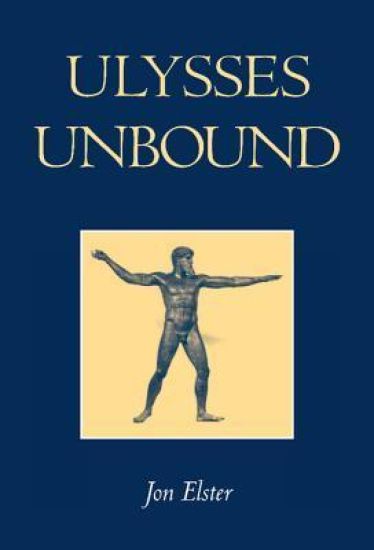
Common sense suggests that it is always preferable to have more options than fewer, and better to have more knowledge than less. This provocative book argues that, very often, common sense fails. Sometimes it is simply the case that less is more; people may benefit from being constrained in their options or from being ignorant. The three long essays that constitute this book revise and expand the ideas developed in Jon Elster's classic study Ulysses and the Sirens. It is not simply a new edition of the earlier book, though; many of the issues merely touched on before are explored here in much more detail. Elster shows how seemingly disparate examples which limit freedom of action reveal similar patterns, so much so that he proposes a new field of study: constraint theory. The book is written in Elster's characteristically vivid style and will interest professionals and students in philosophy, political science, psychology, and economics.
Alexis de Tocqueville, the First Social Scientist

Alexis de Tocqueville, the First Social Scientist

Jon Elster

Cambridge University Press
2009
pokkari
The book proposes a new interpretation of Alexis de Tocqueville that views him first and foremost as a social scientist rather than as a political theorist. Drawing on his earlier work on the explanation of social behavior, Elster argues that Tocqueville's main claim to our attention today rests on the large number of exportable causal mechanisms to be found in his work, many of which are still worthy of further exploration. Elster proposes a novel reading of Democracy in America in which the key explanatory variable is the rapid economic and political turnover rather than equality of wealth at any given point in time. He also offers a reading of The Ancien Régime and the Revolution as grounded in the psychological relations among the peasantry, the bourgeoisie, and the nobility. Consistently going beyond exegetical commentary, he argues that Tocqueville is eminently worth reading today for his substantive and methodological insights.
Closing the Books

Closing the Books

Jon Elster

Cambridge University Press
2004
sidottu
An analysis of transitional justice - retribution and reparation after a change of political regime - from Athens in the fifth century BC to the present. Part I, ‘The Universe of Transitional Justice’, describes more than thirty transitions, some of them in considerable detail, others more succinctly. Part II, ‘The Analytics of Transitional Justice’, proposes a framework for explaining the variations among the cases - why after some transitions wrongdoers from the previous regime are punished severely and in other cases mildly or not at all, and victims sometimes compensated generously and sometimes poorly or not at all. After surveying a broad range of justifications and excuses for wrongdoings and criteria for selecting and indemnifying victims, the book concludes with a discussion of three general explanatory factors: economic and political constraints, the retributive emotions, and the play of party politics.
Reason and Rationality

Reason and Rationality

Jon Elster

PRINCETON UNIVERSITY PRESS
2009
sidottu
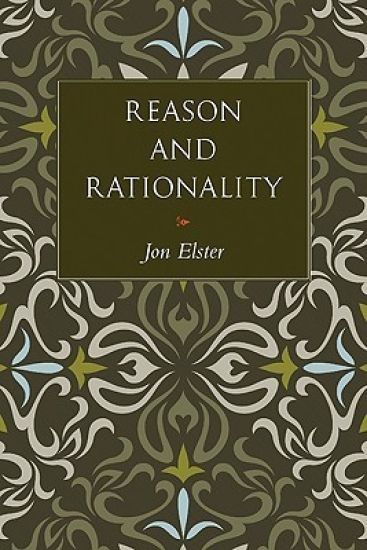
One of the world's most important political philosophers, Jon Elster is a leading thinker on reason and rationality and their roles in politics and public life. In this short book, he crystallizes and advances his work, bridging the gap between philosophers who use the idea of reason to assess human behavior from a normative point of view and social scientists who use the idea of rationality to explain behavior. In place of these approaches, Elster proposes a unified conceptual framework for the study of behavior. Drawing on classical moralists as well as modern scholarship, and using a wealth of historical and contemporary illustrations, Reason and Rationality marks a new development in Elster's thinking while at the same time providing a brief, elegant, and accessible introduction to his work.
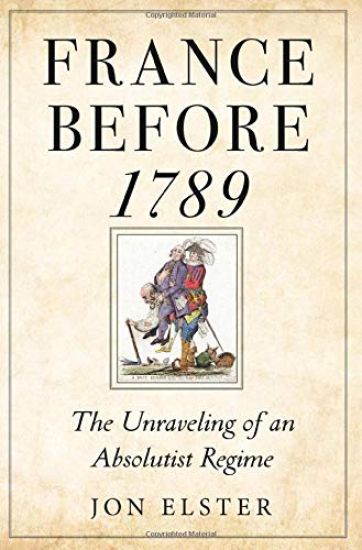
France before 1789

France before 1789

Jon Elster

PRINCETON UNIVERSITY PRESS
2020
sidottu
A masterful new account of old regime France by one of the world's most prominent political philosophersFrance before 1789 traces the historical origins of France's National Constituent Assembly of 1789, providing a vivid portrait of the ancien régime and its complex social system in the decades before the French Revolution. Jon Elster writes in the spirit of Alexis de Tocqueville, who described this tumultuous era with an eye toward individual and group psychology and the functioning of institutions. Whereas Tocqueville saw the old regime as a breeding ground for revolution, Elster, more specifically, identifies the rural and urban conflicts that fueled the constitution-making process from 1789 to 1791. He presents a new approach to history writing, one that supplements the historian's craft with the tools and insights of modern social science. Elster draws on important French and Anglo-American scholarship as well as a treasure trove of historical evidence from the period, such as the Memoirs of Saint-Simon, the letters of Madame de Sévigné, the journals of the lawyer Barbier and the bookseller Hardy, the Remonstrances of Malesherbes, and La Bruyère's maxims.Masterfully written and unparalleled in scope, France before 1789 is the first volume of a trilogy that promises to transform our understanding of constitution making in the eighteenth century. Volume 2 will look at revolutionary America in the years leading up to the Constitutional Convention of 1787 while the third volume will examine all facets of the French and American assemblies, from how they elected their delegates and organized their proceedings to how they addressed issues of separation of powers and representation.
France before 1789

France before 1789

Jon Elster

PRINCETON UNIVERSITY PRESS
2022
pokkari
A masterful new account of old regime France by one of the world's most prominent political philosophersFrance before 1789 traces the historical origins of France's National Constituent Assembly of 1789, providing a vivid portrait of the ancien régime and its complex social system in the decades before the French Revolution. Jon Elster writes in the spirit of Alexis de Tocqueville, who described this tumultuous era with an eye toward individual and group psychology and the functioning of institutions. Whereas Tocqueville saw the old regime as a breeding ground for revolution, Elster, more specifically, identifies the rural and urban conflicts that fueled the constitution-making process from 1789 to 1791. He presents a new approach to history writing, one that supplements the historian's craft with the tools and insights of modern social science. Elster draws on important French and Anglo-American scholarship as well as a treasure trove of historical evidence from the period, such as the Memoirs of Saint-Simon, the letters of Madame de Sévigné, the journals of the lawyer Barbier and the bookseller Hardy, the Remonstrances of Malesherbes, and La Bruyère's maxims.Masterfully written and unparalleled in scope, France before 1789 is the first volume of a trilogy that promises to transform our understanding of constitution making in the eighteenth century. Volume 2 will look at revolutionary America in the years leading up to the Constitutional Convention of 1787 while the third volume will examine all facets of the French and American assemblies, from how they elected their delegates and organized their proceedings to how they addressed issues of separation of powers and representation.
America before 1787

America before 1787

Jon Elster

PRINCETON UNIVERSITY PRESS
2023
sidottu
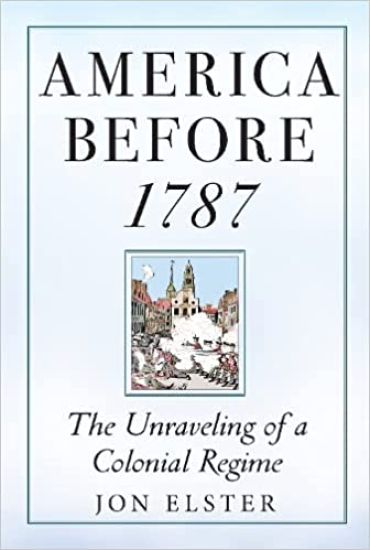
An original account, drawing on both history and social science, of the causes and consequences of the American RevolutionWith America before 1787, Jon Elster offers the second volume of a projected trilogy that examines the emergence of constitutional politics in France and America. Here, he explores the increasingly uneasy relations between Britain and its American colonies and the social movements through which the thirteen colonies overcame their seemingly deep internal antagonisms.Elster documents the importance of the radical uncertainty about their opponents that characterized both British and American elites and reveals the often neglected force of enthusiasm, and of emotions more generally, in shaping beliefs and in motivating actions. He provides the first detailed examinations of “divide and rule” as a strategy used on both sides of the Atlantic and of the rise and fall of collective action movements among the Americans. Elster also explains how the gradual undermining in America of the British imperial system took its toll on transatlantic relations and describes how state governments and the American Confederation made crucial institutional decisions that informed and constrained the making of the Constitution.Drawing on a wide range of historical sources and on theories of modern social science, Elster brings together two fields of scholarship in innovative and original ways. The result is a unique synthesis that yields new insights into some of the most important events in modern history.
America before 1787

America before 1787

Jon Elster

PRINCETON UNIVERSITY PRESS
2025
pokkari
An original account, drawing on both history and social science, of the causes and consequences of the American RevolutionWith America before 1787, Jon Elster offers the second volume of a projected trilogy that examines the emergence of constitutional politics in France and America. Here, he explores the increasingly uneasy relations between Britain and its American colonies and the social movements through which the thirteen colonies overcame their seemingly deep internal antagonisms.Elster documents the importance of the radical uncertainty about their opponents that characterized both British and American elites and reveals the often neglected force of enthusiasm, and of emotions more generally, in shaping beliefs and in motivating actions. He provides the first detailed examinations of “divide and rule” as a strategy used on both sides of the Atlantic and of the rise and fall of collective action movements among the Americans. Elster also explains how the gradual undermining in America of the British imperial system took its toll on transatlantic relations and describes how state governments and the American Confederation made crucial institutional decisions that informed and constrained the making of the Constitution.Drawing on a wide range of historical sources and on theories of modern social science, Elster brings together two fields of scholarship in innovative and original ways. The result is a unique synthesis that yields new insights into some of the most important events in modern history.
Rational Choice

Rational Choice

Jon Elster

New York University Press
1986
pokkari
This series brings together a carefully edited selection of the most influential and enduring articles on central topics in social and political theory. Each volume contains ten to twelve articles and an introductory essay by the editor.