Kirjahaku
Etsi kirjoja tekijän nimen, kirjan nimen tai ISBN:n perusteella.
1000 tulosta hakusanalla Jordan Bang
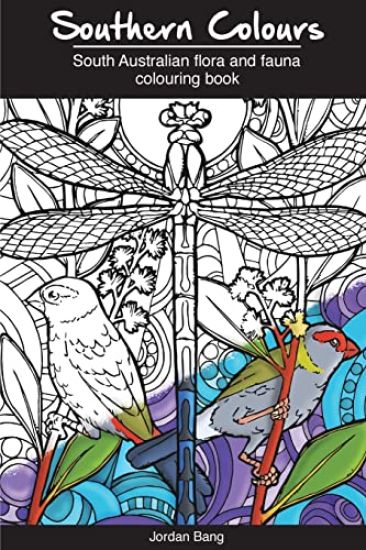
A colouring book for the obsessed. A selection of detailed ink art ready to fill in. Stay in within the weird lines.
Featuring over 36 plant and animal species from contrasting environments presented on abstract backgrounds, this colouring book provides users with the inspiration to explore the natural world of South Australia. Designed as an interactive field guide, small snippets of information for the flora and fauna displayed act as a starting point for further investigation into the vast and beautiful biodiversity of South Australia. Jordan Bang is a South Australian artist, illustrator and conservationist using detailed ink based artwork to inspire and communicate the natural beauty of Australian flora and fauna.
Galago Vol. 93
David Liljemark; Ruben Dahlstrand; Anneli Furmark; Jordan Crane; Jojo Falk; Pontus Lundqvist; Karolina Bång; Coco Moodysson; Lauren Weinstein; Henrik Bromander; Jeffrey Brown; Nanna Johansson; Fabian Göranson; Lena Ackebo; Marcus Ivarsson; Anders Blidlöv Végh; Ron Regé; Joakim Pirinen; Lars Krantz; Kolbeinn Karlsson; Sara Granér; David Nessle; Mats Jonsson
Ordfront Förlag
2008
nidottu
Jordan
Oxford Univ Pr
2025
sidottu
Created as a mechanism for maintaining British influence through a local patron, Jordan’s future never looked certain. Nevertheless, under the leadership of the Hashemite monarchy led by Abdullah and then his grandson Hussein, the Kingdom of Jordan became a permanent feature on the map of the modern Middle East. Under the rule of King Abdullah II, Jordan has remained an influential regional player in the Middle East Peace Process, its strategic position on the borders of Palestine, Israel, Egypt, Saudi Arabia and Iraq ensuring that it cannot be overlooked in the regional and international politics.Updated and expanded to include recent developments in Jordan and the Middle East, the new edition includes coverage and discussion of: the reign of King Abdullah IIthe involvement of the US in the Iraq war and the effect on this on Jordan’s alignment with the West the country’s recent economic growth, with an emphasis on economic liberalisation, privatisation, promotion of tourism and encouragement of foreign investmentthe position of Jordan as a point of continuity in an increasingly unstable Middle East.This volume, intended for both academic and general readers, offers an overview of the history, politics and economics of this fascinating country and its role in a region disfigured by the Arab-Israeli conflict.
Jordan
World Bank Publications
2004
nidottu
This evaluation, prepared in collaboration with the Islamic Development Bank, looks at the effectiveness of Bank assistance to Jordan during the 1990s, from three perspectives: an analysis of the Bank's services and products, development impact, and the contribution of the Bank and its development partners, to development outcomes. The Bank's strategy since 1990, based on wide-ranging and influential analytic and advisory activities, was to support macroeconomic stabilization and pro-market structural reforms to foster growth. The increased focus on the social sectors was aligned with the Millennium Development Goals (MDGs). The strategy was relevant to the government's priorities outlined in a series of five-year economic and social development plans. The Bank's programs, in particular, were successful in promoting policy reforms. Substantial tariff, trade and financial sector reforms, together with the removal of disincentives for investment and the privatization of government enterprises, were achieved. Bank assistance also contributed to significant progress in the agriculture, water and social sectors. With Bank support, Jordan made excellent progress in almost all areas covered by the MDGs, and is likely to meet the target levels by 2015. However, these gains have been achieved in an inefficient manner and the cost in terms of public expenditures has been relatively high. Recommendations outline much needed public sector reform, for despite some public expenditures being curtailed, the country's vulnerability to external shocks, remains high, and the potential for regional instability is also considerable. Future Bank assistance should focus on public expenditure restructuring, enhanced water management and conservation, and poverty reduction.
First published in 1983 Jordan: Crossroads of Middle Eastern Events examines Jordan’s unique role in the Middle East- Arab- Israeli conflict focusing also on its attempt and partial success, at developing its economy and society in the face of a dearth of natural resources and a large influx of refugees. Woven throughout the narrative is the role of King Hussain, a singular Arab ruler, master player on both the Middle Eastern and world stages even though his country lacks significant assets or power in either those arenas. Peter Gubser describes Jordan’s people, culture, history, and social structure, then looks at how the country, buffeted in the tumultuous Middle East, hampered by limited internal political development, and strained by its rapid transition from a peasant, Bedouin economy to one dominated by refugee problems, has moved forward to a much sounder economy based on diversification- in agriculture, industry, mineral extraction, and services. The author argues that Jordan once almost entirely depended on the West for economic largess as well as for political support, now has major Arab sources of assistance and is reorienting its foreign policy accordingly. This is a must read for scholars and researchers of Middle East studies, Middle East history and Middle East politics.
Jordan
IBP USA
2019
pokkari
Jordan: Doing Business, Investing in Jordan Guide Volume 1 Strategic, Practical Information, Regulations, Contacts
The Ninth Inning series presents Memphis Angels' shortstop, Jordan Johnson.Jordan Johnson loves his wife more than anything. After suffering a traumatic loss together, he's willing to give her whatever she needs. She needs space, he'll give her space. She needs time, he'll give her time. However, when Heidi asks for a divorce, Jordan refuses to give it to her. It's tough sometimes, but Jordan won't stop fighting for them.Heidi Johnson's life seems to be a fairytale with the perfect baseball husband, the great vacation beach house, and a good career. Then, tragedy hit her from nowhere. Now, she's trying to figure out which way is up and which is down. She figures leaving Jordan and focusing on opening her own business will make the pain go away, but it doesn't help. Finally, she tells Jordan a divorce is what she needs, but he's too stubborn to give her what she wants the most.Jordan won't give up on her and Heidi won't change her mind. Will he push her further away by reminding her of what they had? Will she push him too far with her rejections that he'll never come back? Or can they save their marriage?When they're put into the ninth inning, will Jordan be able to hold tight to Heidi or will her stubbornness be the end of the game?
Jordan
Nova Science Publishers Inc
2011
sidottu
This book provides an overview of Jordanian politics and current issues in U.S.-Jordanian relations; Jordan's government and economy and its co-operation in promoting Arab-Israeli peace and other U.S policy objectives in the Middle East. Several issues in U.S.-Jordanian relations include the stability of the Jordanian regime, the role of Jordan in the Arab-Israeli peace process, Jordan's role in stabilising Iraq, and U.S.-Jordanian military and intelligence co-operation are discussed. The country's small size and lack of major economic resources have made it dependent on aid from Western and friendly Arab sources. U.S. support, in particular, has helped Jordan deal with serious vulnerabilities, both internal and external.
Among much of the conflict in the Middle East, Jordan has become a place of refuge for many seeking safety. This land of deserts along the Great Rift Valley is home to the ancient city of Petra and people wearing welcoming smiles. This title is the perfect trek through the culture, customs, and daily life in Jordan.
Jordan
Nova Science Publishers Inc
2014
sidottu
Despite conflict on its borders, the Hashemite Kingdom of Jordan appears to remain a relatively stable and reliable partner for the United States in the Arab world. Jordan's strategic importance to the United States may be increasing given the ongoing civil war in Syria, fighting in western and central Iraq, uncertainty over the trajectory of Palestinian and Egyptian politics, and ongoing global counter-terrorism operations. In each of these arenas, U.S.-Jordanian military, intelligence, and diplomatic co-operation seeks to empower political moderates, reduce sectarian conflict, and eliminate terrorist threats. This book provides an overview of Jordanian politics and current issues in U.S.-Jordanian relations. It provides a brief discussion of Jordan's government and economy and of its co-operation with U.S. policy objectives in the Middle East, including the promotion of Arab-Israeli peace.