Kirjojen hintavertailu. Mukana 12 390 323 kirjaa ja 12 kauppaa.

Kirjahaku

Etsi kirjoja tekijän nimen, kirjan nimen tai ISBN:n perusteella.

1000 tulosta hakusanalla Jorge I. Domínguez

Cuba

Cuba

Jorge I. Domínguez

The Belknap Press
1978
nidottu
Upon publication in the late 1970s this book was the first major historical analysis of twentieth-century Cuba. Focusing on the way Cuba has been governed, and in particular on the way a changing elite has made claims to legitimate rule, it carefully examines each of Cuba’s three main political eras: the first, from Independence in 1902 to the Presidency of Gerardo Machado in 1933; the second, under Batista, from 1934 until 1958; and finally, Castro’s revolution, from 1959 to the present.Jorge Domínguez discusses the political roles played by interest groups, mass organizations, and the military. He also investigates the impact of international affairs on Cuba and provides the first printed data on many aspects of political, economic, and social change since 1959. He deals in depth with agrarian politics and peasant protest since 1937, and his concluding chapter on Cuba’s present culture is a fascinating insight into a society which—though vitally important—remains mysterious to most readers in the United States.Cuba’s role in international affairs is vastly greater than its size. The revolution led by Fidel Castro, the Bay of Pigs invasion, the missile crisis in 1962, the underwriting of revolution in Latin America and recently in Africa—all these events have thrust Cuba onto the modern world stage. Anyone hoping to understand this country and its people, and above all its changing systems of government, will find this book essential.
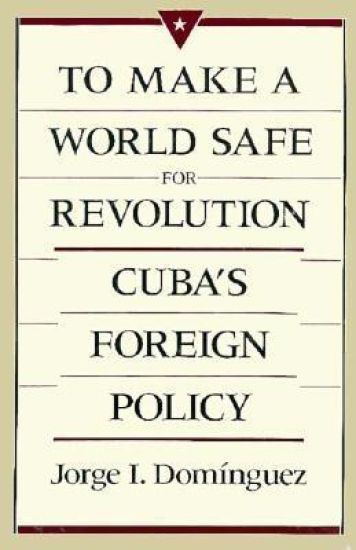
To Make a World Safe for Revolution

To Make a World Safe for Revolution

Jorge I. Domínguez

Harvard University Press
1989
nidottu
The twentieth-century history of Cuba borders on fantasy. This diminutive country boldly and repeatedly exercises the foreign policy of a major power. Although closely tied to the United States through most of its modern history, Cuba successfully defied the U.S. government after 1959, consolidated its own power, and defeated an invasion of U.S.-backed exiles at the Bay of Pigs in 1961. Fidel Castro then brought the world alarmingly close to nuclear war in 1962.Jorge Domínguez presents a comprehensive survey of Cuban international relations since Castro came to power. Domínguez unravels Cuba’s response to the 1962 missile crisis and the U.S.–Soviet understandings that emerged from that. He explores the ties that link Cuba to the U.S.S.R. and other Communist countries; analyzes Cuban support for revolutionary movements throughout the world, especially in Latin America and Africa; and assesses the significance of Cuban political and economic relations with Western Europe, Canada, and Japan.Some have charged that Cuba does not have a foreign policy, that Fidel Castro merely takes orders from his Soviet bosses. Domínguez argues that there is indeed a specifically Cuban foreign policy, poised not only between hegemony and autonomy, between compliance and self-assertion, but also between militancy and pragmatism. He believes that within the context of Soviet hegemony Cuba’s foreign policy is very much its own, and he marshals impressive evidence to support this belief. His book is based on extensive documentation from Cuba, the United States, and other countries, as well as from many in-depth interviews carried out during trips to Cuba.
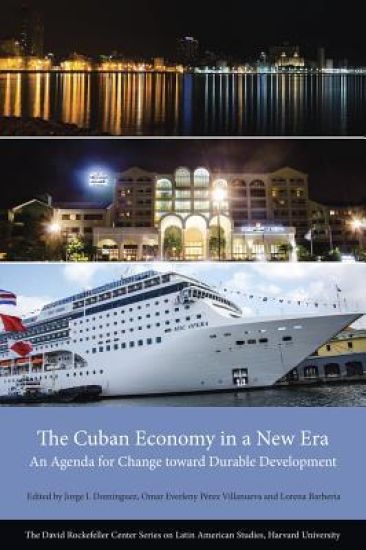
The Cuban Economy in a New Era

The Cuban Economy in a New Era

Jorge I. Dominguez

Harvard University, The David Rockefeller Center for Latin American Studies
2018
pokkari
Cuba’s economy has grown hardly at all during Raúl Castro’s presidency (beginning in 2006), hit by the economic collapse of its Venezuelan partner and burdened by a legacy of decayed infrastructure, a bankrupt sugar industry, and stagnant agriculture.The Cuban Economy in ?a New Era diagnoses the ills that afflict Cuba’s economy and examines possible economic policy changes in seven areas: macroeconomic policy, central planning, small and medium private enterprises, nonagricultural cooperatives, financing options for the new private sector, state enterprise management, and relations with international financial institutions. Cuban economists have contributed these seven chapters, and the combined import is further considered in introductory and concluding chapters. The book is the culmination of over a decade of scholarly collaboration with Harvard scholars, anchored in a series of workshops held over several years in Cambridge, Massachusetts, and Havana.
The United States and Mexico

The United States and Mexico

Jorge I. Domínguez; Rafael Fernández de Castro

Routledge
2009
sidottu
By sharing one of the longest land borders in the world, the United States and Mexico will always have a special relationship. In the early twenty-first century, they are as important to one another as ever before with a vital trade partnership and often-tense migration positions. The ideal introduction to U.S.-Mexican relations, this book moves from conflicts all through the nineteenth century up to contemporary democratic elections in Mexico.Domínguez and Fernández de Castro deftly trace the path of the relationship between these North American neighbors from bloody conflicts to (wary) partnership. By covering immigration, drug trafficking, NAFTA, democracy, environmental problems, and economic instability, the second edition of The United States and Mexico provides a thorough look back and an informed vision of the future.
The United States and Mexico

The United States and Mexico

Jorge I. Domínguez; Rafael Fernández de Castro

Routledge
2009
nidottu
By sharing one of the longest land borders in the world, the United States and Mexico will always have a special relationship. In the early twenty-first century, they are as important to one another as ever before with a vital trade partnership and often-tense migration positions. The ideal introduction to U.S.-Mexican relations, this book moves from conflicts all through the nineteenth century up to contemporary democratic elections in Mexico.Domínguez and Fernández de Castro deftly trace the path of the relationship between these North American neighbors from bloody conflicts to (wary) partnership. By covering immigration, drug trafficking, NAFTA, democracy, environmental problems, and economic instability, the second edition of The United States and Mexico provides a thorough look back and an informed vision of the future.
U.S.-Cuban Relations in the 1990s

U.S.-Cuban Relations in the 1990s

Jorge I Dominguez

Routledge
2019
sidottu
The contributors and editors purpose in this book is to sketch where and why the United States and Cuba differ; to identify the issues where differences are likely to endure because they stem from the central values and interests of such different political and economic regimes; and to point to those other issues where skillful diplomacy might fin
U.s.-cuban Relations In The 1990s

U.s.-cuban Relations In The 1990s

Jorge I Dominguez

Routledge
2020
nidottu
The contributors and editors purpose in this book is to sketch where and why the United States and Cuba differ; to identify the issues where differences are likely to endure because they stem from the central values and interests of such different political and economic regimes; and to point to those other issues where skillful diplomacy might fin
Economic Strategies and Policies in Latin America
Economists have debated Latin America’s economic strategies at two moments since the second world war. The first debate, often characterized as between monetarists and structuralists, flourished from the late 1950s to the early 1970s. It focused on the strengths and weaknesses of a strategy of import-substituting industrialization (ISI). The second debate has unfolded since the early 1980s. It focuses on policies of economic stabilization to control inflation, and on exchange rates, trade regimes and, especially, a strategic orientation toward reliance upon markets in order to foster economic growth. This is collection of essays around the strategies and policies adopted in Latin America.
Parties, Elections, and Political Participation in Latin America
First Published in 1994. This is Volume five of seven of a collection of essays that gathers together scholarly debates from the 1950s to the 1990s on Mexico, Central and South America. This text looks at topics such as government parties in Latin America, the Mexican elections of 1958, political campaigning, the scope of the Chilean Party systems, the case of Peronism and electoral change amongst others.
Latin America's International Relations and Their Domestic Consequences
First Published in 1994. Volume 6 in the 7-volume series titled Essays on Mexico, Central and South America: Scholarly Debates from the 1950s to the 1990s. The central scholarly articles concern interstate peace along with a U.S. propensity to intervene, and international structural vulnerabilities and economic asymmetries along with the significance of elite skills and choices. This title recognises that scholars have paid more attention to international economics in Latin America and seeks to balance the range study.
Race and Ethnicity in Latin America

Race and Ethnicity in Latin America

Jorge I Dominguez

CRC Press Inc
1994
sidottu
First Published in 1994. In nearly all racially and ethnically heterogeneous societies, there is overt national conflict among parties and social movements organized on the basis of race and ethnicity. Such conflict has been much less evident in Latin America. Scholars have pondered the nature of race and ethnicity with regard to both Afro- American and Indo-American societies, though research on Brazil has been particularly prominent. Special attention has been given to the relationship between social class and race and ethnicity.
Revista Venezolana de Legislación y Jurisprudencia N° 11

Revista Venezolana de Legislación y Jurisprudencia N° 11

María Candelaria Domínguez Guillén; Manuel Espinoza Melet; Jorge I. González Carvajal

Independently Published
2019
nidottu
Contenido N 11 Presentaci n, Edison Lucio Varela C ceres Doctrina: Buena fe y relaci n obligatoria, Mar a Candelaria Dom nguez Guill n; La formaci n acad mica y el futuro de la profesi n de abogado, Manuel Espinoza Melet; Notas m nimas sobre derecho(s) de los consumidores e integraci n, Jorge I. Gonz lez Carvajal; La buena fe y la doctrina de los actos propios. Una mirada en el Derecho venezolano, Fernando F. Guerrero Brice o; El delito de desaparici n forzada de personas como tema jur dico en la pel cula Zanahoria, Nilyan Santana Longa; La posesi n de estado. Auge, ocaso y resurgimiento, Edison Lucio Varela C ceres Legislaci n: Anotaciones sobre la publicidad registral inmobiliaria, Mar a Candelaria Dom nguez Guill n y Carlos P rez Fern ndez; Breve an lisis sobre la formaci n del contrato por la v a electr nica en Venezuela, V ctor Guid n Guerrero; El derecho a la vivienda, la dignidad humana y el Decreto con rango, valor y fuerza de Ley del R gimen de Propiedad de las Viviendas de la Gran Misi n Vivienda Venezuela. Contraste del texto con la realidad, Oscar Riquezes Contreras Jurisprudencia: El matrimonio y la nulidad parcial del art culo 46 del C digo Civil, Mar a Fernanda Arteaga Flamerich; Fertilizaci n post mortem, Henry J. Mart nez S.; La nueva casaci n civil, Luis Aquiles Mej a Arnal Miscel neas Mi deuda con Venezuela, ngel Crist bal Montes...
Transparency and Critical Theory

Transparency and Critical Theory

Jorge I. Valdovinos

Springer Nature Switzerland AG
2022
sidottu
This book takes an interdisciplinary approach to the critique of contemporary ideology, offering an innovative genealogy of one of its most fundamental discursive manoeuvres: the ideological effacement of mediation. Providing a comprehensive historical revision of media (from the Greeks to the Internet), this book identifies several critical junctures at which the tension between visibility and invisibility has overlapped with conceptions of neutrality—a tension best incarnated in today's use of the word transparency. Then, it traces this term's evolving semantic constellation through a variety of intellectual discourses, exposing it as a key operator in the revaluation of ideals, sensibilities, and modalities of perception that lie at the core of our contemporary attention-based economy.
Transparency and Critical Theory

Transparency and Critical Theory

Jorge I. Valdovinos

Springer Nature Switzerland AG
2023
nidottu
This book takes an interdisciplinary approach to the critique of contemporary ideology, offering an innovative genealogy of one of its most fundamental discursive manoeuvres: the ideological effacement of mediation. Providing a comprehensive historical revision of media (from the Greeks to the Internet), this book identifies several critical junctures at which the tension between visibility and invisibility has overlapped with conceptions of neutrality—a tension best incarnated in today's use of the word transparency. Then, it traces this term's evolving semantic constellation through a variety of intellectual discourses, exposing it as a key operator in the revaluation of ideals, sensibilities, and modalities of perception that lie at the core of our contemporary attention-based economy.
Herramientas digitales en la formación disciplinar

Herramientas digitales en la formación disciplinar

Jorge I Cortez Nolazco; Ma Rosario Soto Federico; Rosa Laura Gastelum F

Editorial Academica Espanola
2018
pokkari
La presente investigaci n: Herramientas digitales en la formaci n disciplinar aborda el uso de los recursos digitales virtuales y los diferentes softwares que forman parte de las llamadas Nuevas Tecnolog as de la Informaci n y la Comunicaci n (NTIC) por parte de los alumnos de la Licenciatura en Ciencias de la Comunicaci n en la Universidad de Sonora para conocer su perspectiva con respecto a su formaci n disciplinar, as como tambi n para saber lo que piensan con relaci n a su labor acad mica. La investigaci n dio como resultado que los alumnos utilizan en su gran mayor a la red social Facebook para interactuar con compa eros, y muy pocos docentes, y recursos virtuales ofrecidos por Google para poder almacenar documentos y material digital que se genera en lo cotidiano. Adem s, una combinaci n de factores externos ambientales sociales, en combinaci n con la falta de preparaci n de algunos docentes que conforman el corpus acad mico especializado, son los principales responsables de que los alumnos pierdan mucho inter s en usar recursos como sitios de almacenamiento de datos virtuales y por aplicar herramientas ofim ticas de libre licencia a su labor cotidiana.