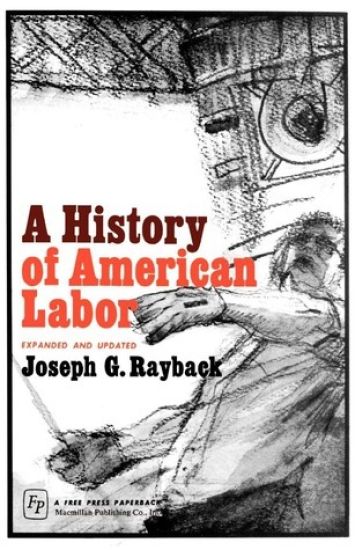
Joseph Rayback’s updated and comprehensive history of the American labor movement.Considered to be a foundational text for any readers interested in learning the important role of American labor union history, The History of American Labor delves into the history of labor in America from the colonial days until the mid-1950's.
Providing the perfect balance of cultural and musical analysis, Rock: Music, Culture, and Business by Joseph G. Schloss, Larry Starr, and Christopher Waterman tells the full story of rock 'n' roll, from its earliest beginnings to today. DISTINCTIVE FEATURES* Balances the history of the music business and the impact of social and cultural movements on the story of rock* Enhanced coverage of contemporary rock music, including the impact of rap* Integrates lively pedagogy: --- Detailed listening guides highlighting the significant elements of more than forty key recordings--- More than 100 photos, many in full color--- Boldfaced key terms and a glossary* Robust support package: --- Instructor Resource CD containing a computerized Test Bank (978-0-19-975837-1)--- Companion Website (www.oup.com/us/schloss)
This book is an abridged edition of the critically acclaimed, three-volume Dictionary of American Military Biography (Greenwood Press, 1984). The scope of the original work encompassed a much wider range of people than soldiers; it included politicians, scientists, inventors, explorers, physicians, and humanitarians who had a significant impact on American military history. This new edition focuses on the most distinguished and important battle commanders in American history from colonial times to the present. Each essay incorporates the latest scholarship on the life under study, depicting the background, education, professional development, and accomplishments of the most notable practitioners of the art of war. Unlike most works of this genre, American Military Leaders offers critical appraisals of its subjects. The essays were contributed by some 100 military historians. Cross references and bibliographies are provided. There is a new introduction and an enhanced reference index. This careful abridgement of an acknowledged classic guide to military history can be used as a supplementary text for courses on the evolution of war and American military history. Professional soldiers will welcome its emphasis on battlefield warriors and military history buffs will find it both insightful and enjoyable reading.
Bock begins with a description of ethnoreligious violence in the world today and then offers a case study about Hindu-Muslim riots in India that illustrates how religion is used to engineer violence by those who gain from it. The way that religion foments violence as compared to how it can be used to prevent it is analyzed in a chapter on the flash-point asymmetry problem. While religion in the direction of hatred seems to be sharp like a sword, it is argued that in some respects it is more like a butterknife in the direction of understanding and tolerance.The second part of Dr. Bock's analysis identifies ways in which religious leaders seeking to prevent ethnoreligious violence might be more effective. He argues that religious leaders must be prepared to respond assertively to ethnoreligious aggression at early stages, not waiting for violence to erupt. Further, these leaders need to help people discipline their information processing so that they are not influenced by bigoted rumors. They must also cultivate a sense of belonging among their followers and exercise their authority by speaking out on matters of theology. He concludes that there are at least seven ways in which religious leaders have similar influence as their violence promoting counterparts. This is an important resource for scholars, researchers, students, and trainers involved with peace studies, conflict resolution, applied theology, and South Asia and Middle East studies.
Bock begins with a description of ethnoreligious violence in the world today and then offers a case study about Hindu-Muslim riots in India that illustrates how religion is used to engineer violence by those who gain from it. The way that religion foments violence as compared to how it can be used to prevent it is analyzed in a chapter on the flash-point asymmetry problem. While religion in the direction of hatred seems to be sharp like a sword, it is argued that in some respects it is more like a butterknife in the direction of understanding and tolerance. The second part of Dr. Bock's analysis identifies ways in which religious leaders seeking to prevent ethnoreligious violence might be more effective. He argues that religious leaders must be prepared to respond assertively to ethnoreligious aggression at early stages, not waiting for violence to erupt. Further, these leaders need to help people discipline their information processing so that they are not influenced by bigoted rumors. They must also cultivate a sense of belonging among their followers and exercise their authority by speaking out on matters of theology. He concludes that there are at least seven ways in which religious leaders have similar influence as their violence promoting counterparts. This is an important resource for scholars, researchers, students, and trainers involved with peace studies, conflict resolution, applied theology, and South Asia and Middle East studies.
Three Mile Island, Seabrook, Diablo Canyon: their controversies have come to symbolize the unhappy fate of American nuclear power. Three decades of effort and an investment of several hundred billion dollars have culminated in wide-spread public fear, huge financial losses, an unworkable regulatory system, and a virtual ban on new reactors. How did one of the world's most flexible political and economic systems produce such a technological white elephant? What does this enormous failure reveal about the compatibility of democracy and technology? And what lessons can be learned for future energy policy making?To answer these questions, Joseph Morone and Edward Woodhouse offer a nonpartisan diagnosis of the decision-making processes that led to the industry's current state. What we think of as nuclear power, they argue, is just one of many technical and organizational forms this energy source could have taken. It was shaped by political and economic choices of the 1950s and 1960s, not by any internal dynamic of the technology. If a few of those choices had been made differently--particularly regarding the scale-up and diffusion of reactors--the nuclear enterprise might have evolved far more acceptably. The ills of the first nuclear era stemmed not from any fundamental incompatibility between technology and democracy, but from a failure of democracy to live up to its own standards of good decision making.Although many nations have turned away from civilian nuclear power, problems with fossil fuels--particularly climate changes from the greenhouse effect--may lead to reappraisal of the nuclear option. A radically altered form of nuclear power, together with alternative energy sources and intensified conservation, could provide a more acceptable and less environmentally destructive energy future--if we learn from the failures of the first nuclear era.
In anticipation of the opening of the H. Lee Moffitt Cancer Center and Research lnstitut~ on the campus of the University of South Florida, an international symposium, "The First Annual H. Lee Moffitt Symposium on Cancer Biology and Therapeutics" was held in Tampa, Florida on January 20-22, 1986. In this first symposium we decided to present a broad-based series of topics dealing with the major issues in the field of cancer. These topics ranged from the biochemistry of the cancer cell to the design of antineoplastic agents, through tumor cell heterogeneity, treatment of ltuman neoplasms to immunological aspects of cancer biology and tr~atment. The speakers chosen represented individuals of international acclaim who are very active in the area of cancer research and treatment. The symposium brought together scien tists/physicians from six nations including Austria, Canada, France, Hungary, West Germany, and of course, the United States. The congeniality of the participants promoted the friendly exchange of knowledge which, it is hoped, will greatly hasten the time when successful management of human cancer will become routine. Future symposia in this series will be highly focused and will deal with a single facet of this vast field of cancer research and treatment. Joseph G. Cory, Editor Andor Szentivanyi, Editor University of South Florida, 1986 V ACKNOWLEDGMENTS This volume presents the Proceedings of the H. Lee Moffitt International Syn~osium on Cancer Biology and Therapeutics which was held in Tampa, Florida on January 20, 21, and 22, 1986.

![Elements of Orthography; Or an Attempt to Form a Complete System of Letters [By J.G. Chambers]](/covers/9781023854542.jpg)
![Elements of Orthography; Or an Attempt to Form a Complete System of Letters [by J.G. Chambers].](/covers/9781146407069.jpg)