

Kirjahaku
Etsi kirjoja tekijän nimen, kirjan nimen tai ISBN:n perusteella.
1000 tulosta hakusanalla Joseph Warren Beach

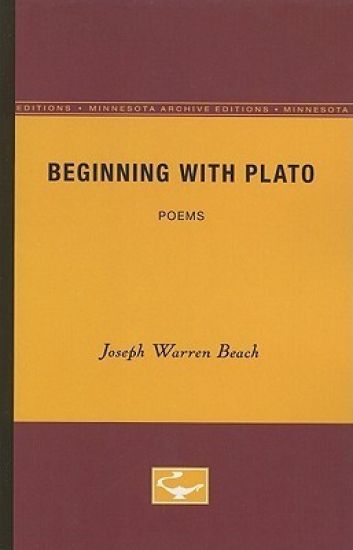
Beginning with Plato was first published in 1944. Minnesota Archive Editions uses digital technology to make long-unavailable books once again accessible, and are published unaltered from the original University of Minnesota Press editions. These selected poems of Joseph Warren Beach range in time from the present year to the age of Pericles; in place from California to Shangri-La, from Paris to the Middle West; in theme from current political issues to the timeless problems of Greek philosophy; in mood from tender love to trenchant satire. In these fifty-odd poems is a rich variety—Anthony Eden and Cordell Hull, the French capital in the summer preceding the first World War, the skylines of the American West, the skylines of Minneapolis, soldier and swan maiden, and the inner life of man wherever lived. Mr. Beach can tell home truths without bitterness, and handle nostalgic emotion without sentimentality.
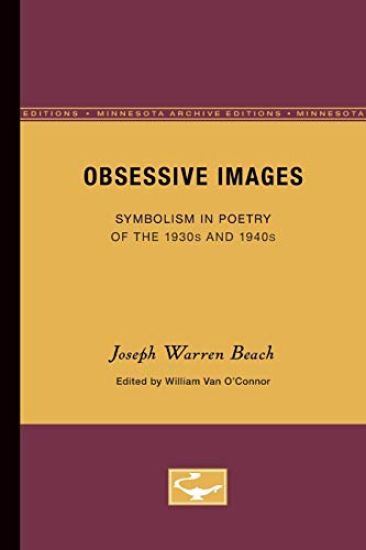
Obsessive Images was first published in 1960. Minnesota Archive Editions uses digital technology to make long-unavailable books once again accessible, and are published unaltered from the original University of Minnesota Press editions. As Mark Schorer comments, this is "the last, unfinished work of a distinguished, well loved critic, poet, and professor." After the death of Joseph Warren Beach, his colleague and friend William Van O'Connor, professor of English at the University of Minnesota, prepared the unfinished manuscript of this work for publication and wrote the foreword. The work is primarily a study of certain words, phrases, and images that turn up with unusual frequency in modern American poetry, especially that of the decades of the 1930's and 1940's, and which are used in unusual senses, to carry special symbolisms, or to imply peculiar philosophical attitudes. Since the study is concerned with such recurring images and themes, many poets of distinction, in whose work they are not to be found, are left out, but Professor Beach also discusses the significance of the absence of these poets.Students and critics will gain insight through this work into the characteristic attitudes of a generation of poets. The book is, moreover, a delight to read, reflecting, as it does, Mr. Beach's own love for the study of poetry. As Professor O'Connor points out, the tone is much more personal than that of Mr. Beach's other books.

A Romantic View of Poetry was first published in 1944. Minnesota Archive Editions uses digital technology to make long-unavailable books once again accessible, and are published unaltered from the original University of Minnesota Press editions. Poetry is of the very essence of living. In this belief Joseph Warren Beach discusses the ways in which poet and reader create and live "a being more intense" and thereby fulfill the function of poetry. "Wherever there is life," says Beach, "there poetry is present potentially and in its rudiments . . . and poetry, as I conceive it, is the sovereign means we have of realizing the satisfaction which we take in living." Against the background of the Romantic School, he develops a pattern for the understanding of poetry that applies to all schools and to all readers. Poetry of realization and release cannot be circumscribed. Wordsworth, Coleridge, Byron, Keats, and Shelley stand here as examples of the poetic artist. And every person who responds to the work of the poet shares with him the imaginative stimulus of poetic creation.A Romantic View of Poetry consists of a series of lectures delivered by Mr. Beach at the Johns Hopkins University in 1941 on the Percy Turnball Memorial Foundation.
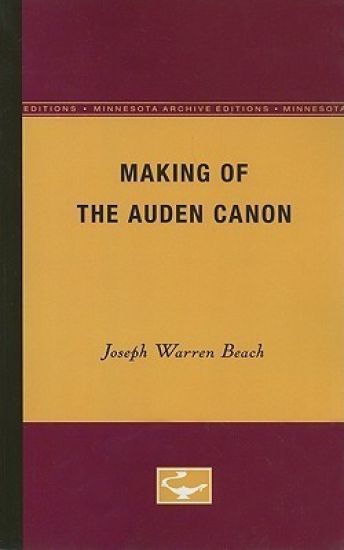
Making of the Auden canon was first published in 1957. Minnesota Archive Editions uses digital technology to make long-unavailable books once again accessible, and are published unaltered from the original University of Minnesota Press editions.No poet writing in English is more representative of the intellectual trends of the thirties and forties than W. H. Auden. British born, Oxford educated, American by naturalization, and now returned to Oxford to occupy the chair of poetry, he is widely regarded as the spiritual guide and keeper of the conscience of the age, at the same time that he exemplifies the gradual passage from ideological left to right so characteristic of the period. This study of Auden's poetry and revisions has far-reaching implications for an understanding not only of Auden's own writing but that of his contemporaries as well. Considering that 1945 Collected Poetry as the Auden canon, or authorized version of the poems, Mr. Beach examines the process by which Auden selected poems to be admitted to the canon. He shows that the poet eliminated many that were at odds with his later style and thought, discreetly revised others to bring them into line, and, at the same time, left unaltered some of the pieces from his unregenerate days. Auden's system of selection and revision reflects the winding course of his thought, and, by tracing this course, Mr. Beach endeavors to penetrate the poet's diverse masks in an effort to get at the identity of t he man himself.



The Concept of Nature in Nineteenth Century English Poetry
Joseph Warren Beach
Literary Licensing, LLC
2012
sidottu
""The Concept of Nature in Nineteenth Century English Poetry"" by Joseph Warren Beach is a comprehensive study of the relationship between nature and poetry in the 19th century. The book examines the various ways in which nature was represented in English poetry during this period, and how these representations reflected the changing attitudes towards nature and the environment.The book begins with an overview of the Romantic poets and their emphasis on the beauty and power of nature. It then moves on to the Victorian era, where nature was often seen as a source of moral instruction and spiritual renewal. The book also explores the impact of Darwin's theory of evolution on poetry, and how poets responded to the growing awareness of the fragility and interconnectedness of the natural world.Throughout the book, Beach analyzes the works of a wide range of poets, including Wordsworth, Coleridge, Tennyson, Browning, and Hopkins. He also considers the influence of other cultural and social factors on the representation of nature in poetry, such as the rise of industrialization and the growing awareness of environmental degradation.Overall, ""The Concept of Nature in Nineteenth Century English Poetry"" provides a fascinating insight into the ways in which poets engaged with the natural world during a period of significant social, cultural, and environmental change.This scarce antiquarian book is a facsimile reprint of the old original and may contain some imperfections such as library marks and notations. Because we believe this work is culturally important, we have made it available as part of our commitment for protecting, preserving, and promoting the world's literature in affordable, high quality, modern editions, that are true to their original work.

The Concept of Nature in Nineteenth Century English Poetry
Joseph Warren Beach
Literary Licensing, LLC
2012
nidottu

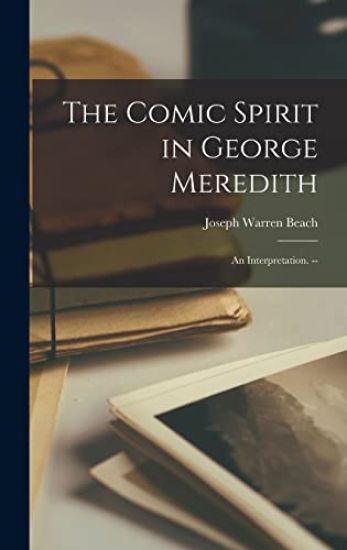
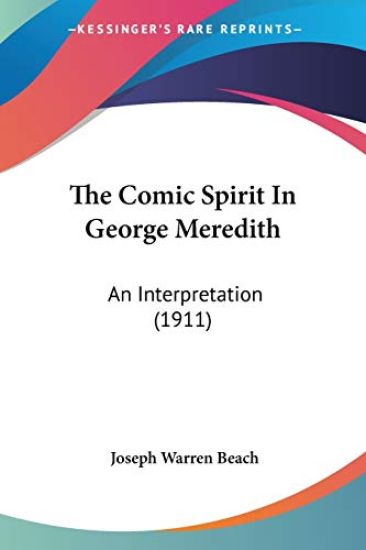
The Comic Spirit in George Meredith: an Interpretation. --
Joseph Warren 1880-1957 Beach
Hassell Street Press
2021
sidottu

This work has been selected by scholars as being culturally important and is part of the knowledge base of civilization as we know it.This work is in the public domain in the United States of America, and possibly other nations. Within the United States, you may freely copy and distribute this work, as no entity (individual or corporate) has a copyright on the body of the work.Scholars believe, and we concur, that this work is important enough to be preserved, reproduced, and made generally available to the public. To ensure a quality reading experience, this work has been proofread and republished using a format that seamlessly blends the original graphical elements with text in an easy-to-read typeface.We appreciate your support of the preservation process, and thank you for being an important part of keeping this knowledge alive and relevant.
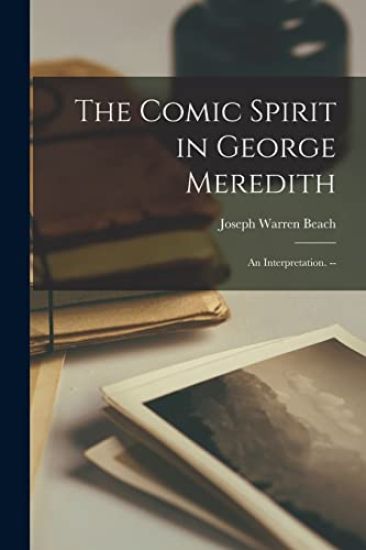
The Comic Spirit in George Meredith: an Interpretation. --
Joseph Warren 1880-1957 Beach
Hassell Street Press
2021
nidottu
![An Oration Delivered March 5th, 1772. at the Request of the Inhabitants of the Town of Boston; To Commemorate the Bloody Tragedy of the Fifth of March, 1770. by Joseph Warren. [three Lines in Latin from Virgil] (the Second Edition).](/covers/9781170882443.jpg)
An Oration Delivered March 5th, 1772. at the Request of the Inhabitants of the Town of Boston; To Commemorate the Bloody Tragedy of the Fifth of March, 1770. by Joseph Warren. [three Lines in Latin from Virgil] (the Second Edition).
Joseph Warren
Gale Ecco, Print Editions
2010
pokkari
![An Oration Delivered March 5th, 1772. At the Request of the Inhabitants of the Town of Boston; to Commemorate the Bloody Tragedy of the Fifth of March, 1770. By Joseph Warren. [Three Lines in Latin From Virgil] (The Second Edition)](/covers/9781385430224.jpg)
An Oration Delivered March 5th, 1772. At the Request of the Inhabitants of the Town of Boston; to Commemorate the Bloody Tragedy of the Fifth of March, 1770. By Joseph Warren. [Three Lines in Latin From Virgil] (The Second Edition)
Joseph Warren
Gale Ecco, Print Editions
2018
sidottu
The 18th century was a wealth of knowledge, exploration and rapidly growing technology and expanding record-keeping made possible by advances in the printing press. In its determination to preserve the century of revolution, Gale initiated a revolution of its own: digitization of epic proportions to preserve these invaluable works in the largest archive of its kind. Now for the first time these high-quality digital copies of original 18th century manuscripts are available in print, making them highly accessible to libraries, undergraduate students, and independent scholars.Delve into what it was like to live during the eighteenth century by reading the first-hand accounts of everyday people, including city dwellers and farmers, businessmen and bankers, artisans and merchants, artists and their patrons, politicians and their constituents. Original texts make the American, French, and Industrial revolutions vividly contemporary.++++The below data was compiled from various identification fields in the bibliographic record of this title. This data is provided as an additional tool in helping to insure edition identification: ++++Library of CongressW007416Parentheses substituted for square brackets enclosing "The second edition." which follows the imprint on title page. With a half-title.Boston: Printed by Edes and Gill, by order of the town of Boston, 1772. 18, 2]p.; 4