Kirjojen hintavertailu. Mukana 11 244 527 kirjaa ja 12 kauppaa.

Kirjahaku

Etsi kirjoja tekijän nimen, kirjan nimen tai ISBN:n perusteella.

1000 tulosta hakusanalla Joseph a Pino

Nigel the Narwhal Keeps Trying

Nigel the Narwhal Keeps Trying

Joseph a Pino

Createspace Independent Publishing Platform
2018
pokkari
Nigel the narwhal is back He still loves to frolic and jump; now he's looking for a sport to play together with his friends. Nigel soon grows frustrated as he comes to realize that finding the right sport for him may not be so easy. Seeking his parents' advice on dealing with his frustration; he ultimately learns that perseverance is the key to achieving his goal.
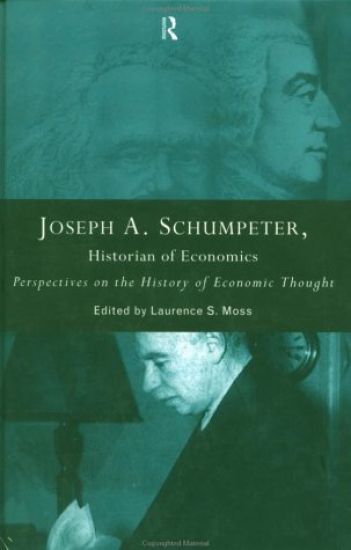
Joseph A. Schumpeter: Historian of Economics
Joseph A. Schumpeter was one of the great economists of the twentieth century. His History of Economic Analsyis is perhaps the greatest contribution to the history of economics, providing a magisterial account of the development of the subject from Ancient Greece to the mid-twentieth century. Schumpeter's views on his predecessors have proved to be a constant source of controversy. Here individual chapters examine such disparate questions as Schumpeter's apparent disregard for the American Institutionalists, his grudging respect for Adam Smith, the perspicacity of his views of Quesnay and his preference for Walras over Pareto. Four chapters are devoted to the early Medieval schools, neglected in all of his writings. Schumpeter's magnum opus is related to the rest of his economic output, especially his views on money and on methodology. With contributions by leading historians of economics from six countries, this volume analyses Schumpeter's contribution to the history of economics, considers its lasting significance, and uses it as a benchmark to assess the current state of the field.
Joseph A. Schumpeter: Historian of Economics
Joseph A. Schumpeter was one of the great economists of the twentieth century. His History of Economic Analsyis is perhaps the greatest contribution to the history of economics, providing a magisterial account of the development of the subject from Ancient Greece to the mid-twentieth century. Schumpeter's views on his predecessors have proved to be a constant source of controversy. Here individual chapters examine such disparate questions as Schumpeter's apparent disregard for the American Institutionalists, his grudging respect for Adam Smith, the perspicacity of his views of Quesnay and his preference for Walras over Pareto. Four chapters are devoted to the early Medieval schools, neglected in all of his writings. Schumpeter's magnum opus is related to the rest of his economic output, especially his views on money and on methodology. With contributions by leading historians of economics from six countries, this volume analyses Schumpeter's contribution to the history of economics, considers its lasting significance, and uses it as a benchmark to assess the current state of the field.
Joseph A. Schumpeter

Joseph A. Schumpeter

Princeton University Press
1991
pokkari
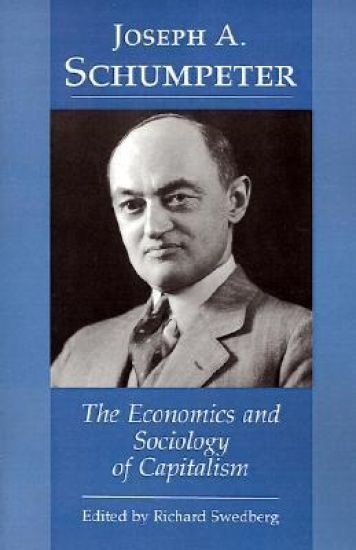
The renowned economist Joseph A. Schumpeter (1883-1950) made seminal contributions not only to economic theory but also to sociology and economic history. His work is now attracting wide attention among sociologists, as well as experiencing a remarkable revival among economists. This anthology, which serves as an excellent introduction to Schumpeter, emphasizes his broad socio-economic vision and his attempt to analyze economic reality from several different perspectives. An ambitious introductory essay by Richard Swedberg uses many new sources to enhance our understanding of Schumpeter's life and work and to help analyze his fascinating character. This essay stresses Schumpeter's ability to draw on several social sciences in his study of capitalism. Some of the articles in the anthology are published for the first time. The most important of these are Schumpeter's Lowell Lectures from 1941, "An Economic Interpretation of Our Time." Also included is the transcript of his lecture "Can Capitalism Survive?" (1936) and the high-spirited debate that followed. The anthology contains many of Schumpeter's classical sociological articles, such as his essays on the tax state, imperialism, and social classes. And, finally, there are lesser known articles on the future of private enterprise, on the concept of rationality in the social sciences, and on the work of Max Weber, with whom Schumpeter collaborated on several occasions.
Joseph A. Schumpeter

Joseph A. Schumpeter

Richard Swedberg

Polity Press
1993
nidottu
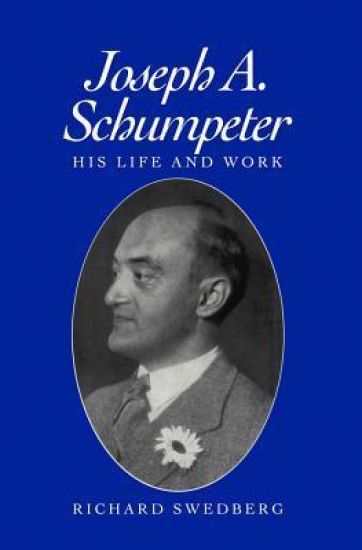
Joseph A. Schumpeter (1883-1950) is one of the most celebrated authors on the economics and sociology of the twentieth century. Richard Swedberg's new biography provides an engaging and vivid account of Schumpeter's varied life, including his ventures into politics and private banking as well as his academic career. As a backdrop to these, Swedberg also discusses Schumpeter's tragic personal life. This book provides a thorough overview of Schumpeter's writings, and also introduces previously unpublished material based on his letters and interviews. Swedberg emphasizes that Schumpeter saw economics as a form of social investigation, consisting of four fields: economic theory, economic sociology, economic history and statistics. The author describes and analyses Schumpeter's theory of social classes and modern states as well as his more famous theory of the entrepreneur.
Joseph A. Schumpeter

Joseph A. Schumpeter

John Medearis

Continuum International Publishing Group Ltd.
2009
sidottu
This is the fourth volume in the "Major Conservative and Libertarian Thinkers" series. Joseph Schumpeter (1883-1950) was one of the foremost economic thinkers of the twentieth century. Today Schumpeter is most well-known for his idea of 'creative destruction'. This is the notion that a market economy is simultaneously creative and destructive and therein lies the process of renewal that is central to the endurance and also the unpopularity of capitalism. Schumpeter's work also contains one of the most important conservative critiques of mass democracy. Schumpeter argued that mass democracy had totalitarian tendencies and was likely to degenerate into the tyranny of the popular.
Joseph A. Goulden [Another Isue] 1917
This work has been selected by scholars as being culturally important, and is part of the knowledge base of civilization as we know it. This work was reproduced from the original artifact, and remains as true to the original work as possible. Therefore, you will see the original copyright references, library stamps (as most of these works have been housed in our most important libraries around the world), and other notations in the work.This work is in the public domain in the United States of America, and possibly other nations. Within the United States, you may freely copy and distribute this work, as no entity (individual or corporate) has a copyright on the body of the work.As a reproduction of a historical artifact, this work may contain missing or blurred pages, poor pictures, errant marks, etc. Scholars believe, and we concur, that this work is important enough to be preserved, reproduced, and made generally available to the public. We appreciate your support of the preservation process, and thank you for being an important part of keeping this knowledge alive and relevant.
Joseph A. Schumpeter

Joseph A. Schumpeter

John Medearis

Bloomsbury Academic USA
2013
nidottu
Joseph Schumpeter (1883 - 1950) was one of the foremost economic thinkers of the twentieth century. Today Schumpeter is most well-known for his idea of 'creative destruction'. This is the notion that a market economy is simultaneously creative and destructive and therein lies the process of renewal that is central to the endurance and also the unpopularity of capitalism. Schumpeter's work also contains one of the most important conservative critiques of mass democracy. Schumpeter argued that mass democracy had totalitarian tendencies and was likely to degenerate into the tyranny of the popular.
Joseph: A Story of Divine Providence

Joseph: A Story of Divine Providence

Longacre Robert E.

EISENBRAUNS
2003
sidottu
In this fully revised, second edition of Joseph, A Story of Divine Providence, Robert Longacre approaches the Joseph story as a paradigm for an approach incorporating the interests of the Old Testament scholar and critic with the interests of the contemporary textlinguist. His study seeks to explore several questions: How does one approach an ancient text? What does one hope to gain from its study? How do we orient ourselves in regard to this story? Does our orientation provide a key to our understanding of the story or does it simply hinder our approaching the story in an unbiased and objective matter? The book is comprised of four parts, the first three exploring the connection Longacre seeks to establish between textlinguistics and biblical studies. The fourth part is a constituent display of the entire Joseph pericope. This new edition of Longacre’s landmark work incorporates a more user-friendly format, particularly noticeable in “Part 4: Constituent Display of Joseph.” The book also includes new textlinguistic insights and updated references.
Joseph: A Story of Divine Providence

Joseph: A Story of Divine Providence

Robert E. Longacre

Eisenbrauns
2003
pokkari
In this fully revised, second edition of Joseph, A Story of Divine Providence, Robert Longacre approaches the Joseph story as a paradigm for an approach incorporating the interests of the Old Testament scholar and critic with the interests of the contemporary textlinguist. His study seeks to explore several questions: How does one approach an ancient text? What does one hope to gain from its study? How do we orient ourselves in regard to this story? Does our orientation provide a key to our understanding of the story or does it simply hinder our approaching the story in an unbiased and objective matter? The book is comprised of four parts, the first three exploring the connection Longacre seeks to establish between textlinguistics and biblical studies. The fourth part is a constituent display of the entire Joseph pericope. This new edition of Longacre’s landmark work incorporates a more user-friendly format, particularly noticeable in “Part 4: Constituent Display of Joseph.” The book also includes new textlinguistic insights and updated references.
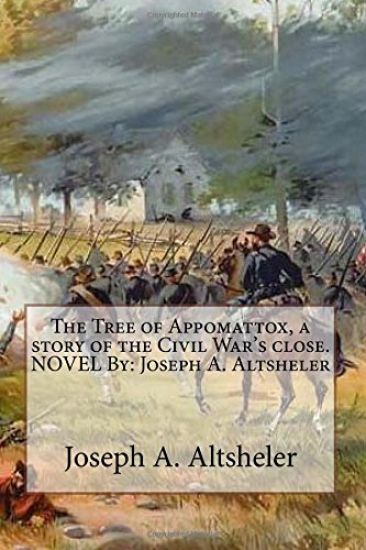
The Tree of Appomattox by Joseph A. Altsheler

The Tree of Appomattox by Joseph A. Altsheler

Joseph a. Altsheler

Independently Published
2019
nidottu
Joseph Alexander Altsheler (April 29, 1862 - June 5, 1919) was an American newspaper reporter, editor and author of popular juvenile historical fiction. He was a prolific writer, and produced fifty-one novels and at least fifty-three short stories. Thirty-two of his novels were part of his seven series: Although each of the thirty-two novels constitutes an independent story, Altsheler suggested a reading order for each series (i.e., he numbered the volumes). The remaining nineteen novels can be read in any order. Note, however, that A Knight of Philadelphia was later expanded through the addition of nineteen chapters and some minor tweaks to become Mr. Altsheler's novel The short stories, of course, can be read in any order. However, some readers might prefer to read them in the order in which they were published. The short story list below is displayed in chronological order with the publication dates shown alongside the titles.Early life and educationAltsheler was born in Three Springs, Hart County, Kentucky, to Joseph and Louise (n e Snoddy) Altsheler. He attended Liberty College in Glasgow, Kentucky, before entering Vanderbilt University.CareerIn 1885, he took a job at the Louisville Courier-Journal as a reporter and later worked as an editor. He started working for the New York World in 1892, first as the paper's Hawaiian correspondent and then as the editor of the World's tri-weekly magazine. Due to a lack of suitable stories, he began writing children's stories for the magazine