

Kirjahaku
Etsi kirjoja tekijän nimen, kirjan nimen tai ISBN:n perusteella.
1000 tulosta hakusanalla Juana Salamack



Juana By Honor de Balzac, Katharine Prescott Wormeley





Juana
Antigonos Verlag
2025
sidottu

Juana explores themes of love, sacrifice, and social struggle against the backdrop of war and societal expectations. The story follows a young woman, Juana di Mancini, the daughter of a courtesan lineage, who is raised in a virtuous merchant household to escape a troubled heritage. Set during the turbulent military conquest of Tarragona, the narrative introduces a soldier captivated by Juana's innocence and beauty. Their complex relationship unfolds amid the chaos of war and political intrigue, highlighting the conflict between personal desire and social duty. Juana's mother's past as a courtesan casts a long shadow, complicating Juana's path toward respectability. The novel vividly contrasts her purity with the harsh realities of her family's history and the ambitions of those around her. Themes of virtue and vice intertwine as Juana navigates love, deception, and loyalty. Ultimately, the story offers a poignant examination of a woman's struggle to reconcile her inherited legacy with her own aspirations within a changing world.

Juana inés De La Cruz and the Theology of Beauty
George H. Tavard
University of Notre Dame Press
1991
sidottu
With Juana Inés de la Cruz and the Theology of Beauty, George H. Tavard presents the first thorough investigation of the theology of the greatest Latin American poet before our own time. HIs program is all the more important because she was the first woman of this continent to assert the right of women to study to the full extent of their capacities. An intelligent and intellectual woman, Juana Inés was eager to live a life of scholarship and felt "a great aversion to matrimony," which directed her to enter the convent in 1667. Tavard provides a thought-provoking analysis both of the theological ideas that Juana Inés expressed in poetry and prose and of the conclusions, provisional or definitive, she may have reached about herself and about humanity. Through a close study of many of her clearly authenticated works—her didactic poem, Primero Sueño (First Dream); her poems in honor of the saints; her religious drama; her poems in honor of Christ and the Virgin; her lyric verse on devotional themes; and her prose writings on religious topics--Tavard draws out Sor Juana's conception of the world and the soul, her ideas about the saints, her understanding of the Virgin, and her Christology. He offers a coherent theological and spiritual argument for Juana's renunciation of further writing in 1692. In discussing the shape of her theological imagination, Tavard concludes that for Juana, "the physical and spiritual beauty of creatures, a gift of God's love, acts as a theopany" through which divine glory is perceived.
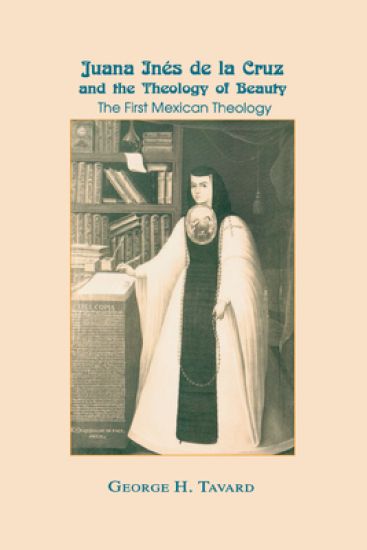
Juana inés De La Cruz and the Theology of Beauty
George H. Tavard
University of Notre Dame Press
2004
nidottu
With Juana Inés de la Cruz and the Theology of Beauty, George H. Tavard presents the first thorough investigation of the theology of the greatest Latin American poet before our own time. HIs program is all the more important because she was the first woman of this continent to assert the right of women to study to the full extent of their capacities. An intelligent and intellectual woman, Juana Inés was eager to live a life of scholarship and felt "a great aversion to matrimony," which directed her to enter the convent in 1667. Tavard provides a thought-provoking analysis both of the theological ideas that Juana Inés expressed in poetry and prose and of the conclusions, provisional or definitive, she may have reached about herself and about humanity. Through a close study of many of her clearly authenticated works—her didactic poem, Primero Sueño (First Dream); her poems in honor of the saints; her religious drama; her poems in honor of Christ and the Virgin; her lyric verse on devotional themes; and her prose writings on religious topics--Tavard draws out Sor Juana's conception of the world and the soul, her ideas about the saints, her understanding of the Virgin, and her Christology. He offers a coherent theological and spiritual argument for Juana's renunciation of further writing in 1692. In discussing the shape of her theological imagination, Tavard concludes that for Juana, "the physical and spiritual beauty of creatures, a gift of God's love, acts as a theopany" through which divine glory is perceived.