Kirjojen hintavertailu. Mukana 11 244 527 kirjaa ja 12 kauppaa.

Kirjahaku

Etsi kirjoja tekijän nimen, kirjan nimen tai ISBN:n perusteella.

1000 tulosta hakusanalla Judith Blau; Alberto Moncada

Human Rights

Human Rights

Judith Blau; Alberto Moncada

Rowman Littlefield Publishers
2005
nidottu
There is growing recognition around the globe that people's fundamental human rights are being imperiled in a world economy that is being driven by multinationals, investors, and banks. The 'race to the bottom' and insatiable greed has intensified poverty and economic inequalities, fueled migration, and rapidly accelerated environmental degradation. The fates of all nations are interdependent and even though the U.S. is the prime driver of the new economy, Americans have likewise experienced declines over the past decades. Blau and Moncada outline the fundamental human rights that all people are entitled to and the important role that nations have in upholding these rights. Americans find it somewhat difficult to accept the basic premise of human rights because liberalism, as a social, political, and economic ethos powerfully undercuts the premise of human rights. American liberalism highlights the efficacy of individual achievement and individual autonomy, thereby promoting the idea that people have no rights to security. . Human rights, in contrast to the liberal ethos, asserts that all humans have inalienable rights, including rights to a job, housing, social security, education, and a cultural, racial or ethnic identity. Under the conditions of a turbulent global economy, human rights need to be granted the highest standing. The authors consider global capitalism, as well as the role of the global media, and the problematic relationship between the state and society in America. In the final chapter, we review the many currents of transformative movements that are promoting a more equitable, fairer, and more egalitarian world.
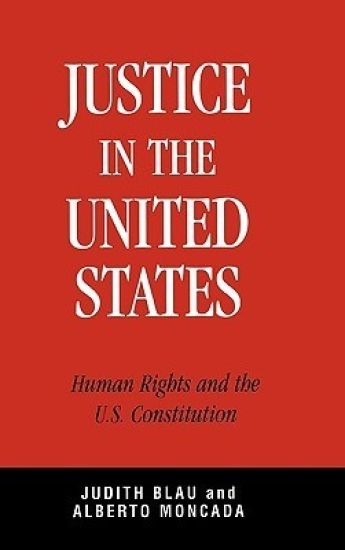
Justice in the United States

Justice in the United States

Judith Blau; Alberto Moncada

Rowman Littlefield Publishers
2006
sidottu
Justice in the U.S. is a sequel to Human Rights: Beyond the Liberal Vision, and the second in a trilogy on human rights. The Bill of Rights of the U.S. Constitution explicitly clarifies the personal political and civil rights of persons, and by court interpretation, the rights of corporations. Yet in the twentieth century, following World War II, most world leaders reached the conclusion that political and civil rights were not sufficient and they had to be supplemented with additional rights that would protect their citizens and create more robust societies. By the end of the century, most countries had amended their constitutions to include many other rights, notably those pertaining to social security, health care, housing, decent jobs, women, minorities, cultural and language rights, and environmental protections. This amounted to nothing less than a worldwide constitutional revolution, but it has gone largely unnoticed in the United States. In this volume, the authors compare the constitutional provisions of different nation-states and summarize some of the relevant United Nations' human rights declarations and treaties. To encourage US citizens to think critically about their Constitution in light of the constitutions of other states, the authors present a draft revision of the U.S. Constitution. Of course, revision of the Constitution must be a comprehensively a democratic process, and the authors wish to show how this process might begin.
Freedoms and Solidarities

Freedoms and Solidarities

Judith Blau; Alberto Moncada

Rowman Littlefield Publishers
2007
sidottu
Much has been written about growing global disparities in wealth and resources, how global capitalism has adversely affected human populations and the environment, and the dangers that a unipolar world order poses to peace and global pluralism. After summarizing the evidence for these arguments, the authors develop two main themes: first, that there is a growing transformative peoples' movement that challenges global capitalism and the imperial superpower; and, second, there is an extraordinary worldwide shift underway in human consciousness that accompanies practical global interdependencies and connectedness. The authors provide evidence for an emerging foundation of what philosopher Peter Singer describes as a 'one-world ethic,' and they show how this ethic is closely connected with what is called the 'human rights revolution.' They compare the western, liberal conception of freedom with conceptions of freedom found in the writings of Jean-Paul Sartre and Amartya Sen, and draw from Hannah Arendt's The Human Condition to clarify that freedom has both collective and individual dimensions. They build on these foundations to address the following topics: positive human rights, collective goods, cosmopolitanism, social and cultural pluralism, and they pose alternatives to capitalism and liberal democracy. The authors work in the tradition of critical social science, but go beyond that to encourage readers to engage in emancipatory projects and utopian thinking. The worlds' peoples face too many terrifying prospects not to engage such projects and thinking.
Freedoms and Solidarities

Freedoms and Solidarities

Judith Blau; Alberto Moncada

Rowman Littlefield Publishers
2007
nidottu
Much has been written about growing global disparities in wealth and resources, how global capitalism has adversely affected human populations and the environment, and the dangers that a unipolar world order poses to peace and global pluralism. After summarizing the evidence for these arguments, the authors develop two main themes: first, that there is a growing transformative peoples' movement that challenges global capitalism and the imperial superpower; and, second, there is an extraordinary worldwide shift underway in human consciousness that accompanies practical global interdependencies and connectedness. The authors provide evidence for an emerging foundation of what philosopher Peter Singer describes as a "one-world ethic," and they show how this ethic is closely connected with what is called the "human rights revolution." They compare the western, liberal conception of freedom with conceptions of freedom found in the writings of Jean-Paul Sartre and Amartya Sen, and draw from Hannah Arendt's The Human Condition to clarify that freedom has both collective and individual dimensions. They build on these foundations to address the following topics: positive human rights, collective goods, cosmopolitanism, social and cultural pluralism, and they pose alternatives to capitalism and liberal democracy. The authors work in the tradition of critical social science, but go beyond that to encourage readers to engage in emancipatory projects and utopian thinking. The worlds' peoples face too many terrifying prospects not to engage such projects and thinking.
Leading Rogue State

Leading Rogue State

Judith R. Blau; David L. Brunsma; Alberto Moncada; Catherine Zimmer

Paradigm
2008
sidottu
Most Americans would be surprised to learn that their government has declined to join most other nations in UN treaties addressing inadequate housing, poverty, children's rights, health care, racial discrimination, and migrant workers. Yet this book documents how the U.S. has, for decades, declined to ratify widely accepted treaties on these and many other basic human rights. Providing the first comprehensive topical survey, the contributors build a case and specific agendas for the nation to change course and join the world community as a protector of human rights.
Leading Rogue State

Leading Rogue State

Judith R. Blau; David L. Brunsma; Alberto Moncada; Catherine Zimmer

Paradigm
2009
nidottu
Most Americans would be surprised to learn that their government has declined to join most other nations in UN treaties addressing inadequate housing, poverty, children's rights, health care, racial discrimination, and migrant workers. Yet this book documents how the U.S. has, for decades, declined to ratify widely accepted treaties on these and many other basic human rights. Providing the first comprehensive topical survey, the contributors build a case and specific agendas for the nation to change course and join the world community as a protector of human rights.
Crimes Against Humanity

Crimes Against Humanity

Judith Blau

Routledge
2018
sidottu
The author is a sociologist who has written extensively on human rights and recently on climate change. In her new book she develops the idea that protecting everyone’s human rights and slowing planetary warming are the same goals. It is now clear that the leader of the richest, most powerful country in the world – United States President Donald J. Trump - has set the trigger of destruction by exempting the United States from the international treaty that aims to give the entire planet some reprieve from warming. That is, all countries of the world have entered into an agreement to end reliance on fossil fuels, except the United States, which withdrew at the outset of the Trump Administration. Regardless of the US position in the future, the country’s emissions are so very extremely high they will continue to wreck havoc on the entire world. While Blau maintains that President Trump has committed a crime against Humanity, even beyond his tenure the book sets the stage for a human rights approach to climate change for the future.
Crimes Against Humanity

Crimes Against Humanity

Judith Blau

Routledge
2018
nidottu
The author is a sociologist who has written extensively on human rights and recently on climate change. In her new book she develops the idea that protecting everyone’s human rights and slowing planetary warming are the same goals. It is now clear that the leader of the richest, most powerful country in the world – United States President Donald J. Trump - has set the trigger of destruction by exempting the United States from the international treaty that aims to give the entire planet some reprieve from warming. That is, all countries of the world have entered into an agreement to end reliance on fossil fuels, except the United States, which withdrew at the outset of the Trump Administration. Regardless of the US position in the future, the country’s emissions are so very extremely high they will continue to wreck havoc on the entire world. While Blau maintains that President Trump has committed a crime against Humanity, even beyond his tenure the book sets the stage for a human rights approach to climate change for the future.
The Paris Agreement

The Paris Agreement

Judith Blau

Springer International Publishing AG
2017
sidottu
This book discusses the immediate and severe threat posed by global climate change and the various obstacles that stand in the way of action. Judith Blau presents scientific evidence relevant to The Paris Agreement (COP-21): an international treaty that promises to strengthen the global response to climate change. As she reckons with the dangers of catastrophic planetary heating, Blau discusses the clash between the deeply ingrained American tradition of individualism and the collective action and acknowledgement of intertwined fate needed to address climate change. She acknowledges that America’s capitalist bent stands in contrast to the idea of the “commons”—a concept that we need to embrace if climate change is to be mitigated. The volume also explains the foundations of international human rights standards as they relate to climate change. Drawing from guiding principles of human rights and equality, the book concludes hopefully—suggesting that the people of the world canmeet the challenge posed by climate change by at once acknowledging shared humanity and celebrating difference.
Human Rights

Human Rights

Judith Blau; Louis Edgar Esparza

Routledge
2016
sidottu
Human Rights: A Primer breaks new ground in clarifying for undergraduates the international significance of human rights. This new edition highlights current and recent developments, using themes familiar to undergraduates. For example, Americans are increasingly aware of the growing disparities in economic well-being. It is indeed a crisis that is global and national. Because this book focuses on globalization and human rights as intertwined, readers will gain a comprehensive understanding of the role of neoliberal capitalism in undermining human rights (dignity, security, and well-being). Major works by Thomas Piketty and Joseph Stiglitz are discussed, along with recent upheavals in Greece, and the rising tide of refugees in Europe and North America. Furthermore, powerful forces that will increasingly test global solidarity and the future of the planet relate to the extent that countries and peoples cooperate in combating global warming and promoting sustainable development goals (SDGs). Key dates for both these issues occurred in the second half of 2015 – the UN Sustainable Development Summit in September and the Paris Climate Conference (COP21) in December. The significance of both conferences for human rights is discussed in this new edition.
Human Rights

Human Rights

Judith Blau; Louis Edgar Esparza

Routledge
2016
nidottu
Human Rights: A Primer breaks new ground in clarifying for undergraduates the international significance of human rights. This new edition highlights current and recent developments, using themes familiar to undergraduates. For example, Americans are increasingly aware of the growing disparities in economic well-being. It is indeed a crisis that is global and national. Because this book focuses on globalization and human rights as intertwined, readers will gain a comprehensive understanding of the role of neoliberal capitalism in undermining human rights (dignity, security, and well-being). Major works by Thomas Piketty and Joseph Stiglitz are discussed, along with recent upheavals in Greece, and the rising tide of refugees in Europe and North America. Furthermore, powerful forces that will increasingly test global solidarity and the future of the planet relate to the extent that countries and peoples cooperate in combating global warming and promoting sustainable development goals (SDGs). Key dates for both these issues occurred in the second half of 2015 – the UN Sustainable Development Summit in September and the Paris Climate Conference (COP21) in December. The significance of both conferences for human rights is discussed in this new edition.
Climate Chaos and its Origins in Slavery and Capitalism
Climate Chaos provides readers the latest consensus among international scientists on the cascading impacts of climate change and the tipping points that today threaten to irreversibly destroy the delicate balance of the Earth’s ecosystems. The book argues that deregulation and an expansion of fossil fuel extraction have already tipped the planet towards a climate that is out of control. This crisis will cause massive human suffering when extreme weather, pollution and disease lead to displacement, food and water shortages, war, and possibly species extinction. The repression of science creates an existential crisis for humanity that has reached crisis proportions in the twentieth-first century. The scale of the crisis has prompted a call for geoengineering, large interventions into the climate by technological innovation. However, the history of colonialism and slavery make the technological and monetary elites untrustworthy to solve this humanitarian and planetary crisis. While the elites have always cast certain groups of humanity as expendable, the climate crisis makes a true humanist and egalitarian movement based in human rights and dignity not only aspirational but also existentially mandatory. The crisis demands that we remake the world into a more just and safe place for all the world’s people.
Blau steht dir nicht

Blau steht dir nicht

Judith Schalansky

mareverlag GmbH
2008
sidottu
Eine Kindheit am Meer. Eine Sehnsucht nach Freiheit. Die Ahnung, dass Freiheit einen Preis hat. Judith Schalansky erzählt in ihrem eindringlichen Romandebüt vom Aufwachsen an der Ostseeküste in der DDR, dort ?wo andere Urlaub machen?. Und von den Reisen der erwachsenen Ich-Erzählerin nach Russland und in die USA, wo sie dem Geheimnis ihrer Liebe zum Matrosenanzug nachspürt.
The Shape of Culture

The Shape of Culture

Judith R. Blau

Cambridge University Press
1992
pokkari
This book systematically examines prevailing cultural patterns in contemporary American society. Using information on several thousands of cultural organisations, including elite ones (such as opera and chamber music companies) and popular cultural ones (such as cinemas and live rock concerts), Professor Blau examines the geography of culture, the changing demands for culture, the interdependencies among cultural organisations of different kinds, the nature of labour markets for artists, and the effects of arts subsidies on nonprofit cultural establishments over a ten year period. One of the major conclusions of the book is that the social conditions that support elite and popular culture are increasingly similar over time.
Judith

Judith

Carey A. Moore

Yale University Press
2007
pokkari
Judith is Volume 40 in the acclaimed anchor Bible series of new book-by-book translations of the Old and New Testaments and Apocrypha. In the Apocrypha, Judith is the saint who murdered for her people. She offered herself to Holofernes, the Assyrian general sent by Nebuchadnezzar to destroy the Israelites. After she had charmed Holofernes with flattery and drink, Judith chopped of his head while he lay in a drunken stupor, thereby leaving his troops “headless” and in a state of total panic and confusion. Her victory was celebrated in song and brought peace to her land for years to come. In his illuminating new translation and commentary, Carey A. Moore considers the historicity of the story and explores the author’s true intent: Was it to describe actual events or to compose a fictitious story of other purposes? Was his concern more historical or theological? The story of Judith abounds in ironies. There is Judith, the beautiful woman who lived a stark, celibate existence after her husband’s death had left her a wealthy widow. Born into a sexist society with rigidly defined roles, Judith better “played the man” than did any of her male compatriots. There is Holofernes, the Assyrian conqueror, unable to defeat a small Israelite village after dozens of countries had fallen under his sword. Intent on seducing Judith, Holofernes instead lost his head to her. Perhaps the ultimate irony of all is the story of Judith itself: the timeless tale of a deeply religious woman who became revered not for her poverty but for an act of murder. Dr. Moore’s study of the canonicity of Judith brings perspective to the story’s varied acceptance among both Jews and Christians. It also notes the similarity between this work and the equally popular story of Esther; each woman, through different means, served her people through acts of bravery. The photographs and maps illustrating Judith include depictions of the story of Judith by such masters as Machiavelli, Botticelli, Caravaggio, and Donatello.
Judith

Judith

Jennifer Johnston

Jennifer Johnston
2023
pokkari
The 1960s was a time when Australia was changing and the old ways were being left behind. At 21 Judith is ready to conquer the world, she has a new job working for the government, and a new life ahead of her that will test her resolve. Moving to the city will take her from naive romantic notions and the protection of small town living to discovering that around the corner life's twists and turns carry you along paths you never anticipated. The communist movement is looking for converts to infiltrate the government. Will they draw her in? Women are living and loving more freely. Will she ignore the promises she made and allow the lure of this new life to change her? Will she find romance or tragedy? What will her family think if she tells them? She will need wisdom, courage and faith for the journey as the road to independence always comes at a price.