Cosmology and theology share a long held relationship with one another, explaining as they do the constitution of the World and the interaction of forces. The author explores the history of this relationship, from ancient pre-scientific and theological, explanations through to contemporary science and philosophy. In this history, a particular problem is highlighted by the author: the prevalence of dualism; from Aristotelian philosophy to modern mechanistic conceptions, many of these accounts presume a sharp, absolute dichotomy between matter and spirit, and the material world and the divine. Increasingly, dualistic conceptions are called into question by contemporary science, theology, and philosophy. The author argues that a particular trajectory stemming from Greek Heraclitian and Platonic philosophy to non-orthodox and early Christian theologies provides a fruitful resource for contemporary discussions. This is the Logos theology and its attendant language of light. The author brings this tradition into dialogue with contemporary science and theology to construct an integrative account.
Get everything you need to create and customize effective nursing care plans, now with evidence-based ICNP® diagnoses! Covering the most common medical-surgical nursing diagnoses and clinical problems, Gulanick & Myers' Nursing Care Plans: Diagnoses, Interventions, and Outcomes, 10th Edition features more than 200 care plans, each reflecting the latest evidence-based guidelines and national and international treatment protocols. It also features highlighted QSEN competencies and a clear differentiation of nursing and collaborative interventions. New to this edition are ICNP® diagnoses, care plans on LGBTQ health issues and on electrolytes and acid-base balance, and a new Online Care Planner that makes it easier than ever to customize care plans. Written by noted educators Meg Gulanick and Judith L. Myers, this #1 care planning book will help you learn to think like a nurse! 61 patient problem care plans include the most common/important patient problems, providing the building blocks for you to create your own individualized care plans. 164 disorder care plans cover virtually every common medical-surgical condition, organized by body system. Patient problem care plan format includes a definition/explanation of the diagnosis, related factors, defining characteristics, expected outcomes, ongoing assessment, and therapeutic interventions. Disorder care plan format covers synonyms for the disorder (for ease in cross referencing), a definition, common related factors, defining characteristics, expected outcomes, ongoing assessment, and therapeutic interventions for each relevant nursing diagnosis. Prioritized care planning guidance internally organizes care plans from "actual" to "risk" diagnoses, from general to specific interventions, and from independent to collaborative/interprofessional interventions, to help you select the most important, priority interventions for your particular patients. NEW! Updated care plans are now based on the evidence-based, complete, and internationally accepted International Classification of Nursing Practice (ICNP®) nursing diagnoses. NEW! 19 all-new care plans are featured in this edition. NEW! Updated content throughout reflects the most current evidence-based practice and national and international guidelines. NEW! Online Care Planner on the Evolve website allows you to easily generate customized care plans based on the book's content. NEW! Improved focus on core content includes several care plans that have been moved from the book's Evolve website.
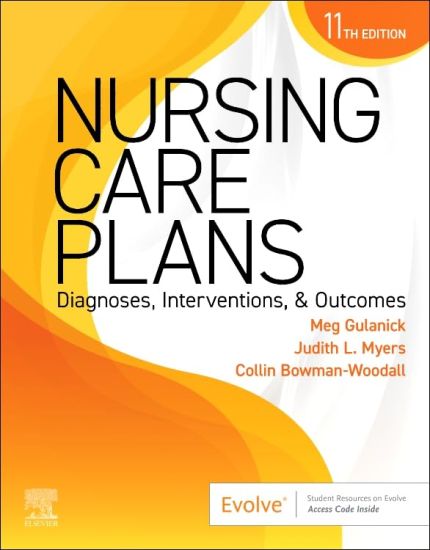
**Selected for 2025 Doody’s Core Titles® in Diagnosis/Assessment** Master the skills you need to create customized nursing care plans! Covering the most common medical-surgical nursing diagnoses and clinical problems, Nursing Care Plans: Diagnoses, Interventions, and Outcomes, 11th Edition features 232 care plans, each reflecting the latest evidence-based guidelines and national and international treatment protocols. It also features ICNP diagnoses, highlighted QSEN competencies, and a clear differentiation of nursing and collaborative interventions. New to this edition are a full-color format, seven new care plans, and a new online care plan template that makes it easier to create care plans. The #1 care planning book is better than ever and will help you learn to think like a nurse! NEW! Seven additional care plans cover: Impaired Skin Integrity Infection Underweight Overflow Incontinence of Urine Eating Disorders Brain Tumor Pancreatic Cancer NEW! Fully updated coverage includes the latest therapeutic interventions and rationales NEW! Full-color format makes this text more user-friendly and accessible UPDATED! Using Nursing Care Plans to Individualize and Improve Care chapter features more illustrations to help you understand the components of a care plan, as well as how to prioritize those which are most appropriate for your patients UPDATED! Content reflects the most current evidence-based practice and national and international clinical practice guidelines Care plans for 77 “clinical problems” (formerly “nursing diagnoses”) use a conceptual model organization and include the most common/important patient problems, providing the building blocks for creating your own individualized care plans Care plans for 155 disorders encompass virtually every common medical-surgical condition, organized by body system Prioritized care planning guidance internally organizes care plans from "actual" to "risk for" clinical problems, from general to specific interventions, and from independent to collaborative/interprofessional interventions to help you prioritize the most important, therapeutic interventions Care plan format for clinical problems includes a definition/explanation of the diagnosis, common etiologies, supporting data, expected outcomes, ongoing assessment, and therapeutic interventions Care plan format by disorder includes synonyms for the disorder (for ease in cross referencing), a definition, common etiologies, supporting data, expected outcomes, ongoing assessment, and therapeutic interventions for each relevant clinical problem NEW! Care plan template on the Evolve companion website gives you a starting point for creating your own plans of care
An outstanding resource for students and practicing nurses, the Ninth Edition of Lippincott’s Manual of Psychiatric Nursing Care Plans contains 52 nursing care plans that address the most commonly encountered behaviors in psychiatric–mental health nursing. An excellent tool to introduce students to clinical psychiatric experience, the Manual demonstrates use of the nursing process in psychiatric nursing and gives suggestions for specific interventions—with rationale—to address particular behaviors, giving the student a sound basis on which to build clinical skills. Covering a range of problems and a variety of approaches, the care plans are meant to be adapted and individualized in planning nursing care for each client. The Ninth Edition has been thoroughly updated and includes new information on complementary and alternative medicine and using the internet; as well as new or expanded appendices on psychopharmacology; side effects of medications and related nursing interventions; and schizoid, histrionic, narcissistic, and avoidant personality disorders.
The deeply moving, untold story of America’s greatest twentieth-century novelist and the three women at the center of his imaginative life This book is about the making of the writer William Faulkner. It is the first to inquire into the three most important women in his life—his black and white mothers, Caroline Barr and Maud Falkner, and the childhood friend who became his wife, Estelle Oldham. In this new exploration of Faulkner’s creative process, Judith L. Sensibar discovers that these women’s relationships with Faulkner were not simply close; they gave life to his imagination. Sensibar brings to the foreground—as Faulkner did—this “female world,” an approach unprecedented in Faulkner biography.Through extensive research in untapped biographical sources—archival materials and interviews with these women's families and other members of the communities in which they lived—Sensibar transcends existing scholarship and reconnects Faulkner’s biography to his work. She demonstrates how the themes of race, tormented love, and addiction that permeated his fiction had their origins in his three defining relationships with women. Sensibar alters and enriches our understanding not only of Faulkner, his art, and the complex world of the American South that came to life in his brilliant fiction but also of darknesses, fears, and unspokens that Faulkner unveiled in the American psyche.
This volume consists of a series of essays inspired by Freud's paper on Jensen's novel Gradiva - "she who steps along." In the story a young archaeologist, Norbert Hanold, suffers from delusions but is able to unravel the mysteries of his emotional life and mind with the aid of a woman who does not challenge these delusions, but rather "steps along" with Hanold, gradually helping him to disentangle truth from fantasy, through what Freud called "cure by love". Gradiva, originally felt to be the source of Hanold's malady, eventually becomes the agent of its resolution and of his return to health. This extraordinary tale formed the basis for the author's concept of "taking the transference". Through clinical vignettes, various aspects of psychoanalytic technique - useful from the first encounter between patient and analyst and throughout the process of the development of mind to termination - are illustrated in detail.
An extraordinary depiction of one analyst's efforts to receive and respond to the vivid impressions of her patients raw and sometimes even unmentalized experiences as they are highlighted in the transference-countertransference connection. Mitrani attempts to feel, suffer, mentally transform, and, finally, verbally construct for and with the patient possible meanings for those immediate versions of lifes earliest experiences as they are re-enacted in the therapeutic relationship. She uses insights from this therapeutic work to contribute to the metapsychology of British and American object relations as well as to the psychoanalytic theory of technique. In these eleven essays, Dr Mitrani masterfully integrates the work of Klein, Winnicott, Bion and Tustin as she leads us on an expedition through primitive emotional territories. She clears the way toward detecting and understanding the survival function of certain pathological manoeuvres deployed by patients when confronted by unthinkable anxieties. In her vivid accounts of numerous clinical cases, she provides and demonstrates the tools needed to effect a transformation of unmentalized experiences within the context of the therapeutic relationship.
Drawing on the rhetorical work of James Phelan, Wayne Booth's ethical criticism, recent work on William Makepeace Thackeray, as well as an understanding of the role of skepticism in eighteenth- and nineteenth-century English thought, Thackeray's Skeptical Narrative and the "Perilous Trade" of Authorship makes a substantial contribution to nineteenth-century reading practices, as well as narratology in general. Judith Fisher combines in this study rhetorical and ethical analysis of Thackeray's narrative techniques to trace how his fiction develops to educate his reader into what she terms a "hermeneutic of skepticism." This is a kind of poised reading which enables his readers to integrate his fiction into their life in what Thackeray called "a world without God" without becoming pessimistic or fatalistic. Although Thackeray's narrative strategies have been the subject of study, most have focused on Vanity Fair and Henry Esmond only, and none look as closely as does this study at actual rhetorical techniques such as his use of pronominalization to interpolate the reader into his skeptical discourse. Fisher also brings her analysis to bear on The Adventures of Philip and The Virginians, Thackeray's last two complete novels, both of which were critical failures even as contemporary critics acknowledged their stylistic excellence. This is the first study to attempt to understand the puzzle of those two books; Fisher recovers them from their marginalized position in Thackeray's oeuvre. Fisher expertly weaves an accessible narrative theory with thoroughgoing knowledge of Thackeray's life in an integrated reading of his entire works. Reading Thackeray holistically in spite of his own disruptive practices, she does full justice to his critical skepticism while elucidating his canon for a new readership.
How can managers motivate their employees? After conducting detailed field studies of work groups in settings as diverse as insurance company offices and regatta sailboats, Judith Komaki has identified two key behaviours that seem to distinguish effective from ineffective managers; monitoring workers' performance and communicating consequences. Drawing on her research over the last ten years, Komaki combines behavioural and cognitive theories of leadership and puts forward a new model for the study of leadership from an operant perspective.
Many people come to analysis appearing quite 'ordinary' on the surface. However, once below that surface, we often come into contact with something quite unexpected: 'extra-ordinary protections' created to keep at bay any awareness of deeply traumatic happenings occurring at some point in life.Judith Mitrani investigates the development and the function of these protections, allowing the reader to witness the evolution of the process of transformation, wherein defensiveness steadily mutates into communication.She lucidly and artfully weaves detailed clinical with a variety of analytic concepts, and her original notions - including 'unmentalized experience' and its expression in enactments; 'adhesive pseudo-object relations' and the way in which this contracts and compares with normal and narcissistic object relations - provide valuable tools for understanding the infantile transference/countertransference and for the refinement of our technique with primitive mental states.Ordinary People and Extra-Ordinary Protections will prove stimulating and accessible in its style and substance to a broad analytic readership, from the serious student of psychoanalysis to the most seasoned professional.
At a time when debate over school reform commands unprecedented attention, Judith L. Pace argues we must grapple with the underlying challenges of classroom teaching and, at the same time, strive to realize the ideals of democratic education. Building on three qualitative studies in grades four through twelve, The Charged Classroom examines the deeply embedded tensions, escalating pressures, and exciting possibilities of the contemporary American public school classroom. Through detailed descriptions and analyses of social studies and English language arts classrooms, Pace disentangles how teachers and students navigate three charged arenas: academic expectations, discussion of provocative topics, and curricular demands. In each domain, democratic learning opportunities, such as promotion of positive student identity, dialogue across differences, and exploration of conflict, are both opened up and closed down. A passionate and persuasive call for education reform, the book offers crucial insights about the realities of teaching and key recommendations for advancing democratic education in a multicultural society.
At a time when debate over school reform commands unprecedented attention, Judith L. Pace argues we must grapple with the underlying challenges of classroom teaching and, at the same time, strive to realize the ideals of democratic education. Building on three qualitative studies in grades four through twelve, The Charged Classroom examines the deeply embedded tensions, escalating pressures, and exciting possibilities of the contemporary American public school classroom. Through detailed descriptions and analyses of social studies and English language arts classrooms, Pace disentangles how teachers and students navigate three charged arenas: academic expectations, discussion of provocative topics, and curricular demands. In each domain, democratic learning opportunities, such as promotion of positive student identity, dialogue across differences, and exploration of conflict, are both opened up and closed down. A passionate and persuasive call for education reform, the book offers crucial insights about the realities of teaching and key recommendations for advancing democratic education in a multicultural society.
In this classic study of Obsessive-Compulsive Disorder (OCD), a distinguished psychiatrist offers hope and help for those suffering from mental illness, suggesting pathways forward through behavioral therapies and mediation. Drawing on the extraordinary experiences of her patients, Dr. Judith Rapoport unravels the mysteries surrounding OCD, an emotionally crippling affliction that affects millions of Americans. The Boy Who Couldn't Stop Washing follows Dr. Rapaport's patient, the pseudonymous "David," who developed such severe OCD symptoms that he spent so long each day washing himself and cleaning his home that he could no longer keep a job. Through the example of her treatment of "David," Dr. Rapoport explores the ways in which OCD manifests, how it affects individuals and their families, and the treatment options available to those who suffer from this mental illness. Revealing breakthroughs in diagnosis, therapies, and medication, as well as offering guidelines for diagnosis, resources, and references, Dr. Rapaport offers hope and practical advice for those seeking help for themselves or their loved ones with OCD.
In this classic study of Obsessive-Compulsive Disorder (OCD), a distinguished psychiatrist offers hope and help for those suffering from mental illness, suggesting pathways forward through behavioral therapies and mediation. Drawing on the extraordinary experiences of her patients, Dr. Judith Rapoport unravels the mysteries surrounding OCD, an emotionally crippling affliction that affects millions of Americans. The Boy Who Couldn't Stop Washing follows Dr. Rapaport's patient, the pseudonymous "David," who developed such severe OCD symptoms that he spent so long each day washing himself and cleaning his home that he could no longer keep a job. Through the example of her treatment of "David," Dr. Rapoport explores the ways in which OCD manifests, how it affects individuals and their families, and the treatment options available to those who suffer from this mental illness. Revealing breakthroughs in diagnosis, therapies, and medication, as well as offering guidelines for diagnosis, resources, and references, Dr. Rapaport offers hope and practical advice for those seeking help for themselves or their loved ones with OCD.
This Collection of Poems honors more of the remarkable strong Women of the West. Those amazing souls who bravely worked to build new towns and churches and businesses while keeping their families safe and together. Many faced poverty and loss still they forged on in faith and fortitude. The stories of Lady In Boomtown, Sheriff Dorothy & Lone Pine Pat make up the true tales of the West all too often left out of the history books.
On a ten-day a visit to San Miguel de Allende, Judith Gille falls in love...with a hot pink house on a rundown alleyway. Without consulting her husband or knowing how she's going to pay for it, she makes the owners a full price offer. Despite a rough start in the new culture, Gille and her family eventually befriend their neighbors on callej n de Chepito and form a close bond with the Cordova clan. As their affection for the lively Mexican family grows, so do the complications of their cross-cultural relationship. When the oldest daughter seeks to cross the border illegally, the lives of the two families become inextricably entwined. The View from Casa Chepitos puts a human face on the immigration controversy and paints an intimate portrait of Mexican life. But the story also explores the deeper issues women of all ages and cultures face: affirming their self-worth and purpose, building enduring relationships, and discovering where it is they truly belong. -------------------------------------------------------------------------------------------------------------------------------------------