Regionally distinct yet influenced by national trends, women's progressive culture in Texas offers a valuable opportunity to analyze the evolution of women's voluntary associations, their challenges to southern conventions of race and class, and their quest for social change and political power. Judith McArthur traces how general concerns of national progressive organizations about pure food, prostitution, and education reform shaped programs at the state and local levels. Southern women differed from their Northern counterparts by devising new approaches to settlement work and taking advantage of World War I to challenge southern gender and racial norms. McArthur's original analysis details how women in Texas succeeded in securing partial voting rights before passage of the Nineteenth Amendment. She also provides valuable comparisons between North and South, among various southern states, and between black and white, and male and female, progressives.
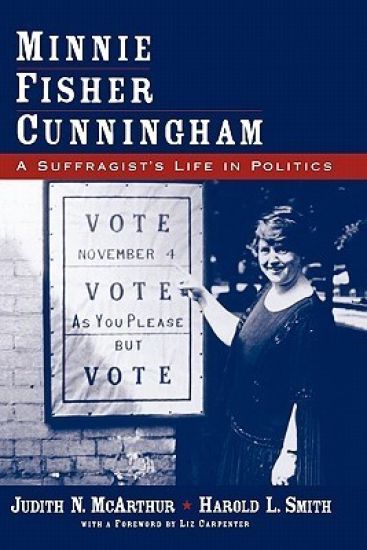
Minnie Fisher Cunningham was Texas's most important female political activist. After directing Texas's womans suffrage campaign, she helped establish the National League of Women Voters and the Woman's National Democratic Club. After an unsuccessful attempt to gain election to the US Senate, Cunningham evolved into a left feminist, increasingly aware that women could be oppressed by class and race as well as by gender. A leader of the post-1945 Texas liberal movement, she inspired a generation of young women, including Liz Carpenter and Billie Carr. This is the first biography of the lifelong politician affectionately known as Minnie Fish.
The principal orchestrator of the passage of women's suffrage in Texas, a founder and national officer of the League of Women Voters, the first woman to run for a U.S. Senate seat from Texas, and a candidate for that state's governor, Minnie Fisher Cunningham was one of the first American women to pursue a career in party politics. Cunningham's professional life spanned a half century, thus illuminating our understanding of women in public life between the Progressive Era and the 1960s feminist movement. Cunningham entered politics through the suffrage movement and women's voluntary association work for health and sanitation in Galveston, Texas. She quickly became one of the most effective state suffrage leaders, helping to pass the bill in a region where opposition to women voters was strongest. In Washington, Cunningham was one of the core group of suffragists who lobbied the Nineteenth Amendment through Congress and then traveled the country campaigning for ratification. After women gained the right to vote across the nation, she helped found the nonpartisan National League of Women Voters and organized training schools to teach women the skills of grassroots organizing, creating publicity campaigns, and lobbying and monitoring legislative bodies. Through the League, she became acquainted with Eleanor Roosevelt, who credited one of her speeches with stimulating her own political activity. Cunningham then turned to the Democratic Party, serving as an officer of the Woman's National Democratic Club and the Women's Division of the Democratic National Committee. In 1928 Cunningham became a candidate herself, making an unsuccessful bid for the U.S. Senate. An advocate of New Deal reforms, Cunningham was part of the movement in the 1930s to transform the Democratic Party into the women's party, and in 1944 she ran for governor on a pro-New Deal platform. Cunningham's upbringing in rural Texas made her particularly aware of the political needs of farmers, women, union labor, and minorities, and she fought gender, class, and racial discrimination within a conservative power structure. In the postwar years, she was called the "very heart and soul of Texas liberalism" as she helped build an electoral coalition of women, minorities, and male reformers that could sustain liberal politics in the state and bring to office candidates including Ralph Yarborough and Bob Eckhardt. A leader and role model for the post-suffrage generation, Cunningham was not satisfied with simply achieving the vote, but agitated throughout her career to use it to better the lives of others. Her legacy has been carried on by the many women to whom she taught successful grassroots strategies for political organizing.
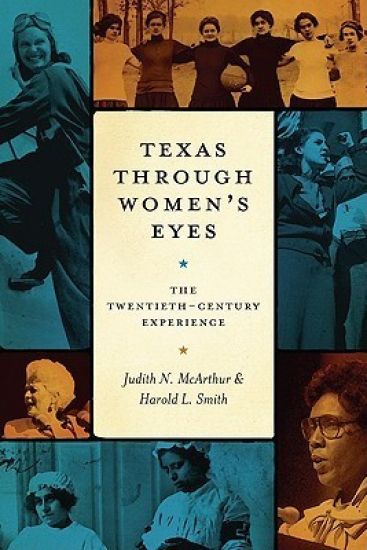
Winner, Liz Carpenter Award For Research in the History of Women, Texas State Historical Association, 2010Texas women broke barriers throughout the twentieth century, winning the right to vote, expanding their access to higher education, entering new professions, participating fully in civic and political life, and planning their families. Yet these major achievements have hardly been recognized in histories of twentieth-century Texas. By contrast, Texas Through Women's Eyes offers a fascinating overview of women's experiences and achievements in the twentieth century, with an inclusive focus on rural women, working-class women, and women of color.McArthur and Smith trace the history of Texas women through four eras. They discuss how women entered the public sphere to work for social reforms and the right to vote during the Progressive era (1900–1920); how they continued working for reform and social justice and for greater opportunities in education and the workforce during the Great Depression and World War II (1920–1945); how African American and Mexican American women fought for labor and civil rights while Anglo women laid the foundation for two-party politics during the postwar years (1945–1965); and how second-wave feminists (1965–2000) promoted diverse and sometimes competing goals, including passage of the Equal Rights Amendment, reproductive freedom, gender equity in sports, and the rise of the New Right and the Republican party.
Den som är rädd är inte fri. Lidande och förtryck finns. Demokratin hotar sig själv. Rädslans liberalism formuleras i skuggan av mänsklighetens mörker. Så hur blir politiken en motkraft när rädslan sprider sig? Rädslans liberalism introducerar Judith N Shklar, en av 1900-talets mest tongivande amerikanska filosofer. I tio fristående essäer undersöker Shklar frihetsbegreppet, demokratins gränser och den liberala synen på staten. Med förord av Isobel Hadley-Kamptz, författare och opinionsbildare.
Judith Shklar called for a radical shift in political theory, toward a view of the history of ideas through the lens of exile. Hess takes this lens and applies it to Shklar's own life and theoretical work.
This is the second volume of Judith Shklar's work and brings together essays on a number of themes, including the place of the intellect in the modern political world and the dangers of identity politics. Editor Stanley Hoffman provides a guide to Shklar's thought, complemented by George Kateb's comprehensive introduction to her work.
In these 13 essays, Judith Shklar explores two themes crucial to discussions of American democracy: first, what she terms the "fundamental social condition" of American life - the tension between expansive political equality and persistent social inequality; and second, "redeeming" American political thought for those who believe it lacks the complexity and depth of the European tradition. She covers issues ranging from the use of history in political discourse to the effect of scepticism on politics and thinkers from Hamilton and Jefferson to Melville.
How can we distinguish between injustice and misfortune? What can we learn from the victims of calamity about the sense of injustice they harbor? In this book a distinguished political theorist ponders these and other questions and formulates a new political and moral theory of injustice that encompasses not only deliberate acts of cruelty or unfairness but also indifference to such acts. Judith N. Shklar draws on the writings of Plato, Augustine, and Montaigne, three skeptics who gave the theory of injustice its main structure and intellectual force, as well as on political theory, history, social psychology, and literature from sources as diverse as Rosseau, Dickens, Hardy, and E. L. Doctorow. Shklar argues that we cannot set rigid rules to distinguish instances of misfortune from injustice, as most theories of justice would have us do, for such definitions would not take into account historical variability and differences in perception and interest between the victims and spectators. From the victim's point of view—whether it be one who suffered in an earthquake or as a result of social discrimination—the full definition of injustice must include not only the immediate cause of disaster but also our refusal to prevent and then to mitigate the damage, or what Shklar calls passive injustice. With this broader definition comes a call for greater responsibility from both citizens and public servants. When we attempt to make political decisions about what to do in specific instances of injustice, says Shklar, we must give the victim's voice its full weight. This is in keeping with the best impulses of democracy and is our only alternative to a complacency that is bound to favor the unjust.
A Course in Modern Geometries is designed for a junior-senior level course for mathematics majors, including those who plan to teach in secondary school. Chapter 1 presents several finite geometries in an axiomatic framework. Chapter 2 continues the synthetic approach as it introduces Euclid's geometry and ideas of non-Euclidean geometry. In Chapter 3, a new introduction to symmetry and hands-on explorations of isometries precedes the extensive analytic treatment of isometries, similarities and affinities. A new concluding section explores isometries of space. Chapter 4 presents plane projective geometry both synthetically and analytically. The extensive use of matrix representations of groups of transformations in Chapters 3-4 reinforces ideas from linear algebra and serves as excellent preparation for a course in abstract algebra. The new Chapter 5 uses a descriptive and exploratory approach to introduce chaos theory and fractal geometry, stressing the self-similarity of fractals and their generation by transformations from Chapter 3. Each chapter includes a list of suggested resources for applications or related topics in areas such as art and history. The second edition also includes pointers to the web location of author-developed guides for dynamic software explorations of the Poincaré model, isometries, projectivities, conics and fractals. Parallel versions of these explorations are available for "Cabri Geometry" and "Geometer's Sketchpad". Judith N. Cederberg is an associate professor of mathematics at St. Olaf College in Minnesota.
Originally published in 1976, this book was written specifically to guide students of political theory who want to understand Hegel's political ideas as they appear in The Phenomenology of Mind. Professor Shklar's commentary uses plain language and English translations of references wherever possible. The core of Hegel's argument is that freedom is the identity of the personal goals of individual citizens and the public ends of the polity as a whole. This is a dynamic process, in which all laws are created by each and all, and in turn expressed and realised in the minds and actions of every member of society. The text emphasises Hegel's criticism of every type of subjectivity. The failure to recognise the cultural character of all experience is the core of Hegel's critical review of all past philosophy, and led him to develop his own theory of history and of knowledge as retrospective thinking.
In this illuminating look at what constitutes American citizenship, Judith Shklar identifies the right to vote and the right to work as the defining social rights and primary sources of public respect. She demonstrates that in recent years, although all profess their devotion to the work ethic, earning remains unavailable to many who feel and are consequently treated as less than full citizens.
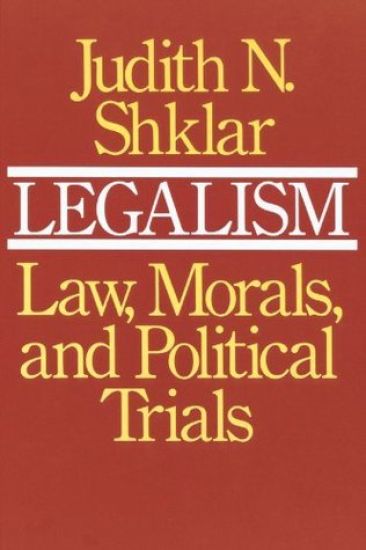
Legalism deals with the area between political theory and jurisprudence. Its aim is to bridge the intellectual gulf separating jurisprudence from other kinds of social theory by explaining why, in the view of historians and political theorists, legalism has fallen short in its approach to both morals and politics. Judith Shklar proposes that, instead of regarding law as a discrete entity resting upon a rigid system of definitions, legal theorists should treat it, along with morals and politics, as part of an all-inclusive social continuum.The first part of the book examines law and morals and criticizes the approach to morals of both the analytical positivists and the natural law theorists. The second part, on law and politics, deals with legalism as a political ideology that comes into conflict with other policies, particularly during political trials.Incisively and stylishly written, the book constitutes an open challenge to reconsider the fundamental question of the relationship of law to society.
The seven deadly sins of Christianity represent the abysses of character, whereas Judith Shklar’s “ordinary vices”—cruelty, hypocrisy, snobbery, betrayal, and misanthropy—are merely treacherous shoals, flawing our characters with mean-spiritedness and inhumanity.Shklar draws from a brilliant array of writers—Molière and Dickens on hypocrisy, Jane Austen on snobbery, Shakespeare and Montesquieu on misanthropy, Hawthorne and Nietzsche on cruelty, Conrad and Faulkner on betrayal—to reveal the nature and effects of the vices. She examines their destructive effects, the ambiguities of the moral problems they pose to the liberal ethos, and their implications for government and citizens: liberalism is a difficult and challenging doctrine that demands a tolerance of contradiction, complexity, and the risks of freedom.
A political philosophy classic from one of the foremost political thinkers of the twentieth centuryAfter Utopia was Judith Shklar’s first book, a harbinger of her renowned career in political philosophy. Throughout the many changes in political thought during the last half century, this important work has withstood the test of time. In After Utopia, Shklar explores the decline of political philosophy, from Enlightenment optimism to modern cultural despair, and she offers a critical, creative analysis of this downward trend. She looks at Romantic and Christian social thought, and she shows that while the present political fatalism may be unavoidable, the prophets of despair have failed to explain the world they so dislike, leaving the possibility of a new and vigorous political philosophy. With a foreword by Samuel Moyn, examining After Utopia’s continued relevance, this current edition introduces a remarkable synthesis of ideas to a new generation of readers.
A critical and creative analysis of the decline of political philosophy in an attempt to understand the nineteenth and twentieth century philosophical and political thinking. Originally published in 1957. The Princeton Legacy Library uses the latest print-on-demand technology to again make available previously out-of-print books from the distinguished backlist of Princeton University Press. These editions preserve the original texts of these important books while presenting them in durable paperback and hardcover editions. The goal of the Princeton Legacy Library is to vastly increase access to the rich scholarly heritage found in the thousands of books published by Princeton University Press since its founding in 1905.
People Power explores the potential of community organizations to develop political consciousness among working class and poor people. Judith N. DeSena argues that participation in community organizations can empower residents to challenge government and corporations, and attempt to influence the outcome of policy decisions regarding municipal services, and the future of neighborhoods. She contends that the people who participate in these organizations are transformed politically in many ways, including their racial attitudes. DeSena points out that involvement in community organizations challenges the participants' stereotypical perceptions of race and ethnicity, and may lead to fewer conflicts between cultures in urban locales. Overall community organizations possess the potential to increase participation in the democratic process, while easing common stress between members of the community, and improving the lives of the people living in complex urban environments.
People Power explores the potential of community organizations to develop political consciousness among working class and poor people. Judith N. DeSena argues that participation in community organizations can empower residents to challenge government and corporations, and attempt to influence the outcome of policy decisions regarding municipal services, and the future of neighborhoods. She contends that the people who participate in these organizations are transformed politically in many ways, including their racial attitudes. DeSena points out that involvement in community organizations challenges the participants' stereotypical perceptions of race and ethnicity, and may lead to fewer conflicts between cultures in urban locales. Overall community organizations possess the potential to increase participation in the democratic process, while easing common stress between members of the community, and improving the lives of the people living in complex urban environments.