

Kirjahaku
Etsi kirjoja tekijän nimen, kirjan nimen tai ISBN:n perusteella.
1000 tulosta hakusanalla Judith N. Shklar

Den som är rädd är inte fri. Lidande och förtryck finns. Demokratin hotar sig själv. Rädslans liberalism formuleras i skuggan av mänsklighetens mörker. Så hur blir politiken en motkraft när rädslan sprider sig? Rädslans liberalism introducerar Judith N Shklar, en av 1900-talets mest tongivande amerikanska filosofer. I tio fristående essäer undersöker Shklar frihetsbegreppet, demokratins gränser och den liberala synen på staten. Med förord av Isobel Hadley-Kamptz, författare och opinionsbildare.

Judith Shklar called for a radical shift in political theory, toward a view of the history of ideas through the lens of exile. Hess takes this lens and applies it to Shklar's own life and theoretical work.

Ein dystopischer Liberalismus? Judith N. Shklar in der Diskussion
Amanda Reiter
Grin Publishing
2016
pokkari

In these 13 essays, Judith Shklar explores two themes crucial to discussions of American democracy: first, what she terms the "fundamental social condition" of American life - the tension between expansive political equality and persistent social inequality; and second, "redeeming" American political thought for those who believe it lacks the complexity and depth of the European tradition. She covers issues ranging from the use of history in political discourse to the effect of scepticism on politics and thinkers from Hamilton and Jefferson to Melville.
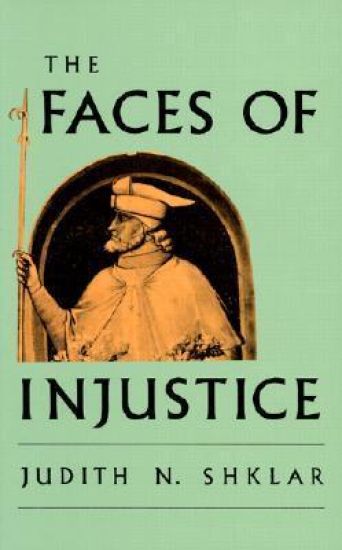
How can we distinguish between injustice and misfortune? What can we learn from the victims of calamity about the sense of injustice they harbor? In this book a distinguished political theorist ponders these and other questions and formulates a new political and moral theory of injustice that encompasses not only deliberate acts of cruelty or unfairness but also indifference to such acts. Judith N. Shklar draws on the writings of Plato, Augustine, and Montaigne, three skeptics who gave the theory of injustice its main structure and intellectual force, as well as on political theory, history, social psychology, and literature from sources as diverse as Rosseau, Dickens, Hardy, and E. L. Doctorow. Shklar argues that we cannot set rigid rules to distinguish instances of misfortune from injustice, as most theories of justice would have us do, for such definitions would not take into account historical variability and differences in perception and interest between the victims and spectators. From the victim's point of view—whether it be one who suffered in an earthquake or as a result of social discrimination—the full definition of injustice must include not only the immediate cause of disaster but also our refusal to prevent and then to mitigate the damage, or what Shklar calls passive injustice. With this broader definition comes a call for greater responsibility from both citizens and public servants. When we attempt to make political decisions about what to do in specific instances of injustice, says Shklar, we must give the victim's voice its full weight. This is in keeping with the best impulses of democracy and is our only alternative to a complacency that is bound to favor the unjust.
Originally published in 1976, this book was written specifically to guide students of political theory who want to understand Hegel's political ideas as they appear in The Phenomenology of Mind. Professor Shklar's commentary uses plain language and English translations of references wherever possible. The core of Hegel's argument is that freedom is the identity of the personal goals of individual citizens and the public ends of the polity as a whole. This is a dynamic process, in which all laws are created by each and all, and in turn expressed and realised in the minds and actions of every member of society. The text emphasises Hegel's criticism of every type of subjectivity. The failure to recognise the cultural character of all experience is the core of Hegel's critical review of all past philosophy, and led him to develop his own theory of history and of knowledge as retrospective thinking.

In this illuminating look at what constitutes American citizenship, Judith Shklar identifies the right to vote and the right to work as the defining social rights and primary sources of public respect. She demonstrates that in recent years, although all profess their devotion to the work ethic, earning remains unavailable to many who feel and are consequently treated as less than full citizens.
Legalism deals with the area between political theory and jurisprudence. Its aim is to bridge the intellectual gulf separating jurisprudence from other kinds of social theory by explaining why, in the view of historians and political theorists, legalism has fallen short in its approach to both morals and politics. Judith Shklar proposes that, instead of regarding law as a discrete entity resting upon a rigid system of definitions, legal theorists should treat it, along with morals and politics, as part of an all-inclusive social continuum.The first part of the book examines law and morals and criticizes the approach to morals of both the analytical positivists and the natural law theorists. The second part, on law and politics, deals with legalism as a political ideology that comes into conflict with other policies, particularly during political trials.Incisively and stylishly written, the book constitutes an open challenge to reconsider the fundamental question of the relationship of law to society.

The seven deadly sins of Christianity represent the abysses of character, whereas Judith Shklar’s “ordinary vices”—cruelty, hypocrisy, snobbery, betrayal, and misanthropy—are merely treacherous shoals, flawing our characters with mean-spiritedness and inhumanity.Shklar draws from a brilliant array of writers—Molière and Dickens on hypocrisy, Jane Austen on snobbery, Shakespeare and Montesquieu on misanthropy, Hawthorne and Nietzsche on cruelty, Conrad and Faulkner on betrayal—to reveal the nature and effects of the vices. She examines their destructive effects, the ambiguities of the moral problems they pose to the liberal ethos, and their implications for government and citizens: liberalism is a difficult and challenging doctrine that demands a tolerance of contradiction, complexity, and the risks of freedom.

A critical and creative analysis of the decline of political philosophy in an attempt to understand the nineteenth and twentieth century philosophical and political thinking. Originally published in 1957. The Princeton Legacy Library uses the latest print-on-demand technology to again make available previously out-of-print books from the distinguished backlist of Princeton University Press. These editions preserve the original texts of these important books while presenting them in durable paperback and hardcover editions. The goal of the Princeton Legacy Library is to vastly increase access to the rich scholarly heritage found in the thousands of books published by Princeton University Press since its founding in 1905.







Political Thought and Political Thinkers
Judith N. Shklar; Stanley Hoffmann
University of Chicago Press
1998
nidottu
This is the second volume of Judith Shklar's work and brings together essays on a number of themes, including the place of the intellect in the modern political world and the dangers of identity politics. Editor Stanley Hoffman provides a guide to Shklar's thought, complemented by George Kateb's comprehensive introduction to her work.
A political philosophy classic from one of the foremost political thinkers of the twentieth centuryAfter Utopia was Judith Shklar’s first book, a harbinger of her renowned career in political philosophy. Throughout the many changes in political thought during the last half century, this important work has withstood the test of time. In After Utopia, Shklar explores the decline of political philosophy, from Enlightenment optimism to modern cultural despair, and she offers a critical, creative analysis of this downward trend. She looks at Romantic and Christian social thought, and she shows that while the present political fatalism may be unavoidable, the prophets of despair have failed to explain the world they so dislike, leaving the possibility of a new and vigorous political philosophy. With a foreword by Samuel Moyn, examining After Utopia’s continued relevance, this current edition introduces a remarkable synthesis of ideas to a new generation of readers.
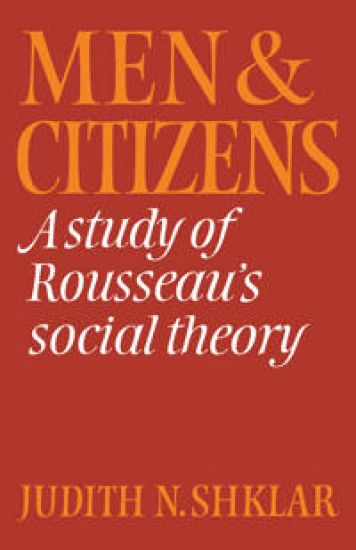
This book, first published in 1969, is widely regarded as one of the best studies of Rousseau's thought in any language. In it, Professor Shklar examines Rousseau's central concern: given that modern civilisation is intolerable and a return to the state of nature impossible, how is man to arrange his existence in society? Shklar organises the study around Rousseau's two conceptions of Utopia: the Spartan city and the autonomous family group. She emphasises the importance for Rousseau of psychological factors and shows how, when mediated through his images of authority and use of metaphor, they bring him to his notorious view that man is 'everywhere in chains'. In Shklar's view, Rousseau's conclusion is almost equally pessimistic: the chances are very remote that we can overcome the psychological obstacles to become both men and citizens.